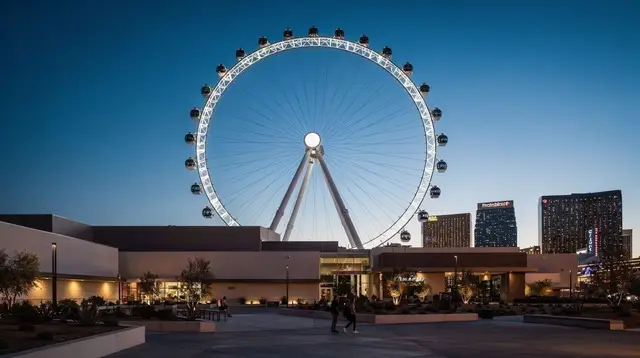
A desert valley, not just a Strip
Most people picture Las Vegas as a single glowing corridor of casinos, but the reality on the ground is a full metropolitan area sitting in the Mojave Desert in southern Nevada. The city of Las Vegas itself has around 650,000-660,000 residents, while the wider Las Vegas Valley — spread across unincorporated Clark County plus the separate cities of Henderson and North Las Vegas — holds roughly 2.3-2.4 million people.
That distinction matters more than it sounds: the Strip itself is not legally part of the city of Las Vegas. Almost the entire Las Vegas Strip sits in the unincorporated towns of Paradise and Winchester, governed directly by Clark County, a setup that dates to 1950 when casino operators lobbied to stay outside city taxation as Las Vegas tried to annex the resort corridor. The address says “Las Vegas,” the government does not.
Downtown, around Fremont Street, is the part that is genuinely inside city limits, and it functions as the historic core — older casinos, the covered Fremont Street canopy, and a noticeably different atmosphere from the mega-resorts a few miles south. Between the two sits the Arts District, a smaller pocket of galleries, vintage shops and independent restaurants that has little to do with either tourist image.
Further from the center, Summerlin on the western edge and Henderson to the southeast are largely residential, master-planned communities where most of the valley’s population actually lives and works — a reminder that Las Vegas, like any American city, is mostly ordinary suburban life orbiting a famous few square miles.
This page is the entry point to that whole territory. Rather than repeat what’s already covered in depth elsewhere, it sets the practical baseline — time zone, airport, climate, transport, and the resort-fee math that catches almost every first-time visitor off guard — and then points to the neighborhood and region pages that go deeper: the Strip walking guide, the Fremont Street guide, and the standalone destination pages for Red Rock Canyon, Hoover Dam and the Grand Canyon.
Time zone, and why it gets confusing fast
Nevada runs on Pacific Time and does observe daylight saving time, shifting clocks in March and November like most of the United States. That sounds simple until you start planning day trips: Utah and Arizona both run on Mountain Time, so Zion National Park, Bryce Canyon and most of Arizona sit an hour ahead of Las Vegas for at least part of the year.
It gets more tangled around Page and Antelope Canyon: Arizona as a state does not observe daylight saving time, but the Navajo Nation — which covers Page’s surroundings, Monument Valley and much of the Grand Circle — does observe it, to stay aligned with Utah and New Mexico. For half the year, Page and the rest of Arizona are effectively on different clocks. If you have a timed tour slot near Page or Monument Valley, confirm the local time with the operator rather than trusting your phone’s automatic guess.
Getting in, and getting around
Harry Reid International Airport (LAS) sits about five minutes’ drive from the south end of the Strip — one of the shortest airport-to-resort-corridor distances of any major destination in the US. Once you’re there, the Strip itself is deceptively long: roughly 4 miles (6.4 km) end to end, which looks walkable on a map but takes far longer on foot than first-time visitors expect, especially with pedestrian bridges, long casino interiors to cross, and desert heat working against you.
Three separate transit systems cover the corridor, and they are not interchangeable:
| System | Route | Cost |
|---|---|---|
| Casino-to-casino trams | Short hops between neighboring resorts (e.g. Mandalay Bay-Luxor-Excalibur, Park MGM-Aria-Bellagio) | Free |
| Las Vegas Monorail | Behind the east side of the Strip, MGM Grand to the Sahara | Paid, per-ride or day pass |
| RTC Deuce & SDX buses | Length of the Strip and to Downtown | About $6 for a 2-hour pass, $8 for 24 hours (2026) |
For anything beyond the resort corridor, a rental car is close to essential. Hoover Dam, Red Rock Canyon, Valley of Fire, the Grand Canyon and the parks of southern Utah are all drive-only or tour-only destinations with no meaningful public transit connection from the Strip. See renting a car in Las Vegas and guided tour vs. rental car for day trips before deciding which suits your plans.
Climate: plan around the heat, not around the calendar
Las Vegas is a genuine desert, and the temperature swing across the year is extreme. June through August daytime highs commonly reach 38-43°C (100-110°F), and heat illness is a real risk for anyone hiking at Red Rock Canyon, Zion or the Grand Canyon during those months — carry more water than feels necessary and avoid midday exertion outdoors. Further out, Death Valley regularly sets some of the hottest temperatures on Earth in summer, often above 49°C (120°F), and is not a casual detour in June-August without a reliable vehicle and extra water.
October through April is the far more comfortable window, with mild days and cool evenings that suit both Strip sightseeing and desert hiking. Winter nights can still be genuinely cold, particularly at elevation around Mount Charleston, so pack layers even on a “warm” trip. For a deeper seasonal breakdown, see best time to visit Las Vegas, the summer heat guide and the winter/off-season guide.
The price you’re quoted is not the price you pay
This is the single most common source of sticker shock in Las Vegas, and it deserves to be stated plainly: the advertised nightly hotel rate is never the final amount charged. Two mandatory add-ons apply almost everywhere on and near the Strip:
- Resort fees, charged per night on top of the room rate, commonly running roughly $40-65 per night on Strip properties as of 2026, and almost never included in the price shown at booking.
- Parking, which is no longer free at most major casino-hotels — expect roughly $15-35 per night for self-parking and $20-50 for valet, though a handful of properties (Sahara, Circus Circus, Treasure Island, and limited free hours at Wynn/Encore/Fontainebleau) still offer some free parking.
On top of both, Clark County’s transient lodging tax adds roughly 13% for Strip-area (“Primary Gaming Corridor”) properties, slightly less elsewhere in the county. None of these is optional once you’ve booked a room — treat the number on the booking page as a starting point, not a total.
The same pattern shows up in smaller ways across the trip: a Strip production show typically runs $60-200+ per ticket, a buffet $35-70 per person, and a full-day guided tour to the Grand Canyon or Antelope Canyon $150-350 per person — always check whether a listed tour price includes park or tribal permit fees before booking. For the full math with worked examples, see resort fees, parking and taxes: the real price of a room.
Legal basics worth knowing before you land
The gambling and drinking age is 21, strictly enforced with photo ID checks at casino floors, bars and liquor purchases. Open containers of alcohol are allowed in public on the Strip and Fremont Street, but only in plastic or approved cups — glass containers are prohibited outdoors, and carrying one on the street can get you stopped. These rules are consistent and rarely bent, so don’t expect exceptions at the door of a casino or a Fremont Street bar.
Day trips: closer than they look on paper, but rarely a quick errand
Las Vegas’s location is genuinely unusual: within a couple of hours’ drive sits one of America’s great engineering landmarks and a reservoir the size of a small sea, and within a day’s drive sits some of the most famous canyon country on the continent. But “on the map” and “in the car” are different measurements, and it’s worth knowing the real numbers before building an itinerary:
| Destination | One-way distance | Approx. drive time |
|---|---|---|
| Hoover Dam | ~35-40 miles | 45 minutes |
| Red Rock Canyon | ~20 miles | 20-30 minutes |
| Valley of Fire | ~50 miles | About 1 hour |
| Death Valley (Furnace Creek) | ~120 miles | 2-2.5 hours |
| Grand Canyon West (Skywalk) | ~130 miles | About 2.5 hours, partly unpaved |
| Zion National Park | ~160 miles | About 2.5 hours |
| Grand Canyon South Rim | ~275-280 miles | About 4.5 hours |
| Antelope Canyon / Page | ~270-280 miles | 4.5-5 hours |
| Monument Valley | ~370-390 miles | 6-6.5 hours |
Two of these deserve a specific warning. Grand Canyon West (the Skywalk) is not the Grand Canyon National Park — it sits on Hualapai tribal land, requires its own tribal permit and ticket, and is a completely different operator and experience from the National Park Service’s South Rim, four and a half hours away. Conflating the two is one of the most common planning mistakes visitors make; see Grand Canyon West vs. South Rim before booking either. And Monument Valley is not a day trip from Las Vegas by any reasonable definition — at 6+ hours each way, it needs an overnight, ideally as part of a longer loop through the Grand Circle.
For those who’d rather not drive, guided options cover the closer destinations well. A half-day tour reaches Hoover Dam or Red Rock Canyon comfortably, while a full-day tour to Grand Canyon West is a realistic single-day round trip with a guide handling the unpaved stretch.
Options bookable directly from Las Vegas include a bus transfer to Grand Canyon West for those who just need transportation, a sunset tour to Grand Canyon West for the golden-hour version of the Skywalk visit, and a day trip to Nelson Ghost Town with an optional mine tour for a shorter, closer alternative near Lake Mead.
Travelers wanting to combine water and desert scenery in one outing can look at a dinner cruise on Lake Mead, while those heading toward Utah’s slot canyons might prefer a family-friendly guided hike through slot canyons over a self-drive.
How to use the rest of this guide
Treat this page as the map, not the destination. For the Strip itself, start with the Strip walking tour guide and the Strip vs. Downtown comparison, which covers the jurisdiction question in full — the Strip actually sits in the unincorporated areas of Paradise and Winchester, Clark County, not within the city of Las Vegas. For the historic core, see the Downtown/Fremont Street guide.
For planning the number of days and a realistic order of stops, see how many days in Las Vegas and the first-time Las Vegas step-by-step guide. And for the desert itself, the destination pages for Hoover Dam, Lake Mead, Red Rock Canyon and the Grand Canyon each go into the detail this hub deliberately leaves out.
Las Vegas: frequently asked questions
Is the Las Vegas Strip actually part of the city of Las Vegas?
No. Almost the entire Strip lies in the unincorporated Clark County towns of Paradise and Winchester, not the city of Las Vegas, though it carries a Las Vegas address and ZIP code. Only Downtown/Fremont Street is genuinely within city limits.
What time zone is Las Vegas in, and does it change with the seasons?
Las Vegas runs on Pacific Time and observes daylight saving time, shifting in March and November. Because Utah and Arizona use Mountain Time, and the Navajo Nation near Page observes daylight saving time even though the rest of Arizona does not, clocks near the Grand Circle can differ from Las Vegas by one or two hours depending on the season.
How far is the airport from the Strip?
Harry Reid International Airport (LAS) is about a 5-minute drive from the south end of the Strip, making it one of the closest major airports to a resort corridor in the US.
Do I really need a rental car in Las Vegas?
Not for the Strip or Downtown, which are walkable or served by trams, the monorail and RTC buses. For day trips to Hoover Dam, Red Rock Canyon, Valley of Fire or the Grand Canyon, a car or a guided tour is close to essential, since there is no direct public transit to any of them.
Are resort fees and parking really mandatory?
Yes. Resort fees are added per night on top of the room rate at nearly every Strip hotel, typically $40-65 per night, and most properties also charge separately for parking, roughly $15-35 self-park and $20-50 valet. Neither is optional once a room is booked, and both are on top of Clark County’s roughly 13% room tax.
What’s the best time of year to visit?
October through April offers the most comfortable temperatures for both the Strip and outdoor day trips. June through August brings daytime highs of 38-43°C (100-110°F), and nearby Death Valley can exceed 49°C (120°F), making midday outdoor activity genuinely risky without preparation.
Can I drink alcohol in public on the Strip?
Yes, but only from plastic or other approved cups — glass containers are prohibited outdoors on the Strip and Fremont Street. The gambling and drinking age is 21, checked with photo ID at casinos, bars and liquor stores.
Is Grand Canyon West the same as the Grand Canyon National Park?
No. Grand Canyon West, home of the Skywalk, sits on Hualapai tribal land and requires its own permit and ticket. The actual Grand Canyon National Park is the South Rim, a roughly 4.5-hour drive from Las Vegas, run by the National Park Service under a completely different set of rules.