Grand Canyon West vs. South Rim: Which One Should You Actually Visit?
What's the real difference between Grand Canyon West and the South Rim?
Grand Canyon West (the Skywalk) is Hualapai tribal land, about 2.5 hours from Las Vegas, and can be done as a day trip. The South Rim is the actual Grand Canyon National Park, about 4.5-5 hours away, with far bigger views but best done with an overnight rather than a same-day round trip.
Two places that share a name and nothing else
Ask ten people in a Las Vegas hotel lobby if they’re “going to the Grand Canyon tomorrow,” and most of them have no idea which Grand Canyon they mean. That’s not a knock on them — it’s a symptom of how the trip gets sold. Tour desks up and down the Strip advertise “Grand Canyon day tours” as if there’s one canyon and one way to see it. There isn’t.
Grand Canyon West is Hualapai tribal land, home to the glass Skywalk, roughly 2.5 hours from Las Vegas by road. The Grand Canyon South Rim is the actual Grand Canyon National Park — the one on postcards, in documentaries, and in most people’s mental image of the place — and it’s a genuinely different destination, roughly 4.5 to 5 hours away. Different owner, different rules, different landscape, different fee structure. Booking one thinking you’re getting the other is the single most common mistake in Grand Canyon planning from Las Vegas, and this guide exists to stop that from happening to you.
The core difference, in one table
| Grand Canyon West | Grand Canyon South Rim | |
|---|---|---|
| Managed by | Hualapai Tribe | National Park Service |
| Distance from Las Vegas | ~130 miles / ~2.5 hours | ~275-280 miles / ~4.5-5 hours |
| Road conditions | Final stretch includes unpaved sections | Fully paved highway access |
| Entrance fee (2026) | ~$100-130 per person for entry + Skywalk | ~$35 per vehicle, or $80/year America the Beautiful pass |
| America the Beautiful pass accepted? | No | Yes |
| Signature feature | The glass Skywalk | Dozens of rim viewpoints, ranger programs, trails below the rim |
| Realistic as a day trip? | Yes, doable round-trip in a day | Technically yes, but exhausting; overnight is far better |
| Number of viewpoints | A handful (Eagle Point, Guano Point) | Dozens along miles of rim |
What Grand Canyon West actually is
Grand Canyon West is not part of the National Park System. It sits entirely on land belonging to the Hualapai Tribe, who operate it as their own tourism destination, independent of the National Park Service in every practical sense — ticketing, rules, infrastructure, and revenue all stay with the tribe, and the America the Beautiful park pass isn’t valid here. That’s worth repeating because it changes what you should expect to pay and what you should expect to see.
The headline attraction is the Grand Canyon West Skywalk, a horseshoe-shaped glass walkway that extends out over the canyon rim, letting you look straight down through the floor at the drop below. It’s a genuinely vertigo-inducing experience and photographs extremely well, but it is a single, specific attraction — not a canyon-wide viewing experience. Beyond the Skywalk, the developed viewpoints at Grand Canyon West are Eagle Point and Guano Point, both worthwhile, but there are only a handful of official overlooks in total, connected by shuttle buses rather than the miles of walkable rim trail you’d find at the national park.
Getting there matters too. The route out of Las Vegas covers about 130 miles and around 2.5 hours, but the final approach on Pierce Ferry Road and Diamond Bar Road includes several miles of unpaved, sometimes washboarded surface. It’s passable in an ordinary car at reasonable speed, but it’s slower and rougher than a highway drive, and it’s the kind of detail GPS travel-time estimates tend to understate. Most visitors treat the whole outing — drive, park time, drive back — as a full but manageable day trip from Las Vegas.
What the South Rim actually is
The South Rim is the Grand Canyon most people picture when they hear the name: it’s the section of Grand Canyon National Park that the National Park Service administers, with a developed visitor center, ranger talks, a paved and shuttle-served scenic drive, and dozens of named viewpoints strung along the canyon’s edge. Because it’s an NPS unit, the $80-per-year America the Beautiful pass covers vehicle entry here — and at every other national park you might visit afterward — which the West Rim, as tribal land, simply doesn’t participate in.
The tradeoff is distance. At roughly 275-280 miles and 4.5 to 5 hours of driving each way, the South Rim is not a quick errand. A same-day round trip from Las Vegas is technically possible, but it means something like 9 to 10 hours behind the wheel on top of whatever time you spend actually looking at the canyon — a genuinely long, tiring day that leaves little room for anything to go wrong.
Most travelers who want a fuller experience — walking a stretch of rim trail, catching sunrise or sunset, maybe descending partway below the rim — plan an overnight in Tusayan, Williams, or Flagstaff rather than pushing the drive twice in one day. If you’re weighing that option against staying closer to town, our South Rim day trip guide walks through what a single-day version actually looks like, including the parts that get rushed.
Landscape and experience: vertical thrill vs. wide panorama
The two sites don’t just differ in distance — they offer genuinely different kinds of scenery. Grand Canyon West is built around one dramatic, vertical sensation: standing on (or looking down through) the Skywalk with open air and canyon floor beneath your feet. It’s a punchy, photogenic, slightly adrenaline-charged experience concentrated into a short visit at a small number of stops.
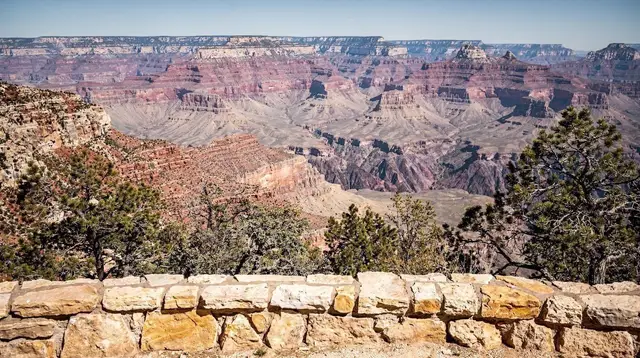
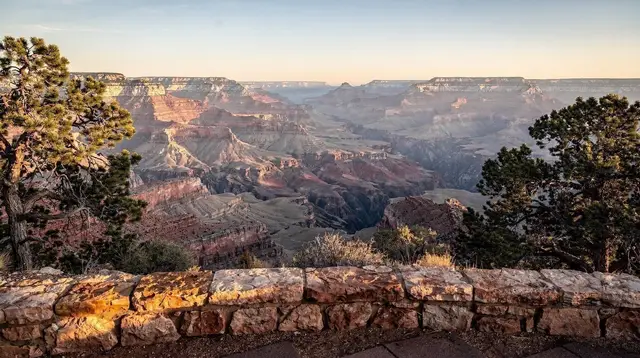
The South Rim is the opposite kind of impressive — a sweeping, horizontal panorama that unfolds gradually as you move along the rim from one viewpoint to the next, each showing a slightly different angle on the same immense canyon. It rewards time: an hour driving the scenic route and stopping at three or four overlooks reveals far more of the canyon’s scale than any single stop can. There’s also simply more infrastructure — paved trails, museum exhibits, ranger-led programs — because it’s a fully developed national park unit rather than a single-attraction site.
Neither is “better” in the abstract. If you want one striking, glass-floor photo and a doable day trip, Grand Canyon West delivers that efficiently. If you want the vast, many-angled canyon view that matches the postcard image, only the South Rim provides it — and it asks for more of your schedule in return.
What each one costs, realistically
Grand Canyon West pricing in 2026 runs roughly $100-130 per person once you combine the base entrance package with Skywalk access, since the Skywalk is sold as an add-on rather than being bundled into standard entry. There’s no annual pass option — every visit, every visitor pays again. Add parking and any optional extras (helicopter or boat add-ons, dining packages) and a family visit adds up fast.
The South Rim charges by vehicle, not by person: about $35 gets an entire carload in for a week, and the $80 America the Beautiful pass covers unlimited entries for a full year at every NPS site nationwide — a considerably better value if you’ll visit more than once or plan to see other national parks in the same year. The catch, again, is that this cheaper entrance sits at the end of a much longer drive, so the “savings” get eaten by fuel, time, and — if you’re sensible about it — a night’s hotel stay.
For either site, a fully guided option removes the driving question entirely. A helicopter tour to Grand Canyon West with a landing on the canyon floor, like the Grand Canyon West Rim helicopter tour with a floor landing, compresses the whole experience into a few hours without the unpaved road. For a slower-paced version that catches golden light over the West Rim, the private Grand Canyon West sunset tour from Las Vegas is built around timing rather than speed.
On the South Rim side, travelers who want the classic postcard views paired with dinner can look at the South Rim sunset tour with dinner included, while those chasing an aerial perspective over the deeper canyon might consider the Spirit helicopter tour departing from the South Rim. And for a genuinely different angle on the whole region — descending rather than just viewing — the Journey to the Bottom tour along historic Route 66 covers ground neither rim tour touches.
So which one should you actually book?
If your trip is built around a single free day, you’re not renting a car, and you mainly want a striking photo and a taste of canyon scenery without derailing the rest of your Las Vegas plans, Grand Canyon West is the pragmatic choice — closer, doable in a day, and centered on one unmistakable attraction in the Skywalk.
If you have two or more days to spare, want the canyon views that match what you’ve seen in photos your whole life, and don’t mind (or actively want) an overnight away from the Strip, the South Rim is worth the extra distance. It’s a different order of scenery, backed by an entire national park’s worth of infrastructure, and the annual pass makes it a better value if a national parks trip is even loosely on your radar for the rest of the year.
What doesn’t work well is expecting Grand Canyon West to substitute for the national park experience, or assuming the South Rim is a casual, low-effort add-on to a Las Vegas weekend. Match the destination to the day you actually have, not the one you wish you had, and either version of “the Grand Canyon” from Las Vegas can be genuinely worth the trip.
For a broader sense of how these two options stack up against everything else within reach of the Strip, see our roundup of the best day trips from Las Vegas by drive time, and if you’re still deciding between renting a car and joining an organized tour for either rim, our guided tour vs. rental car comparison breaks down the tradeoffs in more detail.
Grand Canyon West vs. South Rim: frequently asked questions
Is Grand Canyon West part of the Grand Canyon National Park?
No. Grand Canyon West sits on Hualapai tribal land and is managed entirely by the Hualapai Tribe, not the National Park Service. It has its own entrance fee, its own rules, and its own separate ticketing system from the South Rim.
Does the America the Beautiful pass work at Grand Canyon West?
No. The $80/vehicle/year America the Beautiful pass only covers National Park Service sites, including the South Rim. It has no effect at Grand Canyon West, since that land is not part of the national park system.
Can I do the South Rim as a day trip from Las Vegas?
You can, but it means roughly 9-10 hours of driving in a single day on top of time at the rim, which is a long and tiring day. Most people who want more than a rushed look at the viewpoints plan an overnight in Williams, Flagstaff, or Tusayan instead.
Is the Skywalk included in the Grand Canyon West entrance fee?
No. The base entrance/tour package does not include Skywalk access. Walking onto the glass Skywalk is an additional ticket on top of the base entry, and both add up quickly with parking and optional add-ons.
Which one has better views, Grand Canyon West or the South Rim?
They’re different kinds of views. Grand Canyon West centers on Eagle Point and Guano Point plus the Skywalk itself — a small number of dramatic, specific vantage points. The South Rim has dozens of viewpoints strung along miles of rim, with a wider and generally considered more dramatic canyon cross-section.
Why do so many visitors get confused between the two?
Because tour operators in Las Vegas often advertise trips simply as “Grand Canyon tours” without clarifying which site they visit. Grand Canyon West is closer to Las Vegas and easier to sell as a day trip, so it’s the default on most short brochures — even though it isn’t the national park most people picture.
Is Grand Canyon West cheaper than the South Rim overall?
The entrance itself might look similar in the $100-130 range once you add the Skywalk, but factor in the whole trip: the South Rim’s $80 annual park pass covers unlimited return visits and other national parks, while Grand Canyon West’s per-person tribal fees apply every single visit with no annual option.
Do I need extra time for the drive to Grand Canyon West?
Yes. The final stretch of Pierce Ferry Road and Diamond Bar Road to Grand Canyon West includes several miles of unpaved, sometimes washboarded road, which slows the last portion of the drive regardless of what your GPS estimated time says.
Day Trips vs Walking Tours
Verified deep-linked GetYourGuide tours. Book through these links and we earn a small commission at no cost to you.
GetYourGuide does not provide a product photo for this activity — the image shows the meeting point, photographed by us.