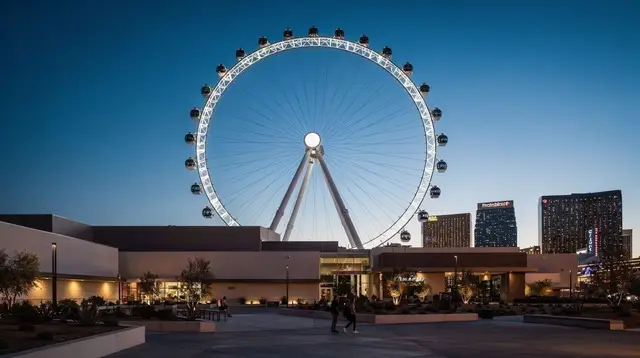
A Resort Corridor That Isn’t Actually Las Vegas
Here is the fact that surprises almost everyone, including people who have visited before: the Las Vegas Strip is not inside the city of Las Vegas. Nearly the entire stretch of casino resorts that people picture when they hear “Las Vegas” sits in unincorporated Clark County, split across the towns of Paradise and Winchester. It has its own address that says “Las Vegas” and a ZIP code that says “Las Vegas,” but the city government has no authority over it.
That arrangement dates back to 1950, when casino operators lobbied hard for unincorporated status specifically to stay outside the city’s taxes and zoning control, right as the city was trying to annex the resort corridor for itself. The plan worked, and it has held ever since. The one part of the story people picture as “the Strip” that genuinely does sit inside city limits is Downtown/Fremont Street, a few miles north — a different neighborhood, a different jurisdiction, and in many ways a different vacation.
This isn’t trivia for a bar quiz. It shapes who polices the Strip (Clark County, not the Las Vegas Police Department’s city division), who collects the room tax, and why a “Las Vegas” hotel bill can look nothing like what a city government would set. Understanding the Strip means understanding it as Clark County’s resort corridor first, and only casually as “Las Vegas.”
The Strip Is Longer Than It Looks
On a map, the Strip looks like a short, dense cluster you could stroll end to end in an evening. In reality it runs roughly 4 miles (6.8 km) from its southern anchor near Mandalay Bay to its northern edge past the Sahara, and that measurement understates the walk. Casino resorts here are enormous — some properties are effectively small cities, with hundreds of meters of interior corridor between a hotel lobby and the street.
Add pedestrian overpasses at the busiest intersections, security screening at entrances, and elevator waits inside towers with thousands of rooms, and a walk that looks like “next door” on a map can take 20 to 30 minutes door to door. Visitors who plan an evening around seeing three or four resorts on foot routinely underestimate how much of that time disappears just getting from a hotel room to the sidewalk and back.
Heat compounds the problem for most of the year. The Mojave Desert around Las Vegas regularly pushes daytime highs past 38-43°C (100-110°F) from June through August, and pavement radiates heat back up at ankle height, making the Strip’s open stretches worse than the air temperature alone suggests. October through April is the genuinely comfortable window for walking outdoors at any length; anyone visiting in summer should plan Strip walking for early morning or after dark, and expect midday movement to mean casino-to-casino via air-conditioned interiors, not sidewalks.
Getting Along the Strip Without Wearing Yourself Out
Three separate systems move people along the corridor, and they are easy to confuse:
| System | Covers | Cost | Notes |
|---|---|---|---|
| Casino-to-casino trams | Short hops between neighboring resorts (e.g., Mandalay Bay–Luxor–Excalibur; Park MGM–Aria–Bellagio) | Free | Only connects specific paired properties, not the whole Strip |
| Las Vegas Monorail | Behind the east side of the Strip, MGM Grand to the Sahara | Paid, single-ride and day passes available | Skips the west side of the Strip entirely |
| RTC Deuce / SDX buses | Full length of the Strip and on to Downtown | Roughly $6 for a 2-hour pass, $8 for 24 hours (2026) | Slower than it looks in Strip traffic, but covers everywhere the monorail doesn’t |
None of these is a citywide free shuttle, and none of them replaces walking entirely — most of a night on the Strip is still spent on foot inside and between resorts. The paid monorail is worth it for one job in particular: skipping the walk along the busiest, most congested stretch of the east side sidewalk during a hot afternoon or a packed Saturday night.
What a Room Rate Doesn’t Tell You
The number quoted when booking a Strip hotel is reliably not the number charged at checkout. Two additions apply almost everywhere on the Strip:
- Resort fees, charged per night on top of the room rate, typically running $30-55 per night depending on the property, before tax. These cover things like Wi-Fi, gym access, and pool access — bundled in whether a guest uses them or not.
- Clark County’s transient lodging tax, which for Strip-area (“Primary Gaming Corridor”) properties runs around 13.38%, applied to the room rate and, in most cases, to the resort fee as well.
Parking adds a third layer at many properties: self-parking commonly runs $15-35 a night and valet $20-50 a night, though a handful of resorts (Sahara, Circus Circus, Treasure Island, and limited free hours at Wynn/Encore/Fontainebleau) still offer some free parking. Put together, a room advertised at $150 a night can easily land closer to $220-250 once resort fee, tax, and parking are added — and that gap is exactly why a Strip trip should be budgeted from the final folio total, not the number shown at the moment of booking. For a full breakdown of how these charges stack, see the guide to resort fees, parking, and Clark County taxes.
Two Cities in One Corridor: Strip vs. Downtown
Visitors who split time between the Strip and Downtown/Fremont Street are effectively visiting two different resort cultures a few miles apart. The Strip is the mega-resort model: newer construction, elaborate themed architecture, big production shows, and the county’s own police jurisdiction. Downtown is smaller, older, and — because it’s inside actual city limits — under the Las Vegas city government properly.
Fremont Street’s covered pedestrian mall, the Viva Vision canopy overhead, and a denser, walkable core make it a genuinely different few hours than a Strip evening, and worth treating as its own outing rather than a quick add-on. The comparison is laid out in more detail in Strip vs. downtown, where to stay.
Landing and Arriving
One advantage the Strip does have going for it logistically: Harry Reid International Airport sits only about 5 minutes’ drive from the Strip’s southern end, among the closest major airports to a resort corridor anywhere in the country. That short hop means a taxi, rideshare, or hotel shuttle from baggage claim to check-in rarely eats more than 15-20 minutes outside of peak congestion, which is a rare bit of good news for a destination otherwise defined by long distances to everything else worth seeing nearby.
Day Trips Start Here, But Don’t End Quickly
The Strip’s real practical role, beyond being a destination in its own right, is as the base camp for the desert and canyon country beyond it. Red Rock Canyon is about 20-30 minutes away, close enough for a half-day escape from the casino floor. Hoover Dam and Lake Mead run about 45 minutes each way, and Valley of Fire State Park about an hour — all realistic half-day or full-day trips from a Strip hotel.
Further out, Grand Canyon West is roughly 2.5 hours by car on mostly two-lane roads, while the Grand Canyon South Rim — the actual National Park, a different destination entirely from the tribal-land Skywalk at West Rim — is a 4.5-hour haul each way. None of that fits into “an evening off the Strip,” and travelers should plan overnight stops rather than treating the farther parks as day trips squeezed around a Strip vacation.
For a first stab at the Skywalk and West Rim without renting a car, a guided option covers the drive and the permit logistics in one booking: a full-day guided tour from Las Vegas to the Grand Canyon West Rim handles the two-lane roads and the unpaved stretch that catches self-drivers off guard. Closer to the Strip, the desert around Lake Mead has its own outdoor options — an ATV tour into Lake Mead National Recreation Area down to the Colorado River is a half-day way to see the reservoir’s shoreline without a long drive.
Nights, Shows, and the Case for Staying More Than One Night
A single night on the Strip is enough to see the fountains, walk a block of casino floors, and catch dinner — it is not enough to see a show, explore more than one or two resorts properly, and still get any sleep before a day trip the next morning. Two to three nights lets a visit split more sensibly: one evening dedicated to the Strip itself, one day pulled out to the desert (Red Rock, Hoover Dam, or Valley of Fire), and a spare evening for Downtown or a show. Anyone weighing whether to add a third or fourth night against renting a car for the longer national park drives should look at how many days to budget for Las Vegas overall before locking in a hotel booking.
For travelers who want an aerial angle on the Strip and the desert beyond it without giving up multiple driving days, a multi-day aerial itinerary bundles several of the region’s landscapes into one trip: a private three-day aerial adventure safari covering Las Vegas and the surrounding desert is built for exactly that kind of compressed sightseeing.
Closer to town, a half-day out to the old mining settlement southeast of the Strip makes a quieter counterpoint to casino floors: a trip to Nelson Ghost Town with the option to add a mine tour is a low-key way to see the desert’s mining history in an afternoon.
What to Get Right Before Booking
A few habits keep a Strip trip from turning into a budget surprise or a wasted afternoon:
- Price a room by its total — room rate, resort fee, and roughly 13.38% county tax — not the number shown at the top of a booking page.
- Decide upfront whether self-parking or valet fits the trip; a car left at a free-parking property and a rideshare into the Strip core can beat nightly valet charges over a multi-night stay.
- Plan outdoor walking for morning or evening between October and April; treat midday hours in June-August as indoor time.
- Treat Downtown/Fremont Street as a separate outing, not a Strip extension — it’s a different jurisdiction with a different feel, worth its own evening.
- Book Grand Canyon, Hoover Dam, or Valley of Fire day trips as full mornings or full days, never as an afterthought squeezed between Strip activities.
Frequently Asked Questions About the Las Vegas Strip
Is the Strip legally part of Las Vegas?
No. Almost the entire Strip lies in unincorporated Clark County, across the towns of Paradise and Winchester, not inside city of Las Vegas limits. It has carried a “Las Vegas” address and ZIP code since operators secured unincorporated status in 1950, specifically to avoid city taxation and control. Downtown/Fremont Street, a few miles north, is the part that is genuinely within the city.
How long does it actually take to walk the Strip?
The Strip runs about 4 miles (6.8 km) end to end, and walking even a fraction of that between two non-adjacent resorts commonly takes 20-30 minutes, once pedestrian bridges, casino interiors, and security checkpoints are factored in. It looks far more compact on a map than it feels on foot.
Are resort fees and taxes included in the price I see when booking?
Almost never. Resort fees typically run $30-55 per night depending on the property, charged on top of the room rate, and Clark County adds roughly 13.38% in lodging tax on top of that. Parking (commonly $15-35 self-park, $20-50 valet) is a separate charge at most Strip resorts, with only a few properties still offering free parking.
Is there a free way to get around the Strip?
Only the casino-to-casino trams that connect specific paired properties, such as Mandalay Bay–Luxor–Excalibur or Park MGM–Aria–Bellagio, are free. The Las Vegas Monorail and the RTC Deuce/SDX buses both charge fares, and neither covers the entire Strip on its own.
When is the best time to walk around the Strip outdoors?
October through April offers the most comfortable daytime and evening temperatures for walking. From June through August, daytime highs commonly reach 38-43°C (100-110°F), making outdoor walking uncomfortable and potentially risky at midday; plan outdoor time for early morning or after sunset instead.
How far is the Strip from the airport?
Harry Reid International Airport sits about 5 minutes’ drive from the southern end of the Strip, making it one of the closest major airports to a resort corridor in the United States.
Is Downtown/Fremont Street the same as the Strip?
No. Downtown/Fremont Street is a separate district a few miles north of the Strip, and unlike the Strip, it sits genuinely within Las Vegas city limits. It has its own covered pedestrian mall and a different, older resort character worth treating as a distinct outing.
How many nights should I plan on the Strip?
Two to three nights is a realistic minimum for seeing a show, exploring more than one resort, and still leaving a day free for a nearby desert trip such as Red Rock Canyon, Hoover Dam, or Valley of Fire. A single night covers little more than dinner and a walk past the fountains.