Strip & Downtown in Two Days
Can you cover the Strip and Downtown Las Vegas in two days without a car?
Yes. Day one works the Strip's central stretch on foot, using free casino trams and the RTC Deuce bus for the ends of the 6.8 km corridor. Day two moves to the Arts District in the morning and Fremont Street downtown in the evening — a bus or rideshare, not a walk, is the realistic way to connect the two zones.
Two days is enough to see why the Strip and Downtown feel like different cities, because in a real sense they are. This plan spends day one on the resort corridor itself, walking the central section and letting free trams and a cheap bus pass cover the rest. Day two swaps the megaresorts for the Arts District in the morning and Downtown/Fremont Street after dark, where a free light show runs overhead every hour.
Before you go: the two things that shape both days
The Las Vegas Strip runs roughly 6.8 km (4.2 miles) end to end, from Sahara Avenue in the north to Russell Road in the south. It looks like a short stroll on a map. On foot, with pedestrian bridges, casino interiors to cross, and desert heat most of the year, it is a full day’s walking if you try to cover all of it. This itinerary deliberately does not try — it concentrates walking on the central stretch and uses transit for the rest.
Second, budget for resort fees: both Strip and Downtown hotels add a mandatory nightly charge on top of the room rate, commonly $30-50 per night in 2026, plus Clark County’s room tax. Whatever price you booked, expect a higher number on the folio. Also note that the gambling and drinking age is 21 everywhere in Nevada, checked with photo ID at every casino floor, bar, and liquor counter — carry ID even if you look well over 21.
Day 1: The Strip, tram by tram
Morning: the south end, on foot
Start at the south end of the Strip, around Mandalay Bay, Luxor, and Excalibur. These three resorts are connected by a free casino tram — one of the few genuinely free ways to move on the Strip — so you can walk through one, ride the tram to the next, and skip the outdoor stretch between them in summer heat. A guided walking tour is a good way to get oriented on your first morning if you’d rather have context than guess at it.
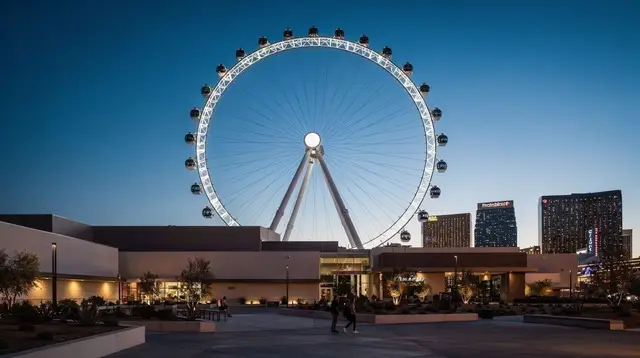
From Excalibur, it’s a walkable stretch north past New York-New York and the MGM Grand toward the center of the Strip. This is also where the Sphere and the High Roller observation wheel come into view if you want a mid-morning detour.
Midday: the central stretch
The center of the Strip — Bellagio, Aria, Crystals, Paris, Caesars Palace — is dense enough that most of it works on foot, and it’s also where the second free tram operates, linking Park MGM, Aria, and Bellagio. Time your walk to catch the Bellagio fountains, which run every 15-30 minutes through the afternoon and evening.
Stop for lunch somewhere in this stretch — the density of restaurants here is higher than almost anywhere else on the Strip, and you won’t need to detour far. If a full sit-down buffet appeals, this section of the corridor has some of the better-known ones; expect roughly $35-70 per person.
Afternoon: north to the Venetian and the Strat
North of Caesars Palace, the character changes again — this is where the Venetian’s gondola rides and the Wynn/Encore properties sit. There is no free tram covering this northern stretch, and it is not directly walkable to the very top of the Strip without real effort in heat.
This is exactly where the Las Vegas Monorail earns its fare (roughly $5-6 one-ride, cheaper with a day pass) — it runs along the east side of the Strip roughly from MGM Grand to the Sahara, so it can shortcut you north without a 45-minute walk. It does not stop at every resort, and it sits behind the properties rather than in front, so it’s a tool for skipping distance, not a door-to-door service.
Alternatively, the RTC Deuce bus runs the full length of the Strip and on to Downtown, with a 24-hour pass running about $8 in 2026 — slower than the monorail because it makes frequent stops, but it covers ground the monorail doesn’t, including the far south and north ends near Sahara Avenue and Russell Road.
Evening: a show, then rest
Cap the day with one of the Strip’s headline entertainment options — a Cirque du Soleil production, a music residency, or a magic show. Tickets commonly run $60-200+ depending on the show and seating; see our guide to choosing a show if you haven’t picked one yet. If you’d rather stay outdoors, the Strip’s night photo spots are worth 30 minutes before heading back to your hotel.
A word on what the Strip’s transit can’t do: neither tram covers the whole corridor, and the monorail skips several major resorts entirely. Don’t plan on hopping seamlessly between any two hotels you pick at random — check whether they’re tram-connected, on the monorail line, or need the Deuce (or a short rideshare) first.
Day 2: Arts District by morning, Fremont Street by night
Morning: the 18b Arts District
Start day two away from the casino floor entirely, in the Arts District — locally called “18b,” a compact grid of galleries, murals, and independent cafés a short ride south of Downtown proper. This neighborhood rewards slow mornings: a walking tour through the galleries and street art pairs naturally with a brunch stop at one of the district’s independent kitchens, which tend to be noticeably better value than Strip equivalents.
If you’d rather have a guide point out the murals and gallery spaces instead of self-navigating, an Arts District walking tour covers the same ground with context. Visitors who want to fold food into the same morning sometimes book an Arts District foodie tour instead of picking a single brunch spot alone, and there’s also an Art & Ale tour through the neighborhood’s brewery row for those who want beer alongside the galleries.
Getting here from a Strip hotel is a rideshare or a bus connection, not a walk — budget 15-20 minutes by car. There’s no tram or monorail service to the Arts District; it’s a distinct pocket of the city, not an extension of the resort corridor.
Afternoon: transition to Downtown
From the Arts District, it’s a short hop (10-15 minutes by rideshare, or a connecting bus) into Downtown Las Vegas proper. Use the afternoon to explore Downtown’s museums while the heat is still up and Fremont Street itself hasn’t come alive yet — the Mob Museum, the Neon Museum, or the Atomic Museum all fit well here, and all lean into the city’s actual history rather than its current resort branding.
On the walk from the Strip: don’t plan on walking from a Strip hotel to Downtown. It’s roughly 45-60 minutes on foot even from the northern end of the Strip, largely without shade, and the route passes through stretches with little to see along the way. The Deuce bus or a rideshare (typically $10-20) is the realistic option, and it’s what most repeat visitors actually use.
Evening: Fremont Street Experience
As the sun sets, head to the Fremont Street Experience — Downtown’s pedestrian-only canopy, and genuinely inside the city of Las Vegas, unlike almost the entire Strip. The Viva Vision light show plays on the canopy roughly once an hour after dark, free to watch from the street below, and it’s one of the better free things to do in the city.
For a first evening Downtown, a Fremont Street Experience walking tour or a private Fremont Street tour is a fast way to get oriented before wandering on your own, and the talking e-scooter tour of Fremont and Downtown is a lower-effort option if you’d rather ride than walk after a full day.
Downtown’s casinos are smaller and generally cheaper than their Strip counterparts — table minimums tend to be lower, and drinks and rooms both run less. If you want a taste of adrenaline before the night ends, the SlotZilla zipline runs directly above Fremont Street and is one of the few attractions you can see from below, then do yourself. Travelers making a night of it sometimes add a Fremont Street bar crawl after the light show, hitting several of Downtown’s cheaper bars in one guided stop.
On drinking in public: open containers are allowed outdoors on both the Strip and Fremont Street, but only in plastic or approved cups — glass containers are prohibited on the street in both areas, and this is enforced.
Getting between the two nights’ bases
If you split your stay — one night on the Strip, one Downtown — moving your luggage is the main friction point, since there’s no direct transit connection built for that; a short rideshare is simplest. If you’re staying at one hotel for both nights and day-tripping to the other zone, the same bus/rideshare logic from Day 2 applies for the return trip.
| Route | Best option | Approx. cost/time |
|---|---|---|
| Within central Strip | Free casino trams | Free, a few minutes each |
| North/south Strip ends | RTC Deuce bus (24h pass) | ~$8, stops frequently |
| Along Strip, skipping distance | Las Vegas Monorail | ~$5-6/ride, doesn’t stop everywhere |
| Strip to Arts District | Rideshare | ~15-20 min, no transit link |
| Arts District to Downtown | Rideshare or connecting bus | ~10-15 min |
| Strip to Downtown | Deuce bus or rideshare | ~30-45 min bus; ~15-20 min rideshare; not a walk |
Where the Strip and Downtown differ most
The most useful way to think about this itinerary is jurisdictional as much as geographic: the Strip is almost entirely unincorporated Clark County land, not the city of Las Vegas, run under county rules and taxation. Fremont Street and Downtown are genuinely within city limits. That distinction doesn’t change what you’ll see, but it explains why Downtown often feels different in pace, price, and character rather than just being “the old Strip.” For a fuller comparison, see Strip vs. Downtown.
Strip and Downtown two-day itinerary: FAQ
Can you walk from the Strip to Downtown Las Vegas?
Technically yes, but it’s a 45-60 minute walk with little shade and few points of interest along the way. Almost no visitors actually do this; the Deuce bus or a short rideshare is the practical choice.
Does the free tram or monorail connect all the Strip hotels?
No. There are two separate free trams (Mandalay Bay-Luxor-Excalibur, and Park MGM-Aria-Bellagio) covering only those properties, and a separate paid monorail running roughly from MGM Grand to the Sahara that skips several resorts, including most of the northern Strip near the Venetian and Wynn. No single system covers the whole 6.8 km corridor.
How much does Strip transit cost in 2026?
The casino-to-casino trams are free. The RTC Deuce and SDX buses run about $6 for a 2-hour pass or $8 for 24 hours. The monorail charges per ride, typically $5-6, with cheaper multi-ride passes available.
Is Downtown Las Vegas cheaper than the Strip?
Generally yes — hotel rates, table minimums, and food and drink prices all tend to run lower Downtown, though resort fees still apply at most Downtown hotels, typically at the lower end of the $30-50 range seen on the Strip.
What time does the Fremont Street light show run?
The Viva Vision canopy show at the Fremont Street Experience runs roughly once every hour after dark, and it’s free to watch from the street.
Do you need a car for this two-day itinerary?
No. This plan is built entirely around walking, free trams, the Deuce bus, the monorail, and occasional rideshares — a rental car adds parking costs and isn’t needed for this itinerary.
Is the Arts District within walking distance of the Strip or Downtown?
Not comfortably from the Strip. It sits between the Strip and Downtown proper, and is best reached from either by a short rideshare or connecting bus rather than on foot, especially in summer heat.
What’s the minimum age for gambling and drinking in Las Vegas?
21, checked with photo ID at every casino floor, bar, and liquor purchase across both the Strip and Downtown.
tours.2 days
Verified deep-linked GetYourGuide tours. Book through these links and we earn a small commission at no cost to you.
GetYourGuide does not provide a product photo for this activity — the image shows the meeting point, photographed by us.