Las Vegas Strip Panoramic Night Tour: What to Expect
What is a Las Vegas Strip panoramic tour and how much does it cost?
It's a guided ride past the Strip's illuminated resort facades, usually in a small bus, minibus, or open-top vehicle, lasting roughly 1 to 1.5 hours and costing around $30-50 per person. Guests stay on board or briefly step off for photos rather than entering the casinos.
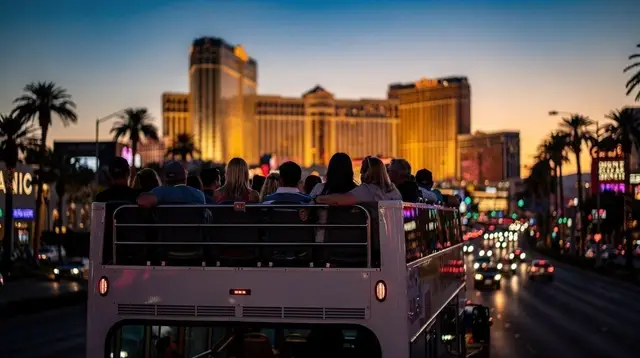
The Las Vegas Strip looks different once the sun goes down: fountains lit from below, hotel facades turned into moving light shows, and a corridor that reads less like a street and more like a stage set. A panoramic night tour is built entirely around that effect. Rather than a walking tour that stops to explain history, or a helicopter flight that shows the whole valley from above, this is a slow, seated pass along the corridor’s brightest stretch, viewed through a bus window or an open-air vehicle, with a driver or guide doing the navigating instead of you.
What a panoramic Strip tour actually is
The format is simple: a small bus, minibus, trolley, or open-top vehicle collects a group and drives a route along Las Vegas Boulevard, pausing or slowing near the most photogenic landmarks. There’s no walking involved beyond getting on and off, and in most versions guests never leave the vehicle except for a possible short photo stop. This makes it a fundamentally different experience from a Strip walking tour, which covers less ground but lets you actually stand in front of things and go inside where you choose.
Typical highlights on a nighttime route include the choreographed water show at the Bellagio fountains, the canal-front facade of the Venetian, the replica Eiffel Tower at Paris Las Vegas, and — more recently — the illuminated exterior sphere of Sphere, which has become one of the most-photographed additions to the skyline. Some routes also swing past the High Roller observation wheel or the Stratosphere tower before looping back. None of this involves entering a casino floor; the tour is about the exterior show, not the interior one.
Durations vary by operator, but most standard panoramic tours run 60 to 90 minutes. A few specialty formats extend the experience — an open-top sightseeing tour built around multiple stops and photo opportunities can stretch closer to 3 hours, especially if it adds a loop through Downtown/Fremont Street or the Arts District. Read the specific listing rather than assuming a single standard length; “night tour of the Strip” covers a wide range of actual itineraries.
Booking one: the tours available
Several operators run some version of this experience, and the vehicle style differs meaningfully between them. A small-group tour in a minibus feels different from an open-air trolley, which feels different again from a ride in a vintage convertible. If a particular vibe matters to you — open air versus air-conditioned, small group versus larger bus — check the vehicle description before booking rather than assuming.
| Tour style | Typical length | What it’s built around |
|---|---|---|
| Open-top sightseeing night tour | ~3 hours | Multiple photo stops, open-air views of illuminated facades |
| Classic convertible night tour | ~1-1.5 hours | Small-group ride in a vintage open-top car, closer to street level |
| Small group city tour | ~1-2 hours | Minibus format, personal guide narration, flexible group size |
| Hop-on hop-off pass | 24 or 48 hours | Not a single guided tour — a multi-stop bus pass you can ride repeatedly and get off wherever you like |
That last option is worth flagging separately: a hop-on hop-off pass is not a narrated panoramic tour in the same sense as the others. It’s a transport ticket that happens to cover Strip landmarks, useful if you want to structure your own multi-day sightseeing rather than sit through one guided loop.
Prices for a standard 60-to-90-minute panoramic ride commonly fall in the $30-50 per person range, with open-top or specialty formats sometimes landing above that depending on length and inclusions. Exact pricing, the pickup point, and which landmarks get a slow pass versus a quick drive-by all vary by operator and by the specific date you book — verify these details at the time of booking rather than assuming they match what worked for a previous visitor.
What the tour won’t promise, and shouldn’t
No honest operator can guarantee a window seat, and neither can this guide. Vehicle layout, how full the group is, and boarding order all affect who sits where, and in an open-top or open-side vehicle most positions give a workable view anyway — but a specific seat assignment isn’t something a shared tour vehicle can lock in ahead of time.
The same goes for weather. Las Vegas is a desert city, but that doesn’t mean guaranteed clear skies every night of the year — wind, occasional rain, or unseasonal cold can affect an open-top ride in particular. Check the forecast for your travel dates and dress accordingly; an open-air vehicle in December is a genuinely different experience from one in July.
Finally, don’t expect an identical route every time. The Strip is a working roadway shared with regular traffic, construction projects, and periodic large events (conventions, marathons, boxing weekends) that can close lanes or reroute buses without notice. A tour description’s list of stops is a plan, built around what’s normally visible and accessible — not a contract that guarantees the same sequence, same pacing, or same photo stops on every single departure.
Why the Strip isn’t actually “Las Vegas” on a map
Here’s a detail that trips up a lot of first-time visitors and even shows up inconsistently on maps and signage: almost the entire Strip is not within the official city limits of Las Vegas. Most of the roughly 6.8 km (4.2-mile) corridor sits in the unincorporated Clark County towns of Paradise and Winchester, a legal arrangement that dates back to 1950, when casino operators lobbied to stay outside the city’s tax and zoning authority as Las Vegas tried to annex the resort corridor. The area still carries a Las Vegas mailing address and ZIP code, which is why the distinction rarely registers with visitors — but Clark County, not Las Vegas city hall, governs almost everything you’ll drive past on a Strip tour.
Downtown and Fremont Street are the genuine exception: that older, more compact gaming district really is inside the city of Las Vegas. If a tour extends into a Fremont Street loop, that portion of the drive is technically in a different jurisdiction from the Strip portion — a small but real distinction, and one reason the region’s own governance and signage can feel inconsistent to first-time visitors.
How it compares to walking, trams, and other transport
A panoramic tour is one of several ways to see the Strip’s lit-up corridor, and each option makes a different trade-off between cost, effort, and flexibility.
Walking is free and lets you stop wherever you like, but the Strip’s roughly 6.8 km length is deceptive — it looks compact on a map and takes far longer on foot than expected, especially once you factor in pedestrian bridges, cutting through casino interiors, and, in summer, genuinely dangerous heat that makes an hour-long stroll a serious undertaking rather than a pleasant walk. A guided tour covers the same distance seated, in air-conditioned or open-air comfort, in a fraction of the time.
Casino-to-casino trams are free but only useful for short hops between adjacent properties — for example, Mandalay Bay to Luxor to Excalibur, or Park MGM to Aria to Bellagio. They don’t run the length of the Strip and aren’t a substitute for seeing the whole corridor.
The RTC Deuce and SDX buses, plus the paid Las Vegas Monorail, run longer routes along or near the Strip but are public transit, not sightseeing experiences — no narration, no guaranteed views, and stops dictated by transit schedules rather than photo opportunities. They’re a reasonable budget option for point-to-point travel, not for a dedicated evening of looking at lit-up facades.
Compared to all of these, a panoramic night tour trades cost for convenience and narration: someone else navigates, parking and walking fatigue disappear, and a guide can point out details — which resort is which, what’s new this year, where the best photo angle sits — that a self-guided walk or a transit ride won’t provide.
Practical notes for booking
A few things worth checking before you commit to a departure time:
- Pickup location and timing. Many tours pick up from a central Strip-area point rather than your specific hotel; confirm this rather than assuming door-to-door service.
- Vehicle type. Open-top and convertible formats put you closer to the light and sound of the Strip but expose you to weather; enclosed minibuses trade a little of that immediacy for climate control.
- What’s included versus what costs extra. Some tours bundle a stop at a landmark like the Fremont Street Experience or a viewpoint; others are strictly a drive-past. Read the itinerary rather than assuming.
- Group size. A small-group format generally means more flexibility and a more personal guide dynamic than a large coach tour, though it can also cost more per person.
None of these details are fixed across the market — they shift by operator, by season, and sometimes by which specific departure you book on a given night. Treat any panoramic tour listing as a snapshot to verify at booking time, not a permanent spec.
Who a panoramic tour actually suits
This format works best for a specific kind of traveler, and it’s worth being honest about who it doesn’t. A panoramic tour suits visitors who want the visual payoff of the Strip’s lights without the logistics of parking, walking, or driving themselves after dark — first-time visitors packing a lot into a short trip, couples looking for an easy evening activity, older travelers or anyone with mobility limitations who’d rather sit than cover 6.8 km on foot, and photographers who want a moving vantage point without worrying about traffic.
It suits families too, though a family-friendly Strip itinerary is worth checking against a specific tour’s age policy before booking, since some open-top or late-departure formats set a minimum age.
It suits these travelers less well: anyone who wants to linger at a specific spot, go inside a resort, or set their own pace should look at a Strip walking tour instead, or simply walk the corridor themselves. Budget travelers doing a short layover might find the free casino trams or the Deuce/SDX buses cover enough ground without the added cost. And anyone prone to motion sensitivity in stop-and-go traffic should factor that into an open-top choice, since the Strip’s evening congestion means a fair amount of idling between landmarks.
Combining a panoramic ride with the rest of an evening
Because the tour itself runs 60 to 90 minutes for most standard formats — longer for the open-top options that add stops — it leaves room either side for other plans on the same night. A common pattern for first-time visitors is dinner first, then a night tour as the evening’s centerpiece, followed by a nightcap somewhere along the route.
If you’d rather build the whole evening around nightlife instead of sightseeing, an operator-run after-dark tour with a drink included folds the two together, and a Strip bar crawl works as a follow-on for a group that wants to keep moving after the bus ride ends rather than turning in.
Some travelers prefer to pair the drive-past format with a short stop at street level rather than staying seated the entire time. A short Strip magic walk or a guided walk to the Strip’s must-see spots can bookend a panoramic ride well: the bus covers distance and provides narration, while a short walking segment lets you actually stand in front of the Bellagio fountains or the Venetian canals for a photo rather than viewing them through glass.
If your group leans toward a special occasion rather than general sightseeing, a few operators build the format specifically around that: a night Strip helicopter wedding package replaces the bus with an aerial view entirely, while a private night city tour keeps the ground-level format but removes the shared-group element, useful for anniversaries, proposals, or a group that simply doesn’t want to share a vehicle with strangers.
A quick comparison with an all-in-one option
Not every panoramic-style tour sticks strictly to the Strip. An all-in-one night city tour with hotel pickup typically widens the route to include Downtown/Fremont Street alongside the Strip itself, trading some depth on any single stretch for broader coverage of the city’s two most photogenic corridors in a single outing. That can be a better fit for a one-night stay where a return Fremont Street trip isn’t realistic, while a Strip-only panoramic tour makes more sense if you’re already planning a separate Downtown walking tour on another evening and don’t need the two combined.
Whichever version you book, the core trade-off stays the same across every format on this page: a panoramic tour exchanges the flexibility of walking or driving yourself for a fixed route, a seat, and someone else handling the navigation — a trade most visitors are glad to make for at least one evening of a Las Vegas trip.
Planning around it
A Strip panoramic tour works well as a single evening activity, easily combined with dinner or an early show, and it pairs naturally with a downtown Fremont Street walking tour if you want to see both districts without driving yourself.
If your priority is photography rather than a guided narration, compare this format against a Strip photo session built specifically around getting the shot, or a night helicopter tour if an aerial view of the same lit-up corridor appeals more than a street-level one. Whichever format you choose, the Strip’s lights are the one part of this trip that don’t require perfect timing, a permit, or a long drive — just an evening and a seat.
Hop-On Hop-Off Bus Tours and City Passes
Verified deep-linked GetYourGuide tours. Book through these links and we earn a small commission at no cost to you.
GetYourGuide does not provide a product photo for this activity — the image shows the meeting point, photographed by us.