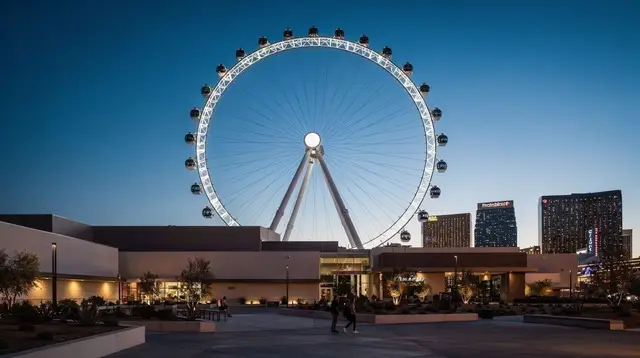
The Las Vegas Strip on Foot: A Practical Walking Guide
How long does it take to walk the entire Las Vegas Strip?
The Strip runs about 4.2 miles (6.8 km) from Sahara Ave to Russell Rd, and walking it end to end without stopping takes roughly 1.5 to 2 hours. In practice, with photo stops, casino crossings, and summer heat, most people need much longer and are better off splitting it into two or three days rather than doing it in one go.
I used to think the Strip would be an easy stroll. It’s a straight line on the map, casino after casino, how hard could it be? The first time I tried to walk it end to end, I gave up two-thirds of the way through, sat down on a bench near a bus stop, and just watched people limp past me in flip-flops. That walk taught me more about the Strip than any guide had.
The real numbers
The Las Vegas Strip runs about 4.2 miles (6.8 km) from Sahara Ave in the north to Russell Rd in the south. Walked non-stop, at a normal pace, that’s roughly 1.5 to 2 hours of actual walking time. That’s the number you’ll see quoted everywhere, and it’s accurate as a raw distance calculation.
What it doesn’t tell you is what “non-stop” actually means here. No stops for photos at the Bellagio fountains, no line for a viewpoint, no detour into a casino to see the Venetian’s canals, no bathroom break, no water stop. Add any of that in, and the honest number climbs fast. I’ve spent entire afternoons covering less than half the distance because I kept stopping to look at things, which is, to be fair, the point of being there.
Why it walks longer than the distance suggests
This is the part that surprised me most, and it’s not about fitness. It’s about the built environment.
Nearly every major intersection on the Strip forces you onto an elevated pedestrian bridge, reached by stairs or an escalator. There is very little street-level crossing here — the intersections are simply too wide and too busy with traffic for it to work any other way. So instead of a flat walk, you’re constantly climbing up, crossing over, and climbing back down, often with a crowd bottlenecked at the escalator. During peak hours those escalators back up, and you end up standing in a stalled line above the traffic you were trying to avoid.
Then there’s the heat, and this applies well beyond the three months everyone thinks of as “summer” in Las Vegas. The Strip has essentially no shade at street level. You’re walking on wide sidewalks and bridges with dark pavement that absorbs heat all day and radiates it back at you well into the evening. There’s no outdoor air conditioning to offer relief between buildings — that only exists inside the resorts, which means every gap between casinos is a real exposure to the ambient temperature, not a cooled-down buffer.
Put those two things together and you get a walk that’s technically 4.2 miles, but that costs you more energy and more time than any flat 4.2-mile walk would.
How I actually plan it now
I stopped trying to do the Strip as one continuous walk. Instead, I split it into three rough zones and treat each one as its own outing:
| Zone | Roughly | What’s there |
|---|---|---|
| North | Sahara Ave to Wynn/Fashion Show area | Sahara, Strat, Fremont Street is a short trip further north |
| Center | Caesars Palace to Bellagio/Paris/Planet Hollywood | Bellagio fountains, High Roller, Sphere area |
| South | MGM Grand to Mandalay Bay/Russell Rd | Shark Reef, New York-New York, Luxor pyramid |
I give each zone its own half-day or full day, depending on how much I actually want to stop and do. The center zone is almost always the one that eats the most time, since it has the highest concentration of things worth stopping for. If your visit is short, I’d rather you properly enjoy one zone than rush all three — this pairs well with thinking through how many days in Las Vegas you actually have before you plan the walking at all.
Mixing walking with the Deuce
One habit that changed things for me: I don’t walk the same stretch twice. If I’ve walked south from my hotel to see something at the far end of the Strip, I take the RTC Deuce bus back rather than retracing my steps. The Deuce runs the length of the Strip and down to Downtown/Fremont Street, and a 2-hour pass is inexpensive enough that it’s not worth the extra hour of walking just to save a few dollars. I’d rather spend that saved energy on the next zone the following day.
The casino-to-casino trams are worth knowing too, but they only cover very short, specific hops — Mandalay Bay to Luxor to Excalibur, or Park MGM to Aria to Bellagio. They’re free, but they won’t replace a real north-south walk plan.
Hydration and timing, especially in summer
If you’re visiting between June and September, walk in the morning before 10am or in the evening after 6pm. I know this sounds like standard advice, but I mean it specifically for walking distance planning: the temperature difference between 9am and 1pm on Strip pavement is enormous, and it directly changes how far you can comfortably go. I carry more water than feels necessary, refill whenever I pass through a casino, and treat any midday walking as a mistake to avoid rather than something to push through.
What I won’t promise you
I’m not going to tell you “the Strip takes X hours to walk” as if that’s true for everyone. It isn’t. Your pace, the weather that day, how many photo stops you make, whether you’re pushing a stroller or walking with kids, whether it’s 15°C in January or 42°C in July — all of it changes the real number. The 1.5 to 2 hour figure is a starting point for a fit adult walking briskly with zero stops in mild weather. Plan around that honestly, not around the number that sounds best in a guidebook.
If you’re heading out toward Hoover Dam or further into the desert on a day trip, the same logic about heat and pacing applies even more — you can pair a Strip walking day with something like a Hoover Dam guided tour or a kayak trip to Emerald Cave to give your feet a rest the next day.
For something further afield entirely, a guided day trip to the Grand Canyon West Rim or even a multi-day aerial adventure safari makes a good contrast to a Strip-heavy stretch of your trip.
Walking the Strip is one of the best ways to actually understand Las Vegas — the scale of it, the strangeness of it, the way it never quite settles into a normal city rhythm. Just don’t plan it like a normal city walk. It isn’t one.
tours.Practical
Verified deep-linked GetYourGuide tours. Book through these links and we earn a small commission at no cost to you.
GetYourGuide does not provide a product photo for this activity — the image shows the meeting point, photographed by us.