The STRAT Tower Guide: Observation Deck, Rides and SkyJump
How much does it cost to go up the STRAT Tower in Las Vegas?
The base observation deck ticket runs roughly $27-29 per person. Adding one of the tower's thrill rides pushes the combined ticket to around $44. SkyJump, the roped free-fall jump from the tower, is a completely separate product priced around $130-170 depending on the day of the week — it is not an add-on to the deck ticket.
Three tickets, three prices, not one bundle
The STRAT Tower — formerly the Stratosphere, and still called that by plenty of longtime visitors and cab drivers — sits at the far north end of the Strip, rising more than 1,000 feet above the desert floor. It is one of the tallest freestanding observation towers in the country, and on a clear day the view stretches from Downtown to the mountains ringing the valley. But before booking anything, it helps to understand what you are actually buying, because the STRAT sells three distinct experiences at three distinct price points, and they are frequently confused with one another online.
The observation deck is the base product: access to the enclosed Skypod and the open-air deck that wraps around it, priced in the neighborhood of $27-29 per person as of 2026. The thrill rides — a small cluster of attractions built onto the tower’s roof — are not included in that base price; adding one bumps the combined ticket to roughly $44. And SkyJump, the tower’s signature roped free-fall jump, is sold entirely separately, generally landing somewhere in the $130-170 range depending on the day of the week. None of these three folds into the others, and none of them is a free add-on once you are already up there. Treat this page as the plain breakdown of what each one costs and what it actually includes.
What the observation deck ticket gets you
The base ticket is the one most visitors actually want: a ride up one of the tower’s high-speed elevators to the Skypod, which houses an enclosed viewing level with floor-to-ceiling windows, a bar, and — on the level above — an open-air deck where you can feel the wind and hear the Strip below rather than just look at it through glass. On a clear day the sightlines run the length of the Strip to the south, out to Red Rock Canyon to the west, and across the valley toward Henderson and the mountains beyond. At night, it is arguably the best elevated view of the Strip’s lights that doesn’t require a helicopter.
A skip-the-line version of this ticket is worth the small premium if you’re visiting on a weekend evening, when the standard ticket line can back up at the base of the tower.
Skip-the-line access to the STRAT Observation Deck avoids that wait and gets you straight into the elevator queue rather than the general admission line.
There is also a Skypod-specific ticket sold as its own product, distinct from any bundled version, worth comparing on price before you book.
A standalone Skypod observation deck ticket covers just the deck itself, at the base price point, without any ride upgrade attached.
Adding a ride: what changes and what it costs
The STRAT’s roof holds a small set of thrill rides built specifically to unsettle people already standing 800-plus feet above the ground — spinning arms, drop mechanisms, and rides that tilt riders out over the tower’s edge. These are genuinely part of the tower experience, but they are gated behind a combination ticket, not included in the base observation deck price. As of 2026, adding ride access to the deck ticket brings the total to roughly $44 per person, compared with the $27-29 deck-only price — a meaningful jump, and one that is easy to miss if you only see the lower number advertised first.
If you’re deciding whether the rides are worth it, the honest answer depends on your tolerance for heights combined with mechanical motion. The view from the deck alone is already the main event; the rides add a few minutes of adrenaline on top of it, priced accordingly. Families with younger kids should check height and age restrictions before counting on ride access, since several of the tower’s attractions have minimum height requirements that rule out younger children — if you’re planning the day around a mix of ages, it’s worth cross-checking against a broader guide to family-friendly Strip attractions before locking in the ride upgrade.
STRAT Tower thrill rides admission is the direct route to the combination ticket if you already know you want deck access plus the rooftop rides rather than piecing the two together separately.
SkyJump: a separate, pricier product
SkyJump is the tower’s best-known feature and its most misunderstood one. It is a controlled free-fall jump from an observation deck near the top of the tower, with riders attached to a guided descent system rather than a traditional bungee cord — riders step off the platform and fall, controlled by cable, before landing upright at the base. It is genuinely one of the more distinctive one-off experiences on the Strip.
What it is not is a discounted add-on to the deck ticket. SkyJump is priced and sold as its own line item, generally in the $130-170 range depending on the day of the week (weekday pricing tends to run lower than weekend pricing). That price is well above both the observation deck ticket and the deck-plus-ride combination, and it does not include separate access to the rides or vice versa — a SkyJump ticket gets you the jump and, typically, deck access as part of the check-in process, but it is not a way to save money on the tower experience as a whole.
Weather is the other factor worth planning around. SkyJump, like the rooftop thrill rides, is suspended during high winds, which are not unusual at this elevation in the desert. If a jump is central to your plans, avoid scheduling it for the last hour before you need to leave for a flight or another commitment — a wind closure can push your slot later in the day or, in rare cases, cancel it outright with limited notice.
A STRAT SkyJump ticket books the jump directly rather than requiring a separate stop at the tower’s ticket counter, which is worth doing in advance if a specific time slot matters to your schedule.
Typical 2026 pricing at a glance
| Ticket | What’s included | Approximate price |
|---|---|---|
| Observation deck only | Enclosed Skypod + open-air deck | ~$27-29 |
| Deck + one thrill ride | Deck access plus one rooftop ride | ~$44 |
| SkyJump | Roped free-fall jump (deck access typically included) | ~$130-170, varies by day of week |
Treat these as order-of-magnitude figures rather than fixed numbers — prices at the STRAT, like most Strip attractions, shift with demand, season, and time of booking, and online advance pricing is usually a few dollars cheaper than walking up and buying at the tower.
Getting to the STRAT: it’s farther than it looks on a map
The single most common planning mistake with the STRAT is underestimating the distance from the rest of the Strip. The tower sits at the very north end, past Downtown/Fremont Street territory on one side and well beyond the last of the major central Strip resorts on the other. On a map it can look like a short stroll from properties near the Wynn or the north end of the resort corridor; on foot, in Las Vegas heat, it is a considerably longer walk than it appears — often 20-30 minutes or more from the nearest major resort, with stretches that aren’t especially pedestrian-friendly.
For most visitors coming from the central or southern Strip, a rideshare or the RTC Deuce bus is the more realistic option, especially in summer when the desert heat makes a long unplanned walk genuinely unpleasant rather than just inconvenient. If you’re combining a STRAT visit with a Downtown/Fremont Street evening, the two are close enough to pair into one outing, but don’t plan on walking the STRAT-to-mid-Strip stretch as a quick add-on to a day built around the Bellagio Fountains or other central-Strip landmarks.
For a broader rundown of the transit options along the whole corridor — monorail, the Deuce, rideshare pickup zones, and where each one actually makes sense — see this guide to getting around the Las Vegas Strip. And if you’re still deciding whether to base your stay near the STRAT’s end of the Strip or closer to Downtown/Fremont Street, this comparison of the Strip and Downtown lays out the trade-offs of each location before you book a hotel.
Live shows and comedy at the STRAT
Beyond the tower itself, the STRAT resort hosts a small cluster of showroom entertainment that’s easy to overlook when the tower is the main draw. A comedy club, a magic and illusion show, and a couple of tribute-style productions all run out of the same property, and pairing one with a tower visit is a straightforward way to build a full evening without leaving the north end of the Strip.
La Comedy Club at the STRAT runs a standup lineup that fits neatly before or after a sunset trip up the tower, and it’s worth comparing against the wider field of comedy clubs and standup shows across Las Vegas if you want options beyond the resort itself.
For something with more spectacle and less audience-facing comedy, Rouge at the STRAT is a burlesque-style production staged in the same building, and it slots into the broader landscape of magic and illusion shows around the city if you’re weighing several show formats against each other before deciding how to spend an evening.
Comparing the STRAT to the Strip’s other viewpoints
The STRAT isn’t the only elevated view on the Strip, and it’s worth knowing how it stacks up against the alternatives before committing an evening to it.
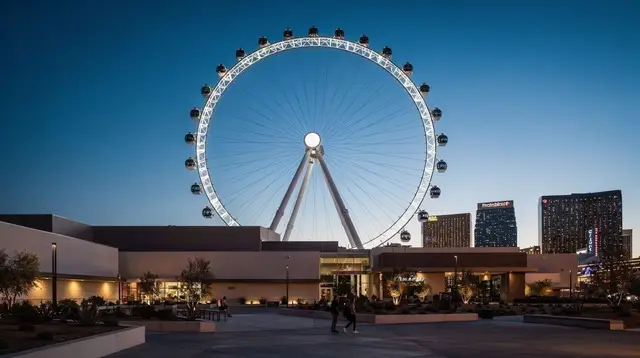
The Eiffel Tower Viewing Deck at Paris Las Vegas sits roughly in the middle of the Strip and offers a lower, closer-in view directly over Bellagio’s fountains — a different angle and a shorter climb than the STRAT’s full-height perspective. The High Roller observation wheel at The LINQ is a slower, more leisurely option near the Strip’s center, better suited to those who want a gentle ride rather than a tower ascent. The STRAT’s advantage is height and the open-air deck; its trade-off is location, sitting apart from the rest of the resort corridor rather than embedded in it.
If you’d rather have a guide handle the whole evening — transport, timing around sunset, and context on what you’re looking at — a guided evening tour bundles well with a STRAT stop.
A guided Las Vegas nights tour can work the STRAT or another elevated viewpoint into a broader evening itinerary without you needing to plan the transit yourself.
Beyond the tower: pairing a STRAT visit with a day trip
If you’re staying near the north Strip for the STRAT, it’s also a reasonable jumping-off point for desert excursions that start north of the main resort corridor. Options built around off-road and desert scenery pair naturally with a tower visit earlier or later in the same day.
A guided off-road Bronco adventure to Boathouse Cove and a private day tour to Valley of Fire both depart from the Las Vegas area and can slot into a day that also includes a STRAT stop, especially if you’re already staying or eating near the tower’s end of the Strip. For a slower-paced option closer to the resort corridor itself, an e-bike tour around Las Vegas is worth considering as a lower-intensity way to cover ground between the STRAT and the central Strip without walking the whole distance.
Should you buy an attraction pass instead?
If the STRAT is one stop among several on your list — the Eiffel Tower deck, the High Roller, a handful of museums or shows — a multi-attraction pass can work out cheaper than buying every ticket individually, though it’s worth running the math against your specific itinerary rather than assuming a pass always wins.
An Explorer Pass covering 2-7 Las Vegas attractions bundles a selection of Strip sights into one purchase, and it’s worth checking whether the STRAT and any other viewpoints on your list are included before assuming it beats buying separately. For a fuller comparison of how the various Las Vegas attraction passes stack up against each other and against paying per ticket, see this guide to comparing Las Vegas attraction passes.
If your plan is really just “see the Strip from above once,” a dedicated guide to skip-the-line viewpoint tickets walks through the STRAT alongside the Strip’s other elevated options, which can be a faster way to decide than working through a pass’s full attraction list.
Practical tips before you go
A few things worth knowing before buying tickets. First, buy the observation deck ticket online rather than at the tower counter when possible — advance pricing is typically a few dollars lower and skip-the-line access matters most on weekend evenings when the queue for the elevators can run long. Second, decide on rides and SkyJump before you arrive, not after seeing the view — both are meaningfully more expensive than the base deck ticket, and neither is refundable once redeemed.
Third, check the weather forecast for wind if SkyJump or the rooftop rides are the reason you’re visiting; a gusty afternoon can shut both down with little warning, and there’s no guarantee of a same-day rebooking slot. Finally, budget the transit time and cost separately from the tower ticket itself — a rideshare or bus fare from the central Strip adds a real line item to the outing that a lot of first-time visitors don’t account for.
Sunset is generally considered the best time to go up, since it gives you both a daylight view of the Strip and valley followed by the lighting-up of the resort corridor after dark, all within the same visit — worth timing your ticket around if the schedule allows it.
Strip Landmarks
Verified deep-linked GetYourGuide tours. Book through these links and we earn a small commission at no cost to you.
GetYourGuide does not provide a product photo for this activity — the image shows the meeting point, photographed by us.