Petroglyphs at Valley of Fire: Atlatl Rock and Mouse's Tank
Where can I see petroglyphs at Valley of Fire, and how hard is it to get to them?
The two easiest petroglyph sites are Atlatl Rock, reached by a short metal staircase a few steps from its parking area, and Mouse's Tank / Petroglyph Canyon, a flat, easy walk of about 0.4 miles round trip. Both are inside Valley of Fire State Park, roughly an hour's drive from Las Vegas, and both require the park's entrance fee since no federal pass applies here.
Two short walks, a lot of rock art
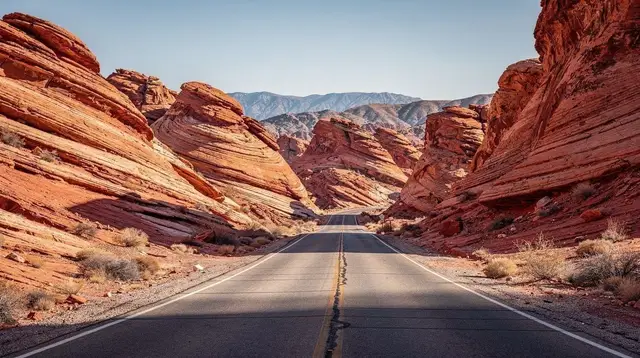
Most first-time visitors to Valley of Fire come for the red sandstone formations and end up surprised by how much human history is carved into that same rock. Two sites make the park’s petroglyphs genuinely easy to see without any hiking experience: Atlatl Rock, where a metal staircase climbs a short distance to a panel of carvings on a boulder face, and Mouse’s Tank, also called Petroglyph Canyon, a flat sandy wash lined with marked panels on either side. Neither requires more than sturdy shoes and a bottle of water, and both sit close enough to their own parking areas that they work well as add-ons to a broader day in the park rather than as destinations in themselves.
This guide covers what’s actually at each site, what the park’s own signage says (and doesn’t say) about the carvings, the practical rules around visiting them, and how to decide between seeing them on your own and joining a guided outing that includes them.
Atlatl Rock: the staircase site
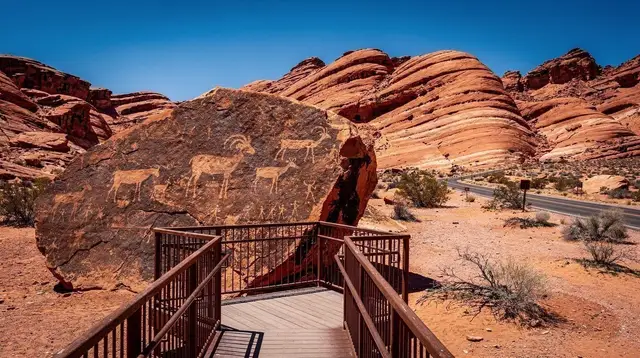
Atlatl Rock sits just off one of Valley of Fire’s main park roads, close enough to the Valley of Fire day-trip route that most itineraries pass right by it. From the parking area, a metal staircase — built specifically to give visitors a closer look without needing to scramble over sandstone — climbs partway up the rock face to a landing in front of the main panel.
The name comes from one of the images on the panel, which park interpretive signage identifies as a depiction of an atlatl, a spear-throwing tool used before the bow and arrow became common in the region. Alongside it are additional carved figures, including animal forms and abstract geometric shapes, pecked into the rock’s dark desert varnish — the thin mineral coating that forms on sandstone over long exposure, and which carving through reveals the lighter stone underneath.
A short stop here typically runs 10 to 15 minutes: a few minutes to walk from the car, time on the staircase landing to look at the panel and read the on-site signage, and the walk back down. The staircase has handrails and a reasonably gentle grade, but it is still a staircase in full desert exposure, so it isn’t the easiest stop for anyone unsteady on their feet or visiting during peak summer heat in the middle of the day.
Mouse’s Tank / Petroglyph Canyon: the walking-trail site
The second easy stop is Mouse’s Tank, reached via the Petroglyph Canyon Trail, a flat, well-defined path through a narrow wash lined with sandstone walls on both sides. The trail is about 0.4 miles round trip and gains almost no elevation, which makes it one of the most accessible walks in the entire park — no scrambling, no route-finding, just a sandy path between rock walls dotted with carved panels at intervals along the way.
The trail’s name comes from a small natural basin, or “tank,” near its end that historically held rainwater; local lore attributes it to a Southern Paiute man known as “Mouse” who is said to have used the water source while evading capture in the 1890s. The petroglyphs themselves, though, predate that story by a wide margin and are unrelated to it — the carvings and the naming legend come from entirely different eras of the canyon’s history.
Because the trail is a linear out-and-back through a narrow corridor, most visitors walk it at a relaxed pace, pausing at each cluster of carvings, and finish in about 20 to 30 minutes total. It pairs naturally with a stop at the Fire Wave and nearby short hikes if you’re spending a fuller day in the park rather than just passing through.
Who made these carvings, and how old are they
Valley of Fire’s interpretive panels attribute the park’s rock art to peoples associated with the Basketmaker and later Ancestral Puebloan archaeological traditions, who occupied and moved through this part of the Mojave Desert over a long span of time — the park’s own materials describe this as covering many centuries, without narrowing any single image to an exact year or even a specific century. That’s a deliberate caution on the part of park archaeologists and interpreters, not a gap in the signage: dating individual petroglyphs precisely is genuinely difficult, since the carvings themselves don’t carry inscribed dates and the desert varnish they’re cut through forms at rates that vary with local conditions.
This guide follows the same restraint. You may see other sources online offer a specific age for a specific carving at Atlatl Rock or in Petroglyph Canyon — treat those claims skeptically unless they’re sourced to the park’s own archaeological documentation. What can be said with confidence is that the images represent generations of use of this landscape by Indigenous peoples long before it became a state park, and that the park’s staff and signage present them as part of a continuous, living cultural heritage rather than as isolated artifacts.
The state park entrance fee, and why federal passes don’t apply
Valley of Fire is a Nevada State Park, administered by the state rather than the National Park Service, and that distinction matters for anyone assuming a park pass covers it. The America the Beautiful pass and other federal recreation passes are valid at National Park Service sites, US Forest Service land, and other federal units — they are not honored at Nevada state parks, Valley of Fire included.
Every vehicle entering pays the state park’s own entrance fee at the gate or a self-pay station, regardless of what federal passes are in the glovebox. If you’re also planning stops at genuinely federal sites like the Grand Canyon or Zion later in your trip, see the America the Beautiful pass guide for where that pass actually does apply — it just isn’t here.
Getting there and what a visit actually costs in time
Valley of Fire sits roughly an hour’s drive from the Las Vegas Strip, making it a realistic half-day or full-day trip rather than a quick errand. Most visitors combine the petroglyph stops with the park’s other well-known sights — the Fire Wave, Rainbow Vista, the visitor center exhibits — rather than making a single trip just for the rock art, and the Valley of Fire day-trip guide lays out a full sample itinerary.
If you’re driving yourself, renting a car in Las Vegas and reviewing basic desert driving safety — carrying extra water, checking your fuel before you leave the highway, watching for wildlife on the park roads — are worth doing before a summer trip in particular. If you’d rather not drive or navigate the park’s turnoffs yourself, a guided option removes that layer of planning; see the comparison below.
| Site | Walk distance | Approximate time | Terrain |
|---|---|---|---|
| Atlatl Rock | A few steps from parking, plus a metal staircase | 10-15 minutes | Staircase with handrails, full sun exposure |
| Mouse’s Tank / Petroglyph Canyon | ~0.4 miles round trip | 20-30 minutes | Flat sandy wash, minimal elevation change |
The one rule that matters most: don’t touch the rock
Every ranger briefing and every piece of park signage at these two sites repeats the same instruction: do not touch, trace, chalk, or make rubbings of the petroglyphs. The carvings exist in the thin desert varnish coating the sandstone, and that coating is fragile — skin oils accelerate its breakdown, and any physical contact, however careful it seems, causes damage that cannot be undone. This isn’t a suggestion; park staff do cite visitors caught touching or marking the rock art, and the National Park Service and state park systems alike treat rock art vandalism as a serious offense.
Practically, this means viewing from the boardwalks, staircases and marked trail surfaces provided at each site, keeping to the established paths through Petroglyph Canyon rather than climbing the canyon walls for a closer look, and photographing rather than touching. It also means resisting the temptation to add your own mark anywhere nearby — modern graffiti near historic rock art sites is unfortunately common enough that rangers watch for it specifically.
Shade, heat and timing: there’s almost none
Both Atlatl Rock and Mouse’s Tank sit in fully exposed desert terrain with essentially no tree cover. The staircase at Atlatl Rock is metal and sits in direct sun; the Petroglyph Canyon wash has sandstone walls but they don’t provide meaningful shade across most of the trail’s width for most of the day. In summer, when Las Vegas-area highs regularly reach 38-43°C (100-110°F), this exposure makes even a 20-minute walk considerably more taxing than the distance suggests, and metal surfaces like the Atlatl Rock staircase railing can be uncomfortably hot to the touch by midday.
The practical response is timing: visiting in the early morning or later afternoon avoids the most intense heat and often gives better light for photographing the carvings, since low-angle sun tends to bring out the contrast between the carved lines and the surrounding varnish more clearly than a flat midday sun does. That said, this guide won’t promise you optimal lighting at any particular hour — the angle of the carvings, the season, and the specific panel all affect how well a given carving reads at a given time, and no single visiting window guarantees the best view of every image at these sites.
Independent visit vs. guided tour
An independent visit to Atlatl Rock and Mouse’s Tank costs nothing beyond the park entrance fee and works well if you’re content reading the on-site interpretive panels, moving at your own pace, and treating the petroglyphs as one stop among several in the park. The signage at both sites is reasonably informative about what’s known and explicitly cautious about what isn’t — dates, meanings and cultural context are presented in general terms rather than site-specific certainty.
A guided tour adds a live narrator who can go further: explaining broader patterns in Southwestern rock art traditions, pointing out carvings that are easy to miss on your own (some panels sit at angles or in shadow that make them easy to walk past), and folding the petroglyph stops into a fuller day that might also cover the Fire Wave, Rainbow Vista or a combination with nearby Red Rock Canyon. If you’re weighing which approach fits your trip, the guided tour vs. rental car comparison and the small group vs. large bus tour guide both go into more detail on the trade-offs.
For a guided day that includes Valley of Fire’s highlights, a private day tour of Valley of Fire covers the park’s main sights with a dedicated guide and vehicle, while a combined Valley of Fire and Red Rock Canyon tour pairs the petroglyph sites with a second desert landscape in one outing.
Travelers who’d rather structure their own day but still skip the driving can look at a Valley of Fire and Red Rock Canyon day trip, and anyone wanting a different kind of desert outing around the same area might consider an off-road desert adventure near Las Vegas as an alternative way to see the surrounding landscape.
Planning the rest of your day around the petroglyphs
Since Atlatl Rock and Mouse’s Tank each take under half an hour, most visitors build them into a longer stop rather than a dedicated trip. If you’re also drawn to the park’s rock formations, the Fire Wave and other short hikes sit within the same park and share the same entrance fee. Travelers combining Valley of Fire with nearby Hoover Dam can follow the Hoover Dam and Valley of Fire day-trip itinerary, while those staying closer to the city might prefer pairing a shorter Valley of Fire visit with Red Rock Canyon and Mount Charleston instead.
For a broader sense of how Valley of Fire fits against other short trips from the Strip, the day trips by drive time guide lines it up next to Hoover Dam, Red Rock Canyon and farther options like Death Valley. And if you’re deciding what else to do once you’re inside the park gates, the things to do at Valley of Fire page rounds up the rest of the park’s sights beyond the two petroglyph stops covered here.
Frequently asked questions about Valley of Fire’s petroglyphs
How old are the petroglyphs at Valley of Fire?
Park signage attributes the rock art to Ancestral Puebloan and earlier Basketmaker peoples who used the area over a long span of time, likely spanning many centuries. No exact date is assigned to any single carving by the park, and this guide does not invent one either.
Is Valley of Fire covered by the America the Beautiful pass or any national park pass?
No. Valley of Fire is a Nevada State Park, not a National Park Service unit, so federal recreation passes are not accepted here. You pay the state park’s own entrance fee at the gate regardless of any federal pass you carry.
Can I touch or make a rubbing of the petroglyphs?
No. Touching, tracing, chalking or rubbing any rock art is prohibited and damages the desert varnish the carvings are cut into. View from the designated staircase and trail surfaces, and photograph rather than make contact.
How long does it take to see Atlatl Rock and Mouse’s Tank?
Atlatl Rock takes about 10-15 minutes including the staircase; Mouse’s Tank / Petroglyph Canyon takes roughly 20-30 minutes at an easy walking pace. Together with the short drive between them, budget about an hour for both.
Is there shade at the petroglyph sites?
Very little at either site. Both trails cross open sandstone and sand with minimal tree cover, so carry more water than feels necessary and consider visiting in the early morning or late afternoon rather than midday.
Is it better to visit independently or with a guided tour?
An independent visit works well with the park’s on-site interpretive panels and lets you move at your own pace. A guided tour adds cultural context, points out carvings that are easy to miss, and can combine the stop with other Valley of Fire highlights in one outing.
Can I visit the petroglyphs at night or see them lit up?
No. There is no purpose-built night lighting or after-hours access at Atlatl Rock or Mouse’s Tank; the park’s standard gate hours apply, and there is no reliable way to view the carvings after dark.
Will I definitely get a clear, well-lit view of the carvings whenever I arrive?
Not guaranteed. How clearly a carving reads depends on the sun’s angle and the shadows across the sandstone at that hour, and this varies by panel and season — there is no single time of day that guarantees the best view of every image at these sites.
Valley of Fire Tours
Verified deep-linked GetYourGuide tours. Book through these links and we earn a small commission at no cost to you.
GetYourGuide does not provide a product photo for this activity — the image shows the meeting point, photographed by us.