Valley of Fire Day Trip Guide
Can I use the America the Beautiful pass at Valley of Fire?
No. Valley of Fire is a Nevada state park, not a federally managed unit, so the America the Beautiful pass is not accepted. Entry is a separate state park fee, roughly $10 per vehicle with Nevada plates and $15 for out-of-state plates in 2026, paid at the entrance station or a self-pay kiosk.
Valley of Fire runs on its own rules, not the national park playbook
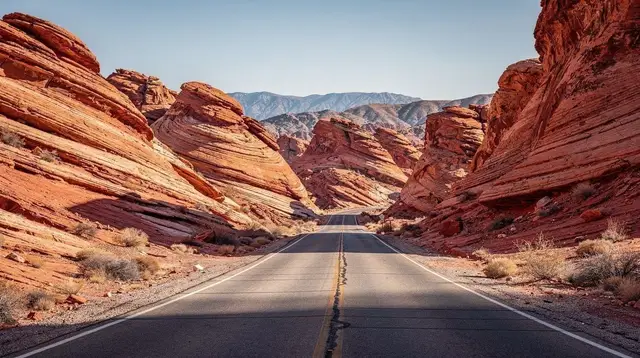
Valley of Fire is Nevada’s oldest state park, a stretch of red and orange Aztec sandstone about 50 miles northeast of Las Vegas. It looks, in photos, like it belongs alongside Zion or the Grand Canyon, and the scenery genuinely competes with both. But it is managed differently, priced differently, and forgiven of none of the desert’s usual hazards, so a plan built on national-park assumptions will misfire here. This guide sets out what actually applies: what you pay, how long the drive and the visit really take, whether to self-drive or book a tour, and why summer here is not a minor inconvenience.
The single biggest point of confusion is the America the Beautiful pass. It is a federal pass, valid at national parks, national monuments, and national conservation areas such as Red Rock Canyon. Valley of Fire is none of those — it’s a Nevada state park, run by Nevada State Parks, not the National Park Service. The federal pass is not accepted here, full stop, and no amount of showing it at the entrance station will change that.
Entry fees: a separate cost, paid on site
Expect to pay a per-vehicle state park entry fee at the entrance station or, if it’s unattended, at a self-pay kiosk. As of 2026, the going rate is roughly $10 per vehicle for Nevada-registered cars and roughly $15 per vehicle for vehicles registered out of state. These numbers come from Nevada State Parks and are subject to change without much warning, so treat them as a current ballpark rather than a fixed number you can bank on for next year. Bring a card or small bills in case the kiosk at your entrance isn’t working.
| Item | What to expect |
|---|---|
| Vehicle entry (Nevada plates) | ~$10, 2026 |
| Vehicle entry (out-of-state plates) | ~$15, 2026 |
| America the Beautiful pass | Not accepted |
| Payment method | Entrance booth or self-pay kiosk |
| Camping / annual passes | Separate fee structure, check current rates before relying on one |
If a guided tour is doing the driving, the park fee is usually already folded into the tour price — but always confirm that before assuming it, since some operators list it as a separate cash payment on arrival.
Getting there: I-15 to NV-169, about an hour
From the Strip or Downtown, the standard route is north on I-15, then east on NV-169 through the Moapa Valley into the park. Total drive time runs roughly 55 to 60 minutes each way under normal traffic, covering around 50 miles. Weekend mornings and holiday traffic on I-15 can stretch that somewhat, so building in a buffer on either end of the day is sensible.
There are two entrances to the park — a west entrance off NV-169 near Valley of Fire Highway and an east entrance closer to Lake Mead’s northern shore — and most self-drive itineraries loop through from west to east or vice versa rather than backtracking. Cell signal inside the park is patchy to nonexistent, so download offline maps or a saved route before you leave Las Vegas rather than counting on real-time navigation once you’re there.
How much time to actually block out
A realistic Valley of Fire day trip needs 4 to 6 hours total, door to door, to see the headline stops with short stops rather than a rushed drive-by. That figure includes the roughly two hours of round-trip driving, leaving somewhere between 2 and 4 hours inside the park itself depending on how many viewpoints and short trails you fit in.
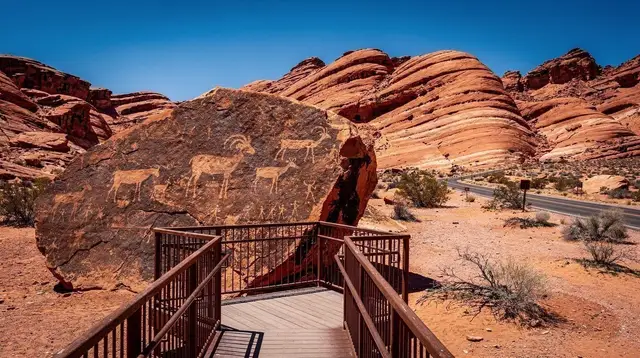
Typical must-see stops for a first visit include the Fire Wave, Elephant Rock, Atlatl Rock’s petroglyphs, and the Rainbow Vista overlook — each one is quick to reach but adds up once you count parking, walking, and photos at each. Trying to add a longer hike or a second, farther-out stop like White Domes on top of all of that tends to push a visit past the 6-hour mark, which is fine if you plan for it but frustrating if you didn’t.
A private day tour to Valley of Fire is one way to structure this without doing your own route planning, since the driver already knows which stops fit comfortably into a half-day window.
Self-drive vs. guided tour: the real trade-off
Both approaches work, and the right one depends more on how you like to travel than on cost alone.
Self-driving gives you full control: you decide how long to linger at the Fire Wave, whether to detour to White Domes, and when to leave. It also means you’re the one finding parking at each pullout (some fill up by mid-morning on weekends), navigating with limited signal, and managing your own water and fuel. A rental car and a filled tank are the only hard requirements.
A guided tour removes the navigation and parking problem entirely — someone else drives, someone else knows exactly where the trailhead is, and you don’t need to worry about a rental. The trade-off is schedule: a shared group itinerary usually allocates less time at each individual stop than you’d give yourself, and the itinerary is fixed rather than adjustable. Options range from small-group outings like a guided hiking day trip through the park’s trails to broader sightseeing formats such as a guided tour covering the park’s main viewpoints.
| Self-drive | Guided tour | |
|---|---|---|
| Flexibility on timing | High — stay as long as you want at each stop | Low — fixed schedule set by the group |
| Parking/navigation hassle | Yours to manage | Handled by the operator |
| Cost structure | Rental + fuel + park entry | Single price, often entry included |
| Good for combining multiple stops | Yes, easiest way to do it | Limited to what’s on the itinerary |
| Cell signal dependency | Higher (own navigation) | Lower (driver knows the route) |
If your interest extends beyond Valley of Fire itself, some operators also run wider regional itineraries — for travelers weighing a broader Nevada day out, comparing a half-day trip against a longer regional outing is worth doing before booking.
Summer heat: the park’s actual biggest hazard
Valley of Fire sits at a lower elevation than Las Vegas and routinely runs hotter. Summer daytime highs here regularly exceed 45°C (113°F), and unlike a hike in the mountains, there is almost no shade across the park’s most photographed sites — the Fire Wave, Elephant Rock, and most of the sandstone formations sit in fully exposed terrain. Combine that with unreliable cell signal for calling for help, and the margin for error in summer is genuinely thin.
Practical adjustments that matter here, not just boilerplate advice:
- Visit at sunrise in summer months if at all possible — both for the light (red sandstone photographs best in low-angle sun) and to be off exposed trails before peak heat.
- Carry more water than feels necessary. Do not assume the park has reliable drinking water at every stop; some facilities can be closed or out of service, and treating any tap as guaranteed working is a bad bet.
- Avoid the longer trails — White Domes, the fuller loop trails — during midday in June through August. Short pullout-to-viewpoint walks are more forgiving than a sustained hike in full sun.
- Keep a full tank of gas and check tire condition before leaving Las Vegas; there’s no fuel station inside the park, and a breakdown on NV-169 in extreme heat with poor signal is a genuinely bad scenario.
- Let someone know your route and expected return time, especially on a self-drive with an early start.
None of this means avoid Valley of Fire in summer — plenty of visitors do it safely every year — but it does mean summer here isn’t a scaled-down version of a mild season; it changes what’s sensible to attempt.
Don’t mix this up with Red Rock Canyon
It’s an easy mix-up because both are red-rock desert scenery within roughly an hour of the Strip, but Red Rock Canyon is a federally managed National Conservation Area, run under the Bureau of Land Management, where the America the Beautiful pass is valid. Valley of Fire is a Nevada state park, where it is not.
If you’re planning to use a federal pass to save money across multiple stops on a trip, Red Rock Canyon counts toward that; Valley of Fire needs its own separate payment regardless of what pass you’re carrying. Some visitors pair the two into the same trip — see Red Rock Canyon and Mount Charleston as a single day trip for how that combination is usually structured — but they are never interchangeable when it comes to fees or jurisdiction.
Combining Valley of Fire with the rest of the region
Valley of Fire sits close enough to Lake Mead, Hoover Dam, and Boulder City that some day trips loop through more than one of them, though doing all three plus Valley of Fire in a single day usually means seeing each one briefly rather than properly. If you’d rather add water-based activity to the trip, options like a guided biking and kayaking combo tour from Las Vegas run in the same general direction and can sometimes be paired with a shorter Valley of Fire stop, though this takes more planning than a straightforward one-site day trip.
For travelers weighing which desert stop deserves the day, Valley of Fire’s short hikes to the Fire Wave and nearby formations and the park’s petroglyphs at Atlatl Rock are the two most consistently recommended stops for a first visit, and both fit comfortably into the 4-to-6-hour window described above.
Getting the logistics right before you go
A short pre-trip checklist covers most of what trips a first-time visitor up:
- Confirm current entry fees on the Nevada State Parks site before you leave — don’t rely on a number from an old blog post or a previous year’s receipt.
- Fill the gas tank in Las Vegas; there’s no fuel station inside the park boundary.
- Download offline maps for the NV-169 route and the park’s internal roads, since cell coverage inside the park is unreliable.
- Pack more water than seems necessary, plus sun protection — hat, sunscreen, sunglasses — regardless of season.
- If self-driving, plan your loop (west entrance to east, or the reverse) before arriving so you’re not deciding at each junction.
- If booking a tour, confirm in advance whether the park entry fee is included in the tour price or paid separately on arrival.
Frequently asked questions about visiting Valley of Fire
Does the America the Beautiful pass work at Valley of Fire?
No. That pass covers federal lands such as national parks and national conservation areas, and Valley of Fire is a Nevada state park. It has its own separate entry fee that the federal pass does not cover.
How much does it cost to enter Valley of Fire State Park?
As of 2026, expect roughly $10 per vehicle for Nevada-registered cars and roughly $15 per vehicle for out-of-state plates, payable at the entrance station or a self-pay kiosk if the booth is unattended. Fees are set by Nevada State Parks and can change, so treat these as an order of magnitude rather than a locked-in number.
How far is Valley of Fire from Las Vegas?
It’s about 50 miles from the Strip, roughly 55 to 60 minutes by car via I-15 north and then NV-169, depending on traffic and where in Las Vegas you start from.
How many hours should I plan for a Valley of Fire day trip?
A realistic visit covering the main viewpoints and one or two short trails runs 4 to 6 hours including the drive both ways. Add extra time in summer, when heat forces slower movement between stops.
Is Valley of Fire the same as Red Rock Canyon?
No, they are different places with different rules. Red Rock Canyon is a federally managed National Conservation Area where the America the Beautiful pass is valid; Valley of Fire is a Nevada state park with its own fee and no federal pass acceptance.
Is it better to drive myself or book a guided tour to Valley of Fire?
Self-driving gives you full control over timing and which stops you linger at, which matters because the park’s highlights are spread out. A guided tour removes the need to navigate and park, but a shared group itinerary usually allots less time at each individual site.
Is there shade or water available inside the park?
Very little. Most viewpoints and trails sit in open desert with no shade structures, and drinking water is not reliably available at every stop. Bring more water than you think you’ll need and treat any water source in the park as unconfirmed rather than assuming a fountain will be working.
Is Valley of Fire dangerous to visit in summer?
Summer temperatures here regularly exceed 45°C (113°F), and with minimal shade and unreliable cell signal, heat illness is a real risk. Visiting at sunrise, carrying extra water, and limiting time on exposed trails during midday hours are standard precautions rather than optional extras.
Valley of Fire Tours
Verified deep-linked GetYourGuide tours. Book through these links and we earn a small commission at no cost to you.
GetYourGuide does not provide a product photo for this activity — the image shows the meeting point, photographed by us.