Is the America the Beautiful Pass Worth It From Las Vegas?
What does the America the Beautiful Pass cover from Las Vegas, and what does it not cover?
It covers per-vehicle entry to federally managed sites — Zion, Grand Canyon South Rim, Bryce Canyon and Death Valley are the relevant ones near Las Vegas. It does not cover Grand Canyon West (Skywalk), which is Hualapai tribal land, or Antelope Canyon and Monument Valley, which are Navajo Nation attractions with their own separate tickets.
What the America the Beautiful Pass actually pays for
If you’re planning more than one national park stop out of Las Vegas — Zion, the Grand Canyon South Rim, Bryce Canyon, or Death Valley — the America the Beautiful Pass is worth understanding before you book anything. It is a single annual pass, issued by the U.S.
federal government, that replaces the individual vehicle entrance fee at national parks and a long list of other federally managed public lands. As of January 1, 2026, it costs $80 for U.S. residents and $250 for non-U.S. residents, available as a physical card mailed to you or a digital pass you can use immediately through Recreation.gov, and it now covers up to two motorcycles per pass at sites that charge motorcycle fees.
The catch, and the reason this guide exists, is that the pass only covers federally managed land. Around Las Vegas that means it works at some of the region’s biggest draws and does nothing at others that sit right next door on the map. Getting this wrong is one of the most common and expensive mistakes first-time visitors make when planning a Grand Circle road trip, because two of the most photographed spots in the entire region — Grand Canyon West and Antelope Canyon — are not run by the National Park Service at all.
Where the pass works: federally managed parks near Las Vegas
The America the Beautiful Pass covers per-vehicle entrance fees at every unit of the National Park System, plus sites managed by the U.S. Forest Service, Bureau of Land Management, U.S. Fish and Wildlife Service, and the Army Corps of Engineers that charge a standard amenity fee. For a Las Vegas-based trip, the sites that matter are:
| Site | Managed by | Distance from Las Vegas | Typical vehicle entry fee (no pass) |
|---|---|---|---|
| Zion National Park | National Park Service | ~160 miles, ~2.5 hours | ~$35 |
| Grand Canyon South Rim | National Park Service | ~275-280 miles, ~4.5 hours | ~$35 |
| Bryce Canyon National Park | National Park Service | ~260-270 miles, ~4 hours | ~$35 |
| Death Valley National Park | National Park Service | ~120 miles, ~2-2.5 hours | ~$30 |
Entrance fees at individual parks are set by the National Park Service and do shift over time, so treat the figures above as the order of magnitude to plan around, not a guaranteed quote — always check the current fee on the park’s own NPS page before you drive out. What doesn’t move is the underlying math: the America the Beautiful Pass pays for itself once you’ve visited two to three of these parks by vehicle within its 12-month window.
A single Las Vegas trip that combines a Zion day trip with a stop at Bryce Canyon — a common pairing, since both sit along the same general route through southern Utah — already gets you past the break-even point on its own. Add a separate visit to the Grand Canyon South Rim or a detour through Death Valley, and the pass is comfortably ahead of paying fee-by-fee.
Where the pass does NOT work — the mistake that costs visitors real money
This is the part every Grand Circle itinerary needs to get right, because the two attractions most visitors assume are covered are the two that definitely are not.
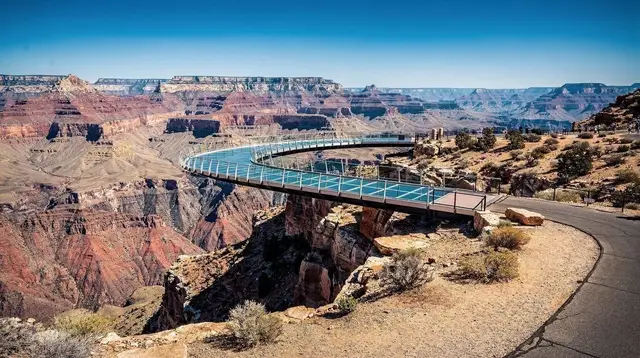
Grand Canyon West, home of the glass Skywalk, is not part of Grand Canyon National Park. It sits on land belonging to the Hualapai Tribe, roughly 130 miles from Las Vegas — a genuinely different destination, a different managing authority, and a different ticket system entirely from the actual National Park Service-run South Rim, which is another 150 miles further east.
The America the Beautiful Pass has no effect there whatsoever; admission is a tribal entry fee charged directly by the Hualapai Tribe, with the Skywalk itself sold as an add-on. If your plan is “flash the federal pass and walk in,” you will be turned back at the gate. For a full breakdown of how different these two “Grand Canyons” really are, see our Grand Canyon West vs. South Rim comparison.
Antelope Canyon works the same way. Both Upper and Lower Antelope Canyon sit on Navajo Nation land near Page, Arizona, and can only be visited on a guided tour booked through a licensed Navajo operator, on a tribal permit — there is no walk-up or independent access at any price, federal pass or not. Monument Valley is the same story: Navajo Nation land, its own tribal park fee, no federal pass acceptance. If Page and the Grand Circle are on your route, our Antelope Canyon booking and Navajo permit guide explains how those bookings actually work, since permit slots sell out well ahead of summer dates.
The pattern to remember: the America the Beautiful Pass only ever applies to federal land. Hualapai and Navajo Nation attractions are sovereign tribal lands with their own fee structures, and no federal pass, membership, or annual card crosses that line.
| Site | Managed by | Covered by America the Beautiful Pass? |
|---|---|---|
| Zion National Park | National Park Service (federal) | Yes |
| Grand Canyon South Rim | National Park Service (federal) | Yes |
| Bryce Canyon National Park | National Park Service (federal) | Yes |
| Death Valley National Park | National Park Service (federal) | Yes |
| Grand Canyon West / Skywalk | Hualapai Tribe | No |
| Antelope Canyon (Upper & Lower) | Navajo Nation | No |
| Monument Valley | Navajo Nation | No |
| Horseshoe Bend | Bureau of Land Management (federal, but generally a separate parking/entry fee, not a standard park entrance fee) | Check current signage on arrival |
What the pass includes — and what it still doesn’t buy you
Even where it is valid, the America the Beautiful Pass has a specific, limited scope. It’s worth being precise about this so nobody plans a trip assuming benefits it doesn’t offer.
What it covers:
- The standard per-vehicle entrance fee at national parks and other federal fee sites, for the pass holder and everyone riding in that one private, non-commercial vehicle.
- Up to two motorcycles per pass at motorcycle-fee sites.
- At sites that charge per-person rather than per-vehicle, it covers the pass holder plus three additional adults (children under 16 are already free at NPS sites regardless of the pass).
- 12 months of validity from the month of purchase — not a calendar year. A pass bought in September 2026 remains valid through September 2027, which matters if you’re weighing whether to buy it for one trip or plan a return visit within the year.
What it does not cover:
- Camping fees, backcountry permits, or any timed-entry reservation fee. Zion and several other parks run separate timed-entry or shuttle reservation systems during peak season that exist independently of the entrance fee.
- In-park shuttle fares where a park charges separately for a shuttle system.
- Any commercial guided tour, activity, or transportation — the pass gets your vehicle through the gate, nothing more.
A guided small-group tour like a Zion and Bryce Canyon trip from Las Vegas is priced and booked completely separately from park entrance, and most reputable operators already build the entrance fee into the tour price if you’re not driving yourself.
- Priority or expedited entry. The pass does not create a faster lane at any gate; it simply replaces the fee once you reach the booth.
- Grand Canyon West, Antelope Canyon, Monument Valley, or any other tribal-land attraction, as covered above.
Digital pass vs. physical pass
Recreation.gov now issues the America the Beautiful Pass in two forms, and for a Las Vegas-based road trip the choice is mostly about timing:
| Format | How you get it | Best for |
|---|---|---|
| Digital pass | Delivered instantly through the Recreation.gov app or website after purchase | Buying the week of (or the morning of) a trip, or as a backup if a physical card is lost |
| Physical card | Mailed to your address, or purchased in person at a park entrance station or federal recreation site | Buying well ahead of travel, or picking one up locally if you’re already near a park |
If you’re organizing a trip from outside the U.S. and won’t have a U.S. mailing address in time, the digital option removes the shipping-time risk entirely — buy it a day or two before you leave and it’s ready on your phone at the gate.
Should you buy the pass, or just pay per-park?
Run the numbers against your actual itinerary before deciding. A first-time Grand Circle trip that touches Zion, the Grand Canyon South Rim, and Bryce Canyon in one loop is visiting three separate $30-35 fee sites — at that point the $80 pass is already cheaper than paying individually, before you’ve even accounted for a possible return trip within the same 12 months. A visitor doing a single park — say, only Death Valley on a half-day out of Las Vegas — is generally better off paying the one-time entrance fee and skipping the pass.
Where people get burned isn’t the math on the parks themselves — it’s assuming the pass extends to Grand Canyon West or Antelope Canyon and discovering otherwise at the gate, sometimes after driving hours to get there. If your itinerary is built primarily around those two tribal-land attractions rather than the National Park Service sites, the America the Beautiful Pass may not be worth buying at all, since none of your major stops will actually accept it.
For travelers doing a guided tour rather than self-driving, this calculation often disappears entirely — a guided outing such as a small-group day trip to Zion and Bryce Canyon from Las Vegas or a guided hiking tour inside Bryce Canyon typically bundles park entrance into the tour price, so there’s nothing extra to buy.
The pass mainly matters if you or your group are renting a car and driving yourselves through the gates, whether that’s a scenic loop like an off-road tour with a picnic at the rim, a horseback ride through the Dixie National Forest near Bryce Canyon, or simply a self-guided sightseeing drive between parks.
A practical checklist before you buy
- Confirm the current price on Recreation.gov before purchasing — it changed at the start of 2026 and federal fee schedules can be revised again.
- Count the federal parks on your actual route: Zion, Grand Canyon South Rim, Bryce Canyon, and Death Valley are the ones that matter from a Las Vegas base. Two or more visits generally clears the $80 break-even for residents.
- Budget separately for Grand Canyon West, Antelope Canyon, and Monument Valley — none of them accept the pass, and each has its own tribal entry fee and, for Antelope Canyon and Monument Valley, a mandatory guided tour booking.
- Check whether any park on your route requires a separate timed-entry reservation on top of the entrance fee — this is increasingly common during peak season and is not solved by the pass.
- Decide digital vs. physical based on how far out you’re buying — digital removes any shipping delay risk.
- Remember the pass runs 12 months from purchase, not the calendar year, so time the purchase around your actual travel window rather than assuming it resets each January.
For a wider look at how to sequence multiple parks, tribal-land stops, and drive times into one trip without over-scheduling a single day, our three-day Zion and Bryce Canyon loop itinerary and the broader passes and tickets category walk through how the entrance-fee side of a Grand Circle trip fits alongside guided tours and tribal-land permits.
Frequently asked questions about the America the Beautiful Pass from Las Vegas
How much does the America the Beautiful Pass cost in 2026?
As of January 1, 2026, the pass costs $80 for U.S. residents and $250 for non-U.S. residents, available as a physical card or a digital pass through Recreation.gov. Always confirm the current price before buying, since it changed at the start of 2026 and can change again.
Is the America the Beautiful Pass valid for a calendar year?
No. It is valid for 12 months from the month of purchase, not the calendar year, so a pass bought in September 2026 is good through September 2027.
Does the pass cover Grand Canyon West and the Skywalk?
No. Grand Canyon West is on Hualapai tribal land, not inside Grand Canyon National Park, and it charges its own separate admission that the pass does not touch.
Does the pass cover Antelope Canyon or Monument Valley?
No. Both sit on Navajo Nation land and require their own paid, guide-led tickets. The America the Beautiful Pass only applies to federally managed National Park Service and other federal agency sites.
How many vehicles or people does one pass cover?
One pass covers the pass holder and everyone in a single private, non-commercial vehicle at per-vehicle fee sites, and it now covers up to two motorcycles per pass at motorcycle-fee sites. At per-person fee sites it covers the pass holder plus three additional adults.
How many parks do I need to visit for the pass to pay for itself?
With individual per-vehicle entry fees commonly running $30-35 at parks like Zion, Grand Canyon and Bryce Canyon, two to three park visits within the 12-month validity window typically covers the $80 resident price.
Can I buy the America the Beautiful Pass in Las Vegas?
You can buy it online in advance through Recreation.gov as a physical or digital pass, or in person at a park entrance station once you arrive — buying ahead avoids any risk of a delay or gate line eating into a day-trip schedule.
Does the pass give faster entry or free shuttle access inside the parks?
No. It only replaces the entrance fee. It does not include priority lanes, timed-entry reservations (several parks require these separately), in-park shuttle fares where charged, or camping and backcountry permit fees.
Passes and Tickets
Verified deep-linked GetYourGuide tours. Book through these links and we earn a small commission at no cost to you.
GetYourGuide does not provide a product photo for this activity — the image shows the meeting point, photographed by us.