Kanab Slot Canyons: Peek-a-Boo, Red Canyon and Beyond
Are the slot canyons near Kanab a substitute for Antelope Canyon?
Not exactly. Kanab's Peek-a-Boo Canyon, Red Canyon and Kanab Canyon sit on open BLM land, so most are free or low-cost and need no Navajo guide, unlike Antelope Canyon near Page. But they're less polished, often require a 4x4 on sandy tracks, and carry the same flash-flood risk with far less on-site infrastructure.
A quieter alternative to Antelope Canyon, with a different set of trade-offs
Most Las Vegas visitors who want to see a slot canyon head straight to Antelope Canyon and Page, and for good reason — it’s the most photographed slot canyon on earth. But roughly an hour west of Page sits Kanab, a small Utah town that works as a base for a very different kind of slot canyon experience: open, largely free, and far less crowded, but also less predictable and less accessible without the right vehicle or local knowledge.
Kanab sits at the crossroads of several major landscapes — it’s a natural stop between Las Vegas, Zion National Park, and Bryce Canyon, and a genuine alternative base for canyon country exploration. But its real draw for this guide is what lies just south and east of town on Bureau of Land Management (BLM) land: Peek-a-Boo Canyon, Red Canyon, and Kanab Canyon itself, plus access points toward the wider Vermilion Cliffs and Grand Staircase-Escalante BLM lands.
The core distinction to understand before you plan anything: Antelope Canyon is Navajo Nation tribal land, and every visitor must book a paid tour with a licensed Navajo guide — there is no independent or walk-up access, full stop. Kanab’s BLM slot canyons are open public land, and for most of them, no guide is legally required and access is free or nearly free. That’s the appeal. It’s also exactly why they demand more self-sufficiency, better vehicle preparation, and a much more serious respect for flash-flood risk than a guided Antelope Canyon tour, where a licensed guide is monitoring conditions for you.
Getting to Kanab from Las Vegas
Kanab sits roughly 260 miles (about 420 km) from Las Vegas, and the drive takes around 4 hours 15 minutes under normal conditions. The standard route runs north on I-15 into Utah, then east on US-89 toward Kanab — a straightforward desert and canyon-country drive, but a long one, especially if you’re also planning a hike the same day.
A critical detail that trips up first-time visitors: Utah runs on Mountain Time year-round, one hour ahead of Nevada’s Pacific Time. Leave Las Vegas at what feels like a comfortable mid-morning hour and you can arrive in Kanab an hour later on the clock than you expected — which matters if you’ve booked a guided tour slot or want to beat afternoon heat on an exposed hike. For the full regional picture on how this compounds around Page and the Navajo Nation, see our Nevada-Utah-Arizona time zone guide.
Because of the distance, a single-day round trip from Las Vegas to Kanab’s slot canyons is long — realistically 9-10+ hours door to door once you add hiking time, making it more of a full day commitment than a casual excursion. Many visitors instead combine Kanab with a Zion or Grand Circle multi-day itinerary, overnighting in or near Kanab rather than driving back to Las Vegas the same day.
The three main slot canyon areas around Kanab
Peek-a-Boo Canyon
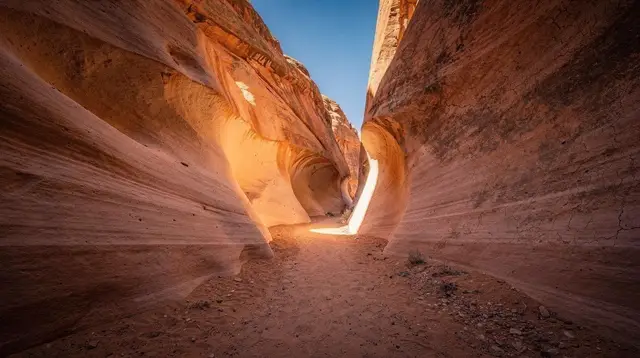
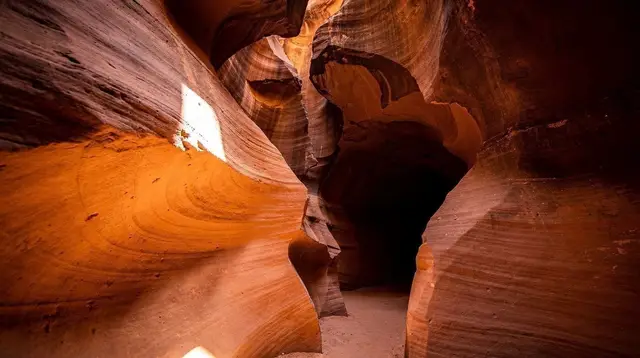
Peek-a-Boo Canyon is the best-known of Kanab’s BLM slot canyons, and the one most often compared to Antelope Canyon for its narrow, sculpted sandstone walls. It sits south of Kanab off a network of sandy BLM roads, and while the canyon itself is free and open to independent hikers, the approach is the real obstacle: several miles of soft sand that regularly strands standard rental cars and even some two-wheel-drive SUVs.
This is where a guided option earns its cost. A guided Peek-a-Boo Canyon tour handles the sandy approach roads, timing around weather, and route-finding inside the canyon — useful even though no permit is legally required, simply because the navigation and driving are the hard part, not the hiking. For those who want to drive themselves, a self-driven UTV tour to Peek-a-Boo Canyon rents you the vehicle capable of the sand approach while still including guidance on the route.
For visitors who’d rather not drive at all, a guided tour into Peek-a-Boo Slot Canyon from Kanab covers transport, the sandy approach, and the hike itself as one package.
The Great Chamber and Red Canyon
Near Peek-a-Boo, the Great Chamber is a wider, cathedral-like sandstone chamber that pairs well with a slot canyon hike on the same outing — many tours combine both in a single half-day trip. A combined Peek-a-Boo Canyon and Great Chamber guided hike covers both features with a local guide handling logistics, or for those focused specifically on the chamber, a guided hike to the Great Chamber alone.
Red Canyon, a separate BLM area near Kanab known for its vivid red-rock formations (also home to a well-known off-road recreation area), offers another access point into this same BLM slot canyon network. Like Peek-a-Boo, it sits on open public land — no Navajo-style guide requirement — but the sandy, sometimes rutted tracks reward a high-clearance 4x4 far more than a standard car.
For those wanting maximum control over pace and route while still avoiding the risk of getting stuck, a guided 4WD tour to the Great Chamber with a hike included covers the vehicle and the walking portion together.
Kanab Canyon and beyond
Kanab Canyon itself runs close to town and offers a gentler, more accessible slot canyon experience without the deep-sand approach roads of Peek-a-Boo or Red Canyon — a reasonable option if your vehicle is a standard rental sedan and you’d rather not risk the sandier tracks. It won’t deliver quite the same dramatic narrow-slot photography, but it’s a genuinely free, low-effort way to see what a BLM slot canyon looks like.
Further afield, the Kanab area also serves as a gateway toward White Pocket, a striking sandstone formation on Vermilion Cliffs BLM land that, like the slot canyons here, sits on open public land but demands serious 4x4 capability and local knowledge to reach safely. A guided tour and hike to White Pocket from Kanab is the practical way to see it without a dedicated overlanding vehicle.
Cost comparison: Kanab’s BLM canyons vs. Antelope Canyon
The financial contrast between these two slot canyon experiences is the single most useful thing to understand before booking anything.
| Kanab area (BLM land) | Antelope Canyon (Page, Navajo Nation) | |
|---|---|---|
| Land ownership | Bureau of Land Management, public | Navajo Nation, tribal |
| Guide requirement | Not legally required for most areas | Mandatory for every visitor |
| Typical cost | Free to a few dollars (day-use/camping fees) | Guided tour fee required, no free option |
| Booking lead time | None needed for independent access | Weeks to months in peak season |
| Vehicle needs | 4x4 strongly recommended for most trailheads | Guide provides transport within the canyon |
| Crowd levels | Low to moderate | High, especially midday |
| Photography conditions | Variable, less curated | Famous light-beam effect, especially midday summer |
Neither option is objectively “better” — they trade off differently. Antelope Canyon guarantees a polished, guide-led experience with the famous light shafts, at a real cost and with real crowds and booking pressure. Kanab’s BLM canyons trade that polish and guaranteed light-beam photography for a cheaper, quieter, more self-directed experience that asks more of your vehicle and your own judgment.
Flash-flood risk: the same danger, less infrastructure
Every slot canyon in this region — Kanab’s included — carries genuine flash-flood risk, and it deserves the same seriousness here as it does at Antelope Canyon. A slot canyon acts as a funnel for runoff across a wide desert watershed. A thunderstorm dropping rain dozens of miles away, with clear blue sky directly overhead where you’re standing, can send a fast-moving wall of water and debris through a narrow canyon with almost no warning.
At Antelope Canyon, a licensed Navajo guide is actively watching weather conditions upstream and will pull a group out or cancel a tour if risk rises. At Kanab’s BLM canyons, that safety net generally does not exist for independent hikers. There’s no ranger stationed at the trailhead checking forecasts on your behalf. Access to specific canyons is sometimes closed by BLM without advance notice when conditions turn risky, but responsibility for checking conditions before you go rests with you.
Practical rules that apply here without exception:
- Check the weather forecast for the entire regional watershed, not just Kanab or the trailhead itself — storms upstream are the danger, not storms overhead.
- Never enter a narrow slot canyon if any rain is forecast anywhere in the surrounding region that day, even if the sky above you is clear.
- If you notice sudden temperature drops, distant thunder, rising water, or debris in the water, exit the canyon immediately toward higher ground.
- A guided tour shifts this monitoring burden to someone with local, current knowledge — a meaningful safety upgrade for a first-time visitor unfamiliar with reading regional weather risk.
This guide will not promise that any of these canyons are free of flash-flood risk. They are not, and treating a quiet-looking sandstone slot as inherently safer than Antelope Canyon because it’s free and ungoverned by a tribal permit system would be a serious misjudgment.
Rental car vs. 4x4 vs. guided tour: what actually gets you there
The single biggest practical decision for a Kanab slot canyon trip is the vehicle question, and it’s worth being blunt about it.
A standard rental sedan or economy SUV limits you to Kanab Canyon and any trailheads directly accessible from paved roads. It will not safely reach Peek-a-Boo Canyon, Red Canyon’s more remote sections, or White Pocket — the sandy tracks are deep enough to strand a two-wheel-drive vehicle, sometimes requiring a costly tow from a remote location with limited cell service.
A genuine 4x4 with high clearance, rented specifically for the terrain or brought as an overlanding vehicle, opens up Peek-a-Boo Canyon, Red Canyon, and similar trailheads to independent access — provided you’re comfortable with sand driving and have basic recovery gear (a shovel, traction boards, extra water) in case you do get stuck.
A guided tour or self-driven UTV rental removes the vehicle risk entirely. Local operators know current road conditions, current closures, and the specific route through the sand that day — conditions shift after every storm. For most visitors without prior desert 4x4 experience, this is the sensible default rather than an upsell.
Do not assume a “4x4” rating on a standard rental SUV means it will handle these roads confidently — clearance and tire type matter as much as drivetrain, and local outfitters see stranded rental vehicles regularly.
Planning your visit: practical notes
- Cell service is unreliable throughout the BLM lands around Kanab. Download offline maps before you leave town, and tell someone your planned route and return time.
- Water: carry more than feels necessary. There’s no facility at most trailheads, and summer heat in this part of Utah easily reaches the same dangerous range as Las Vegas and Death Valley.
- Footwear: closed-toe shoes that can get sandy or wet — sections of some canyons involve wading or scrambling.
- Combine with Page: since Kanab and Page/Antelope Canyon sit about an hour apart, many multi-day itineraries pair a free BLM canyon hike near Kanab with a booked Antelope Canyon slot the same trip — see our Antelope Canyon booking and permit guide for how far ahead to reserve.
- Season: spring and fall offer the most comfortable hiking temperatures; summer heat is intense, and winter can bring snow or ice on higher-elevation approach roads.
- Pair it with Zion or Bryce: Kanab’s location makes it a natural stopover on a Zion and Bryce Canyon loop rather than a standalone destination from Las Vegas.
Kanab’s slot canyons reward visitors who come prepared for open, ungoverned desert terrain rather than expecting a curated attraction. Get the vehicle and the weather judgment right, and you’ll see sandstone scenery that rivals Antelope Canyon’s, without the crowds or the guide fee — but only if you take the flash-flood risk and the sandy approach roads exactly as seriously as this guide has described them.
Kanab Slot Canyons
Verified deep-linked GetYourGuide tours. Book through these links and we earn a small commission at no cost to you.
GetYourGuide does not provide a product photo for this activity — the image shows the meeting point, photographed by us.