Upper Antelope Canyon: The Complete Guide
Can you visit Upper Antelope Canyon without a guide?
No. Upper Antelope Canyon sits entirely on Navajo Nation land and can only be entered with a licensed Navajo guide on a timed, pre-booked slot. There is no walk-up or self-guided access, and in high season (March-October) popular slots sell out weeks ahead.
Why Upper Antelope Canyon is not a drop-in stop
Upper Antelope Canyon — known locally as “The Crack” — is one of the most photographed places in the American Southwest, and also one of the most misunderstood in terms of logistics. It sits entirely within the Navajo Nation, on land the Navajo people control and manage directly. There is no public entrance, no ticket booth you can walk up to, and no way to see the canyon on your own terms. Every visitor enters as part of a small guided group, on a specific time slot booked in advance, led by a licensed Navajo guide who also serves as photographer, safety monitor, and gatekeeper against the flash flooding that can turn this narrow sandstone corridor lethal in minutes.
That single fact — guided-only, timed-slot-only — shapes everything else about planning a visit, from how early to book to how the schedule interacts with the confusing Arizona/Navajo Nation time difference. This guide covers the access model, realistic costs, the light-beam season that drives most of the demand, how Upper compares with its sibling canyon Lower Antelope, and the honest math on driving here from Las Vegas.
Where Antelope Canyon actually is
Antelope Canyon sits just outside Page, Arizona, on the eastern side of Lake Powell country, close to the Utah border. It is part of the wider Grand Circle region that also includes Horseshoe Bend, Lake Powell, and Monument Valley. From Las Vegas the standard route runs north on US-93 through Hoover Dam country, then east via I-40 and US-89 into Page — about 440 km (275 miles) and a realistic 4.5 hours of driving, before any stops.
That is longer than the drive to Zion or the Grand Canyon South Rim, and it is not a trip to underestimate: see distances and drive times from Las Vegas for how it stacks up against other day-trip options, and consider whether a 3-day Grand Circle itinerary suits your schedule better than a single brutal round trip.
Guided-only access: what it means in practice
Because the canyon is Navajo tribal land, every visitor books through a Navajo-operated tour company, not the National Park Service (Antelope Canyon is not a national park at all, despite frequently being lumped in with nearby NPS sites). Guides walk small groups through the canyon on a fixed schedule, and rangers at the canyon entrance check that every group matches a booked slot before entry. There is no waiting around for a same-day opening, no discount for showing up without a reservation, and no way to linger past your allotted window if the next group is due in.
For the mechanics of booking — which operators run which slots, how far ahead to book, and what a Navajo permit fee actually covers — see the dedicated Antelope Canyon booking and Navajo permit guide. The short version: in high season, popular midday slots can sell out three to six weeks in advance, and last-minute travelers are often limited to early-morning or late-afternoon tours with no light beam.
a guided Upper Antelope Canyon tour with a certified Navajo operator is the standard way to lock in a slot before it sells out, particularly for a March-October visit.
The light beam: what it is and when it happens
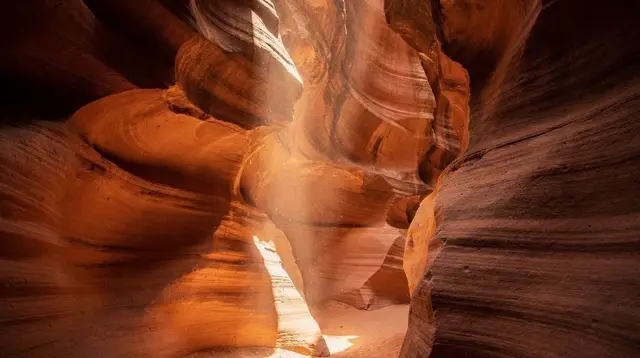
The image most people associate with Antelope Canyon — a solid shaft of sunlight cutting down through the rock to the canyon floor — is a real phenomenon, but a seasonal and time-of-day dependent one. It requires the sun to be high enough in the sky to reach through a narrow opening in the canyon roof, which in practice means roughly mid-March through early September, and mainly within an hour or two of solar noon. Outside that window the canyon is still strikingly beautiful, with its sculpted orange and red sandstone walls, but there is no beam.
Tour operators know this and price accordingly: midday slots during light-beam season are the most requested and typically the most expensive, while early-morning and late-afternoon slots, and any visit outside mid-March to early September, are cheaper but beam-free. No operator can guarantee a beam even in the right season and time slot — cloud cover, seasonal sun angle drift, and dust levels in the air all affect how visible it is on any given day. Treat “we’ll get the beam” as a possibility to plan around, not a promise anyone can honestly make.
What it actually costs
Standard Upper Antelope Canyon tours run roughly $90-140 per adult as of 2026, depending on the operator and the time slot booked. That price usually bundles the Navajo Nation permit fee into one ticket, so there is rarely a separate charge to track. Light-beam-season midday slots sit at the upper end of that range; shoulder-season and off-peak-hour slots are cheaper. Children’s pricing and photography-tour upgrades (extended time, tripod permits) vary by operator and are worth checking before booking rather than assuming they match the standard adult rate.
| Slot type | Season | Approx. price/adult | Light beam likely? |
|---|---|---|---|
| Midday | Mid-March to early September | ~$120-140+ | Yes, weather permitting |
| Early morning / late afternoon | Mid-March to early September | ~$90-110 | No |
| Any daytime slot | Late September to mid-March | ~$90-110 | No |
How long you’re actually inside
The guided walk through Upper Antelope Canyon itself typically lasts about 1 to 1.5 hours. The terrain is flat, sandy, and easy underfoot — no ladders, no scrambling — which makes it accessible to most visitors regardless of fitness level, and it’s part of why Upper is generally recommended over Lower for anyone with mobility concerns, young kids, or a fear of tight, physical spaces. Budget extra time beyond the walk itself for check-in at the tour office, a short shuttle ride out to the canyon entrance (standard vehicles cannot drive the access road), and waiting if your group is called slightly behind schedule — plan on roughly 2 to 2.5 hours total from arrival to departure.
Upper vs. Lower Antelope Canyon
These are two separate canyons, sold as two separate tickets, sitting across the road from each other, and it’s a common mix-up to book one thinking it’s the other.
| Upper Antelope Canyon | Lower Antelope Canyon | |
|---|---|---|
| Terrain | Flat sand, no ladders | Narrow, several steep metal ladders |
| Physical demand | Easy | Moderate to strenuous |
| Typical duration | 1-1.5 hours | 1-1.5 hours |
| Light beam | Yes, mid-March to early September, midday | Minimal to none |
| Best for | Photography, accessibility, families | Adventure, tighter crowds, fewer people at once |
a combined Upper and Lower Antelope Canyons tour covers both in one booking for travelers who want to compare them directly rather than pick just one — though note it means two separate guided segments, not a single continuous walk.
The Navajo Nation daylight saving trap
This catches even well-prepared travelers. Arizona as a state does not observe daylight saving time — it stays on Mountain Standard Time year-round. But the Navajo Nation, whose land includes Page’s surroundings, Antelope Canyon, and Monument Valley, does observe daylight saving time, to stay synchronized with neighboring Utah and New Mexico. For roughly eight months of the year (spring through fall), this means Page and the canyon can be on a different clock than the rest of non-Navajo Arizona a short drive away.
Coming from Las Vegas, which runs on Pacific Time and does observe daylight saving time, the practical effect shifts across the year — sometimes a one-hour gap to Page, sometimes effectively two hours of confusion if you’re also comparing to non-Navajo Arizona along the way. The only safe approach: confirm your tour slot’s time explicitly against Navajo Nation local time when you book, and again the day before, rather than assuming it matches your phone’s default time zone as you cross state lines.
Booking a slot near Horseshoe Bend
Because Horseshoe Bend requires no guide or permit and sits only a few minutes from Page, it pairs naturally with an Antelope Canyon booking — most travelers doing the long drive from Las Vegas prefer to see both rather than make the trip twice. an Upper Antelope Canyon ticket and guided tour booked for morning or early afternoon leaves time to walk out to the Horseshoe Bend overlook afterward, on your own schedule, before the drive back.
For details on the overlook itself, the parking situation, and the short walk involved, see the Antelope Canyon and Horseshoe Bend combo tour guide and the standalone entry for Horseshoe Bend.
Realistic day-trip math from Las Vegas
At roughly 4.5 hours each way, a same-day round trip from Las Vegas to Antelope Canyon means close to 9 hours of driving alone, before any time inside the canyon, at Horseshoe Bend, or stopped for food and fuel. Combined with a fixed, non-negotiable tour slot time, this is one of the least forgiving day trips in the region — arriving even 15 minutes late for a booked slot can mean losing the tour entirely, since the next group is already queued.
Because of this, most experienced visitors treat Antelope Canyon and Page as an overnight stop rather than a single grueling day, either as a standalone trip or folded into a longer loop through Zion, Bryce Canyon, and Monument Valley.
See the 4-day Grand Circle: Page, Antelope, Horseshoe Bend itinerary or the fuller 7-day complete Grand Circle itinerary for how to structure that without the single-day drive fatigue. If a full multi-day trip isn’t feasible, compare the trade-offs of a guided tour versus a rental car for day trips — an organized tour bus handles some of the driving fatigue but locks you to its own schedule on top of the canyon’s own timed slot.
Getting from Las Vegas: the route
The most direct route from Las Vegas to Page runs north on US-93 past Hoover Dam and through the edge of Lake Mead country, then connects to I-40 eastbound before turning north on US-89 into Page. It is almost entirely paved highway driving, unlike the partly unpaved approach to Grand Canyon West, but it is a long, largely rural stretch — fuel up in Kingman or Flagstaff-area stops rather than assuming frequent services along the way.
Desert driving conditions apply for the whole route: see desert driving safety tips for Nevada and Arizona before setting out, especially in summer when both the car and the driver need more margin than a shorter city commute would suggest.
What not to expect
A few expectations are worth correcting before you book. There is no walk-up or unguided access to Upper Antelope Canyon under any circumstances — arriving without a reservation means being turned away, not being sold a same-day ticket. No operator can guarantee a visible light beam even in a midday, high-season slot; weather and dust conditions genuinely vary. And the Las Vegas–Page round trip cannot realistically be compressed under roughly 9 hours of total driving — treat any itinerary that promises otherwise with skepticism.
Upper Antelope Canyon: frequently asked questions
How far is Upper Antelope Canyon from Las Vegas?
About 440 km (275 miles) and roughly 4.5 hours of driving one-way, typically via US-93 north to I-40/US-89 into Page, Arizona. It is a long day trip by car, or better planned as an overnight.
Do I need to book Upper Antelope Canyon in advance?
Yes, and well in advance. Tours run on fixed, timed slots controlled by Navajo operators, and slots for the light-beam season (roughly mid-March to early September, around midday) commonly sell out several weeks ahead.
What is the light beam and when can I see it?
The light beam is a shaft of sunlight that drops through a narrow opening in the canyon roof when the sun is high enough overhead, roughly mid-March through early September, mainly around midday. It is not visible outside that window, and even inside it conditions (cloud, dust in the air, exact slot time) vary day to day.
How much does an Upper Antelope Canyon tour cost?
Standard tours run roughly $90-140 per adult depending on operator and time slot, usually including the Navajo Nation permit fee. Midday light-beam-season slots are priced at the higher end of that range.
How long does the tour actually last?
The guided walk inside the canyon itself runs about 1 to 1.5 hours, on flat, accessible sand. Add time for check-in, shuttle transport to the canyon entrance, and waiting for your slot.
Is Upper Antelope Canyon the same as Lower Antelope Canyon?
No. They are two separate slot canyons across the road from each other, sold as separate tickets by different (though sometimes affiliated) Navajo operators. Upper is flat and wide; Lower is narrower, involves ladders, and is more physically demanding.
Can I combine Upper Antelope Canyon with Horseshoe Bend?
Yes, several operators sell combined tours, and it is a logical pairing since Horseshoe Bend is a short drive from Page and does not require a guide. It is worth booking as a combo if you are already making the long drive from Las Vegas.
Why does the time on my ticket look wrong?
The Navajo Nation observes daylight saving time even though the rest of Arizona does not. For part of the year Page and the surrounding Navajo land run on a different clock than nearby non-Navajo Arizona, so always confirm the slot time against Navajo Nation local time, not a generic Arizona assumption.
Antelope Canyon and Page Day Trips
Verified deep-linked GetYourGuide tours. Book through these links and we earn a small commission at no cost to you.
GetYourGuide does not provide a product photo for this activity — the image shows the meeting point, photographed by us.