Grand Canyon West Day Trip from Las Vegas
Can you do Grand Canyon West as a day trip from Las Vegas?
Yes. It's about 195 km (120 miles) and roughly 2h15 each way, including a stretch of unpaved road on Diamond Bar Road. A realistic day runs from a pre-7am departure to a 7-8pm return, with 4-5 hours at Eagle Point and Guano Point in between.
What a full day at Grand Canyon West actually looks like
Grand Canyon West sits on Hualapai tribal land, not inside the National Park Service’s Grand Canyon, and that single fact shapes almost everything about how the day works — the ticket, the pass rules, and the type of experience waiting at the end of the drive. It’s close enough to Las Vegas to do in a day, but it’s not a quick hop: budget the entire day, not a half-day, and set expectations before you book anything.
This guide walks through the drive, the unpaved stretch nobody mentions until it’s too late, a realistic hour-by-hour schedule, what things cost in 2026, and the honest trade-off between renting a car and booking an organized tour. For the different, much longer trip to the actual National Park boundary, see Grand Canyon West vs. South Rim — the two are not interchangeable and shouldn’t be planned as a single flexible option.
The drive: distance, route, and the part rental companies don’t love
From the Strip or Downtown, Grand Canyon West is roughly 195 km (120 miles) away, and the drive itself takes about 2 hours 15 minutes under normal traffic. Most of that route runs on well-maintained highway through open desert — US-93 south toward Kingman, then a turn north on local roads toward Pierce Ferry Road and Diamond Bar Road.
The detail worth knowing before you rent a car: the final several miles into Grand Canyon West on Diamond Bar Road are unpaved, washboarded gravel, not smooth pavement. It’s passable in a normal sedan at reduced speed, but some rental agencies explicitly discourage or void coverage for economy-class vehicles driven on unpaved roads — read your rental contract’s fine print, not just the price. If you’re driving a low-clearance economy car and unsure, it’s worth calling the rental desk directly to confirm what’s covered before you leave the Strip.
Round trip, that’s over 4.5 hours of driving alone — refuse to believe any itinerary promising a round-trip drive under 4 hours total; the road doesn’t allow it. Add the on-site time below and a full-day departure window becomes non-negotiable.
A realistic hour-by-hour schedule
| Time | Activity |
|---|---|
| Before 7:00am | Depart Las Vegas (earlier in summer to beat heat and crowds) |
| ~7:00-9:15am | Drive to Grand Canyon West (~2h15, incl. Diamond Bar Road) |
| ~9:15am | Arrive, park, pick up shuttle pass |
| 9:30am-1:30pm | Eagle Point and Guano Point via shuttle (4-5 hours total) |
| ~1:30pm | Depart Grand Canyon West |
| ~1:30-3:45pm | Drive back toward Las Vegas |
| ~7:00-8:00pm | Arrive back in Las Vegas (with stops for lunch, fuel, photos) |
That 7am departure isn’t arbitrary — leaving earlier avoids peak summer heat on the unpaved stretch, gets you ahead of tour bus crowds at Eagle Point, and builds in slack for the inevitable stop for gas or a photo of the open desert along Red Rock Canyon country as you leave the valley. If you depart later than 8am, expect a return closer to 8-9pm rather than 7pm.
Eagle Point and Guano Point: what fills the 4-5 hours
Once you’re on site, movement between the two main viewpoints happens by mandatory shuttle bus included in general admission — you cannot drive your own car between them. Budget the time roughly like this:
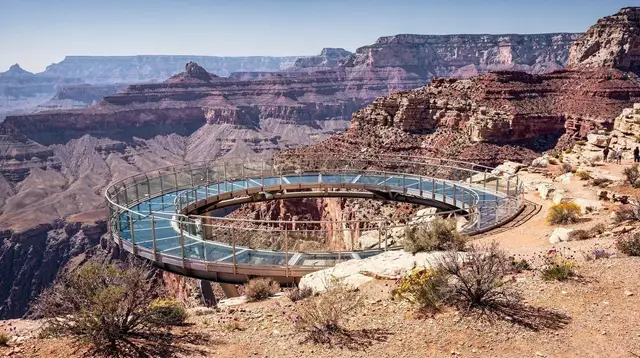
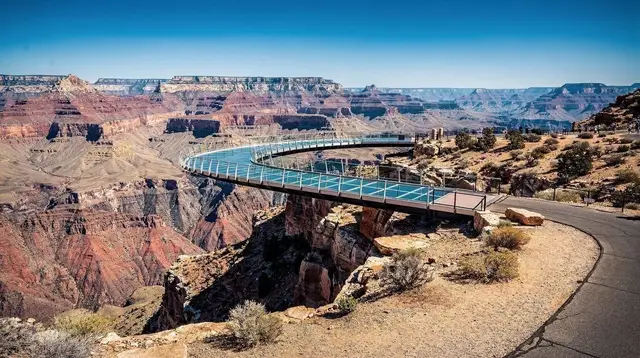
- Eagle Point: home to the glass Skywalk (a paid add-on, not included in base admission), a small Hualapai cultural village with dance performances, and several overlooks. Most visitors spend 1.5-2 hours here.
- Guano Point: a short walk up to a dramatic overlook with a 360-degree view of the canyon and the Colorado River far below, plus a simple grill serving lunch. Most visitors spend 1-1.5 hours here.
- Hualapai Ranch: a third stop some shuttle routes include, with a Western-town feel and (as a separate paid add-on) horseback or wagon rides.
- Shuttle transit time: 30-45 minutes total moving between stops, since the shuttle is the only way to cover the ground.
Refuse any plan that promises included access down to the Colorado River itself — reaching the river requires a further paid add-on (typically a shuttle down to Hualapai Ranch’s boat launch, or a helicopter descent), and it’s not guaranteed to run every day. The standard day-trip experience stays on the rim.
Budget: what a 2026 day trip actually costs
| Item | Typical 2026 cost |
|---|---|
| General admission (“All-Access” style ticket) | ~$99-113 per adult |
| Skywalk add-on | Separate ticket, purchased on site |
| Lunch at Guano Point grill | ~$15-20 per person |
| Fuel/tolls (self-drive, round trip) | Minor — a tank of gas, no significant tolls |
| Rental car (if not already rented for the trip) | ~$50-100+/day before insurance |
| Organized bus/van tour, all-inclusive | ~$130-200+ per person |
The single most important budget fact: the America the Beautiful pass does not work here. That pass covers National Park Service and other federal fee sites; Grand Canyon West is Hualapai tribal land with its own separate fee structure, and no federal pass waives or discounts it. If you’re also planning a South Rim visit on the same trip, that pass will help there — just not at Grand Canyon West.
When to go: season, heat, and light
Timing this trip by season matters almost as much as timing it by hour. Spring and fall give the most comfortable conditions for both the drive and the walking between Eagle Point and Guano Point — daytime temperatures stay manageable, and the desert light in the early morning or late afternoon is genuinely dramatic along the route. See best time to visit Las Vegas for how this trip fits into the wider seasonal picture for the region.
Summer is still a realistic option, but it changes the math: the pre-7am departure stops being optional, shade is scarce at both viewpoints, and the unpaved stretch of Diamond Bar Road is far less forgiving on a vehicle already working hard in the heat. Carry more water than feels necessary and treat the Las Vegas summer heat guide as required reading before a July or August trip, not optional background.
Winter brings cooler, quieter days and thinner crowds at both viewpoints, though mornings can start cold enough to want a layer, and short daylight hours compress the schedule slightly. Whatever the season, the isolation of the drive is a constant — cell coverage thins out well before the highway turns off toward Pierce Ferry Road, so the general desert driving safety tips for Nevada and Arizona are worth reading once, regardless of when you go.
What to pack for the day
Because so much of this trip happens outdoors, in a car, or walking between shuttle stops, the packing list is short but non-negotiable:
- Water — more than seems necessary, especially between spring and fall. There’s no reliable water source between Las Vegas and the canyon rim itself.
- Sun protection — a hat, sunscreen, and sunglasses; there’s little natural shade at Eagle Point or Guano Point.
- Comfortable, closed-toe shoes for the walking sections at both viewpoints and the shuttle stops between them.
- A light layer for cooler mornings, especially outside summer, when the pre-dawn departure can be noticeably colder than midday.
- An offline map or downloaded directions if self-driving — cell service drops out for stretches of the route well before Diamond Bar Road begins.
None of this requires specialized gear; it’s closer to what you’d pack for a long hike than for a road trip, because a meaningful part of the day is spent on foot in open desert.
Rental car vs. organized tour
A small-group sunset tour to Grand Canyon West is one way to skip the unpaved-road question entirely — someone else does the driving, and you’re free to watch the desert go by instead of the odometer.
Renting a car gives you control over exact timing, the freedom to stop for photos, and privacy for the day — but it also means over 4.5 hours of desert driving crammed around 4-5 hours on site, part of it on gravel, in a single long day. It suits travelers who are comfortable with a long drive and want to set their own pace at Eagle Point and Guano Point.
An organized tour — typically a bus or van package running roughly $130-200+ per person — removes the driving and the unpaved-road question, includes a guide who can explain the Hualapai land and the canyon’s geology, and usually bundles admission into the price. The trade-off is a fixed departure time and a shared schedule with the rest of the group. For travelers who’d rather see the canyon from the air, a helicopter tour with a landing at the canyon floor compresses the whole day into a few hours and swaps the drive for a flight.
For a broader comparison of both approaches across the region, see guided tour vs. rental car for day trips and small-group vs. large bus tour.
Alternative ways to see Grand Canyon West
Not every visitor wants to spend a full day on the road. A few other approaches worth knowing about:
- Helicopter tours: a helicopter tour that lands at the canyon floor turns the trip into a half-day, flying over the same landscape the drive would otherwise cross at ground level.
- Combination tours: some operators pair Grand Canyon West with river time, such as a combined whitewater rafting, helicopter, and Skywalk itinerary, which packs several experiences most self-drive visitors would need separate add-ons for into one booking.
- Route 66 add-ons: travelers who want a taste of the historic highway alongside the canyon can look at a tour following Historic Route 66 down toward the canyon floor, a different framing of the same general area.
- All-in-one packages: for travelers who’d rather book once and skip separate add-on decisions, a 5-in-1 tour bundling transport, admission, and a rim lunch covers most of what a self-drive visitor would otherwise assemble piece by piece.
- Afternoon-only entry: travelers already self-driving who just need the ticket itself can look at afternoon entry admission with the Skywalk included, useful for a later start than the 7am schedule above assumes.
Don’t confuse this with the South Rim
It’s worth repeating plainly: Grand Canyon West and the Grand Canyon South Rim are structurally different trips, not two versions of the same one. West is roughly 2h15 away, sits on Hualapai land, and revolves around the Skywalk, Eagle Point, and Guano Point.
The South Rim is the actual National Park Service site, about 4.5 hours from Las Vegas each way, with a scale of trails, viewpoints, and services that makes it a poor fit for a single day trip from Las Vegas — most visitors doing the South Rim from Las Vegas either fly, or plan it as an overnight via Flagstaff & Williams rather than a there-and-back day.
If your priority is standing on the Skywalk, this Grand Canyon West itinerary is the one to follow — note that Grand Canyon West sits on Hualapai tribal land, outside the National Park boundary, with its own entrance fee; if it’s the full National Park experience, start instead with the Grand Canyon South Rim day trip guide and its very different time math.
For travelers weighing whether a day trip anywhere in the region fits their schedule at all, best day trips from Las Vegas by drive time lines this trip up against shorter options like Hoover Dam and Valley of Fire.
Frequently asked questions about the Grand Canyon West day trip
How far is Grand Canyon West from Las Vegas?
About 195 km (120 miles) one-way, roughly 2h15 of driving in normal traffic. That’s roughly 4.5 hours of driving alone for the round trip, before any time on site.
Is the road to Grand Canyon West paved the whole way?
No. Most of the route is paved, but the final stretch on Diamond Bar Road includes several miles of unpaved, washboarded surface. Some rental car agreements restrict or discourage driving economy vehicles on unpaved roads, so check your contract before you go.
Does the America the Beautiful pass work at Grand Canyon West?
No. Grand Canyon West sits on Hualapai tribal land, not inside Grand Canyon National Park, so it isn’t covered by the National Park Service’s America the Beautiful pass or any NPS fee waiver.
Is the Skywalk included in the general admission ticket?
No. The base All-Access-style ticket covers entry, the shuttle between viewpoints, and Eagle Point/Guano Point access; walking out onto the glass Skywalk itself is a separate add-on ticket, usually purchased on site.
Can you drive down to the Colorado River at Grand Canyon West?
Not on your own. Reaching the river requires a separate paid add-on — typically a shuttle down to Hualapai Ranch or a boat/pontoon excursion booked on site — it isn’t part of the standard admission and isn’t guaranteed to run every day.
Is this the same trip as visiting the Grand Canyon South Rim?
No, and the two shouldn’t be planned interchangeably. Grand Canyon West is about 2h15 away and sits on Hualapai land; the South Rim is the actual Grand Canyon National Park, about 4.5 hours from Las Vegas, with a completely different scale of visitor infrastructure.
Is it better to drive yourself or book an organized tour?
A rental car gives you flexible timing and privacy but means over 4 hours of desert driving, part of it unpaved. An organized bus or van tour costs more per person but removes the driving, handles the unpaved stretch, and includes a guide — a trade worth weighing against how much you value a fixed schedule.
What’s the best time of year for a Grand Canyon West day trip?
Spring and fall bring the mildest temperatures for the drive and the time spent walking between viewpoints. Summer is doable but demands an earlier departure and more water, since the desert stretch between Las Vegas and the canyon offers little shade. Winter is cooler and generally quieter, though mornings can start cold enough to need a layer.
What should I pack for a Grand Canyon West day trip?
More water than feels necessary, sun protection (hat, sunscreen, sunglasses), comfortable closed-toe shoes for walking between viewpoints, and a light layer for cooler mornings or evenings. If you’re self-driving, add a paper map or downloaded offline map, since cell coverage drops out well before Diamond Bar Road.
Grand Canyon West and South Rim Tours
Verified deep-linked GetYourGuide tours. Book through these links and we earn a small commission at no cost to you.
GetYourGuide does not provide a product photo for this activity — the image shows the meeting point, photographed by us.