Eagle Point and Guano Point: The Two Stops on Your Grand Canyon West Ticket
What is the difference between Eagle Point and Guano Point at Grand Canyon West?
Eagle Point has the glass Skywalk, a reconstructed Hualapai/Native American village, and views of an eagle-shaped rock formation, while Guano Point is a short 10-15 minute walk to a promontory with a 360-degree panoramic view and the ruins of an old guano mine. Both are included on the All-Access ticket, and a free shuttle (the only way to move between them) links the two.
Two Stops, One Shuttle, and No Shortcuts Between Them
Nearly every visitor who buys a ticket to Grand Canyon West ends up moving between the same two overlooks: Eagle Point and Guano Point. They are the two headline stops bundled into the standard All-Access ticket, and they could not feel more different from each other. One is built up, with a glass-floored bridge, a reconstructed village, and gift shops; the other is stripped back to a short walk, weathered rock, and a view that opens up in every direction at once. Understanding what each one actually delivers — and how long getting between them really takes — makes the difference between a rushed half-day and a well-paced visit.
This guide focuses specifically on these two viewpoints inside Grand Canyon West. It does not cover Grand Canyon National Park’s South Rim, which is a different park, a different administration, and a different four-and-a-half-hour drive from Las Vegas — more on that distinction below.
Eagle Point: The Skywalk and the Village
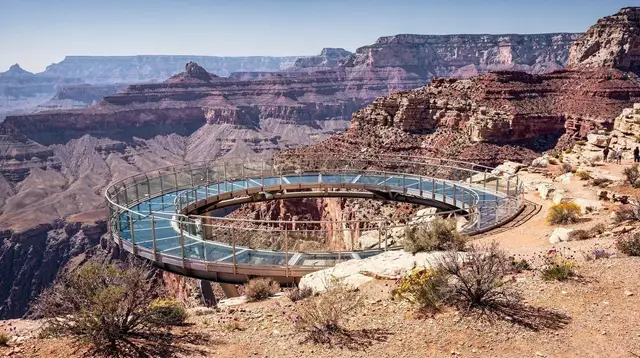
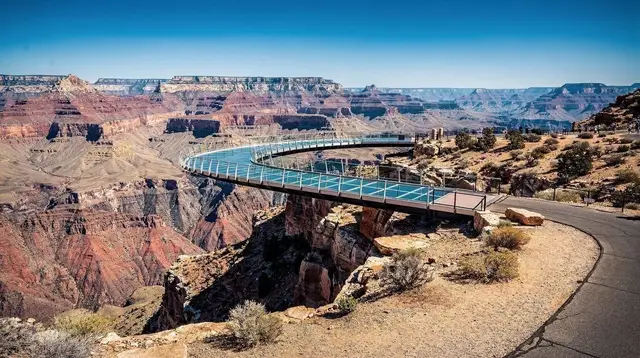
Eagle Point is the stop most people already know by name, even if they have not heard “Eagle Point” itself — it is where the glass-bottomed Skywalk cantilevers out over the canyon rim. The point takes its name from a rock formation across the gorge that, from the right angle, resembles an eagle with its wings spread, a natural landmark rather than anything built.
Around the Skywalk itself, Eagle Point has grown into a small cultural complex. There is a reconstructed Native American village with structures representing several tribal traditions, including Hualapai, Navajo, and other Southwest nations, along with cultural demonstrations and performances that run through the day depending on staffing and season. It is worth treating this area as its own attraction rather than a waiting room for the Skywalk — the walking paths, overlooks, and village exhibits can easily fill an hour on their own before you ever line up for the bridge.
The Skywalk itself requires a separate ticket add-on in most packages (cameras and personal bags are not permitted on the bridge; lockers are provided), and lines can build quickly in the late morning and around midday, when tour buses from Las Vegas tend to arrive in clusters. Walking out onto a transparent surface suspended above the canyon floor is the entire appeal, and it delivers exactly that — a vertigo-inducing, memorable few minutes — but it is a short experience, typically ten to twenty minutes including the walk out and back, not a lingering stop.
Realistic time at Eagle Point: 1.5 to 2 hours, covering the village, the overlook trails, and the Skywalk queue if you add it. Visitors who skip the Skywalk can often do Eagle Point’s other features in a bit less.
Guano Point: The Short Walk With the Big Payoff
Guano Point asks less of you and, according to a large share of visitors, gives back more. From the shuttle drop-off, a short trail of about 10 to 15 minutes each way climbs gently to a rocky promontory. Along the way and at the top, you pass remnants of an old aerial tramway and mining operation once used to extract guano — bat droppings mined decades ago for use as fertilizer — from caves in the canyon walls. The rusted cable towers and tram remains still stand as a quiet, slightly surreal historical footnote in an otherwise wild landscape.
What makes Guano Point stand out is the view at the top: a genuinely 360-degree panorama, with the canyon and the Colorado River’s gorge visible on multiple sides rather than from a single fixed platform. Many repeat visitors and tour guides rank this view above what Eagle Point offers, precisely because nothing frames or interrupts it — no glass, no railing walkway, just open rock and air. There is a small snack bar and gift shop at the base, but the point of Guano Point is the walk and the view, not the amenities.
The trail is not strenuous, but it is uneven in places, crossing old mine tailings, loose rock, and packed dirt, so proper shoes rather than sandals make it noticeably more comfortable. There is little shade, which matters in the warmer months.
Realistic time at Guano Point: 1.5 to 2 hours, including the shuttle ride, the walk up and back, and time at the top to take in the view — longer if you linger over lunch at the snack bar.
The Shuttle Is Not Optional
This is one of the most misunderstood parts of visiting Grand Canyon West: you cannot drive your own vehicle between Eagle Point, Guano Point, and Hualapai Ranch. Once you arrive and park at the main welcome area, all movement between the points happens on the free shuttle buses included with every ticket. There is no paid express option to skip the queue and no private-vehicle workaround, even in high season when shuttle lines lengthen.
In practice this means your day has a built-in rhythm: shuttle to a point, spend your time there, shuttle back or onward, repeat. Waiting for a shuttle can add anywhere from a few minutes to twenty or more during the busiest midday hours, so it is worth building slack into your schedule rather than assuming instant transfers. Arriving earlier in the day, when the property first opens, generally means shorter shuttle waits and thinner crowds at both points.
No Altitude Adjustment Needed
Unlike the South Rim of Grand Canyon National Park, which sits above 2,100 meters (roughly 7,000 feet) and can leave some visitors short of breath, Grand Canyon West sits at a comparatively modest elevation of around 1,200 meters (about 4,000 feet). For context, that is not far above the elevation of Las Vegas itself. Most people notice no altitude effects at all here — no lightheadedness, no need to pace themselves on the short walks, no acclimatization day built into the itinerary. The walk to Guano Point, easy as it already is, does not become any harder because of thin air.
This is a meaningful practical difference if you are also planning to visit the South Rim on the same trip: treat the two as separate physical experiences, not variations of the same hike.
Comparing the Two Points at a Glance
| Eagle Point | Guano Point | |
|---|---|---|
| Main draw | Skywalk, Native American village | 360-degree panoramic overlook |
| Walking required | Minimal, mostly paved paths | Short trail, 10-15 minutes each way |
| Extra cost | Skywalk usually a paid add-on | None beyond base ticket |
| Realistic time | 1.5-2 hours | 1.5-2 hours |
| Best for | First-timers wanting the iconic bridge photo | Visitors who value scenery over structure |
| Terrain | Flat, developed | Uneven, old mine tailings and rock |
If You Can Only Choose One
Time-pressed visitors — especially those doing a single-day round trip from Las Vegas by helicopter or bus — sometimes have to pick between the two rather than doing both properly. The general guidance from repeat visitors and local guides is straightforward: if the goal is the best possible view, choose Guano Point. Its unobstructed panorama is consistently rated as the more dramatic and memorable of the two, and it costs nothing extra beyond the base ticket.
Choose Eagle Point instead — or add it alongside Guano Point if your schedule allows both — if walking the glass Skywalk itself is the priority, since that experience exists only there. Visitors who want the cultural village displays and the specific thrill of standing on a transparent floor above the canyon should not skip Eagle Point, but should go in knowing the Skywalk is a brief, ticketed add-on rather than the centerpiece of a long visit.
A full day that includes both points, the Skywalk, and a relaxed lunch typically runs from mid-morning to mid-afternoon once travel time from Las Vegas is factored in. For planning the full round trip, see the day trip guide to Grand Canyon West.
What This Is Not
Eagle Point and Guano Point are not viewpoints inside Grand Canyon National Park, and they should not be confused with Mather Point or Yavapai Point at the South Rim, which sit on National Park Service land roughly 4.5 hours from Las Vegas by road. Grand Canyon West as a whole operates on Hualapai tribal land, under a separate tribal permit and ticketing system, entirely distinct from the National Park.
Neither point offers a continuous, sweeping view of the Colorado River from every angle. The river is visible in sections and glimpses, more so from parts of Guano Point than from Eagle Point, but it is not a constant backdrop the way brochure photography sometimes implies. And in busy periods — holiday weekends, peak summer months, and midday hours generally — the shuttle system can mean real waiting, not instant transfers between points; there is no way to bypass this by driving yourself.
Getting There and Booking Ahead
Grand Canyon West sits roughly 130 miles from the Strip, about a 2.5-hour drive on mostly two-lane roads with a stretch of unpaved road near the property. Most visitors from Las Vegas choose an organized tour rather than a self-drive, given the road conditions and the value of a guide who already knows the shuttle rhythms.
For visitors who want the widest possible view of the canyon before ever setting foot on a trail, a helicopter approach adds an aerial perspective neither Eagle Point nor Guano Point can match from the ground — the Grand Canyon West Rim helicopter tour with a landing inside the canyon combines a flight with time at ground level. Travelers who prefer to time their visit around golden light might look at the private sunset tour from Las Vegas to Grand Canyon West, which schedules the visit for the most flattering light on both overlooks.
For a more active day that pairs the canyon with the river below, the whitewater rafting, helicopter, and Skywalk combination tour bundles several of the region’s signature experiences into a single outing. And travelers drawn to the canyon’s frontier history alongside its views can consider the Journey to the Bottom tour along historic Route 66, which descends into the canyon rather than stopping at the rim.
Whichever way you arrive, plan your day around the shuttle system rather than against it, and budget the full 1.5 to 2 hours at each point you intend to see properly — Grand Canyon West rewards visitors who slow down rather than those trying to check off both stops in an hour.
How This Compares to the South Rim Experience
Because both places share the name “Grand Canyon,” first-time planners often assume Eagle Point and Guano Point are simply a closer version of the same overlooks found at the National Park. They are not. For a fuller side-by-side on distance, scenery, and what each rim actually offers, see Grand Canyon West vs. South Rim. If your itinerary has room for both areas rather than choosing one, the Grand Canyon West day trip guide and the separate day-trip planning for Grand Canyon South Rim lay out what each round trip from Las Vegas actually costs in time.
Skywalk Tickets and What Else Is Bundled
Skywalk pricing and what it bundles with changes often enough that it deserves its own explanation rather than a single line here. The Skywalk guide walks through the current ticket tiers, what the All-Access package includes beyond Eagle Point and Guano Point, and the camera and bag restrictions on the bridge itself in more detail than fits in this comparison.
Choosing How You Get There
Most visitors settle the Eagle Point vs. Guano Point question before they settle the bigger one: bus, helicopter, or self-drive. The bus vs. plane tour comparison already linked above covers travel time and comfort trade-offs, but two more specific options are worth flagging.
A dedicated Las Vegas to Grand Canyon bus tour is the most budget-friendly way to reach both points, while a Strip-to-Grand Canyon helicopter flight turns the transfer itself into part of the highlight, arriving with an aerial view of the terrain before ever boarding the shuttle between points. For travelers weighing a rental car against a booked seat generally, guided tour vs. rental car for day trips applies just as much to Grand Canyon West as it does elsewhere in the region, given the unpaved stretch of road near the property.
If a helicopter landing inside the canyon itself — rather than just a scenic flyover — is the goal, the helicopter landing tour guide covers that specific experience in more depth, including how it fits around time at Eagle Point and Guano Point. And for a full sense of what a packaged, multi-stop outing typically covers versus what it leaves out, what an organized multi-day tour actually includes is a useful reality check before booking.
Pairing the Visit With Hoover Dam
Because Grand Canyon West and Hoover Dam both lie roughly along the same general direction from the Strip, some tour operators combine the two into a single long day. The Grand Canyon West and Hoover Dam tour with optional Skywalk is built around exactly this pairing, adding a stop at the dam either before or after time at Eagle Point and Guano Point. If you would rather treat Hoover Dam as its own separate outing instead of combining it with a full canyon day, the Hoover Dam half-day trip from the Strip guide covers that shorter, standalone version.
Travelers building a full multi-day route through the region, rather than a single day trip, may also want the broader Grand Canyon West day trip itinerary, which sequences the shuttle stops, meal breaks, and return drive into a single planning framework.
Frequently Asked Questions About Eagle Point and Guano Point
Can I drive myself between Eagle Point and Guano Point?
No. Private vehicles are not permitted to move between the points inside Grand Canyon West. The free shuttle bus included with every ticket is the only way to travel from one stop to the other, and it also serves Hualapai Ranch.
Do I need to acclimatize to altitude at Grand Canyon West?
No. Grand Canyon West sits at roughly 1,200 meters (about 4,000 feet), which is far lower than the South Rim’s 2,100+ meters. Most visitors feel no altitude effects at all, unlike at the National Park’s rim.
Which point should I visit if I only have time for one?
Most visitors who have to choose one stop pick Guano Point, since its 360-degree panoramic overlook is widely considered more dramatic than the view from Eagle Point, and it does not require paying extra for the Skywalk.
Is the Colorado River visible from Eagle Point or Guano Point?
Only partially and not continuously. Both points sit well above the river gorge, and the water is visible in glimpses from certain angles at Guano Point, not as a constant, sweeping river view.
How long should I plan to spend at each point?
Budget roughly 1.5 to 2 hours per point once you include the shuttle ride, walking time, and time at the viewpoint itself. Seeing both points properly, plus the Skywalk, generally fills most of a day.
Is Eagle Point the same as the Grand Canyon National Park?
No. Eagle Point and Guano Point are both part of Grand Canyon West, which sits on Hualapai tribal land and is a separate destination, operator, and administration from Grand Canyon National Park’s South Rim, roughly 4.5 hours away by car.
Is the hike at Guano Point difficult?
No. It is a short, easy walk of about 10-15 minutes each way over uneven but manageable terrain, suitable for most fitness levels, though sturdy shoes help since the path crosses old mine tailings and rock.
Does the All-Access ticket include the Skywalk?
Yes, in most current ticket packages the All-Access option includes Skywalk entry along with Eagle Point, Guano Point, and Hualapai Ranch, though ticket structures can change, so it is worth confirming what is bundled when booking.
Grand Canyon West and South Rim Tours
Verified deep-linked GetYourGuide tours. Book through these links and we earn a small commission at no cost to you.
GetYourGuide does not provide a product photo for this activity — the image shows the meeting point, photographed by us.