Fremont Street's SlotZilla Zipline and Zoomline Guide
What is the difference between the SlotZilla Zipline and Zoomline?
The Zipline is the lower-level, seated ride that covers about half of Fremont Street and typically costs roughly $25-45 depending on the time slot. The Zoomline is the upper-level, horizontal 'Superman' position ride that flies the full length of Fremont Street and typically costs roughly $45-65, more on Friday and Saturday evenings after 5pm.
Two rides, two platforms, one canopy
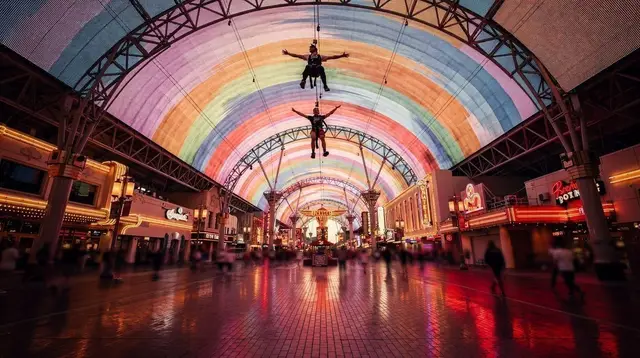
SlotZilla is the giant slot-machine-shaped structure that towers over the west end of Fremont Street, and it is actually two separate rides stacked on top of each other, not one attraction with a single price. Both send riders flying under the Viva Vision canopy that covers this stretch of Downtown, which means the light-and-sound show overhead is part of the experience after dark — but it also means the whole thing only exists inside the pedestrian mall, not out on the Strip. If you are staying at a Strip resort, budget real travel time to get here; this is a distinct part of town, not a five-minute walk from Bellagio.
The two rides are the Zipline and the Zoomline, and confusing them is the single most common mistake visitors make when booking.
Zipline: the seated, lower-level ride
The Zipline departs from a lower platform on the SlotZilla tower. Riders are strapped into a harness seat, more or less like a chairlift, and the line runs at a gentler angle roughly halfway down Fremont Street, ending at a landing platform near Fourth Street. It’s the calmer, shorter, and cheaper of the two options, and it’s the one more commonly chosen by first-timers, older riders, or anyone nervous about flying face-down.
Pricing is not flat. As a rough order of magnitude, expect somewhere around $25-45 depending on the day and time slot you book — earlier or off-peak slots tend to sit toward the low end, while evening slots push toward the top.
Zoomline: the horizontal, upper-level ride
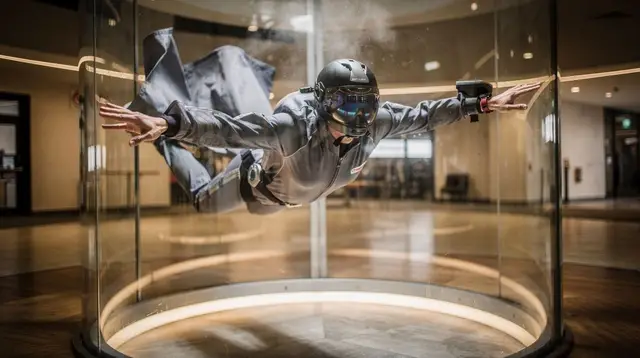
The Zoomline departs from a platform roughly ten storeys above the Zipline’s, near the top of the SlotZilla structure. Riders lie flat in a horizontal, arms-forward “Superman” position rather than sitting, and the line covers the full length of Fremont Street, not just half of it. It’s faster, longer, higher, and considerably more of an adrenaline hit — and it costs more accordingly.
Expect something in the region of $45-65, with pricing skewing toward the higher end specifically on Friday and Saturday evenings after 5pm, when Fremont Street is at its busiest and demand for the flagship ride peaks. Don’t assume a Tuesday afternoon price will match a Saturday night price; they generally don’t.
| Zipline | Zoomline | |
|---|---|---|
| Platform | Lower level | Upper level (~10 storeys higher) |
| Riding position | Seated harness | Horizontal “Superman” |
| Distance covered | About half of Fremont Street | Full length of Fremont Street |
| Typical price range | Roughly $25-45 | Roughly $45-65 |
| Priciest slots | Evenings, generally | Friday/Saturday after 5pm |
| Weight limit (approx.) | ~23-135 kg (50-300 lb) | Somewhat higher than the Zipline |
Treat every figure in that table as a range, not a quote. Pricing on both rides is dynamic and tied to demand, so the number you see when you actually check availability for your date is the one that matters.
Weight limits are real, and they’re checked
Both rides run on manufacturer-set harness equipment, which means there are genuine weight limits — this isn’t a formality. The commonly cited range for the Zipline is roughly 23-135 kg (about 50-300 lb), and the Zoomline’s upper limit tends to run somewhat higher because the horizontal harness distributes weight differently than a seated one. These numbers can be adjusted by the operator without much notice, so don’t lock in a family member’s participation based on a figure you read months ago — confirm current limits when you book or check in.
There’s no way around this at check-in: staff weigh or otherwise verify riders against the posted limit before letting anyone board, for the same reason airlines enforce carry-on sizes — the equipment is rated for a specific range, not a suggestion. If you’re near either boundary, it’s worth calling ahead rather than finding out in line.
Age and height minimums also apply on both rides (SlotZilla is not really built for young children), so if you’re planning a family evening on Fremont Street, check current age requirements before you promise the kids a flight down the canopy.
When SlotZilla can’t fly: wind and weather
SlotZilla is an outdoor zipline, and outdoor ziplines everywhere share the same vulnerability: high wind can force a temporary shutdown. Las Vegas isn’t a particularly windy city on average, but the Mojave Desert produces sudden gusty spells, and a canopy-height cable line is understandably more wind-sensitive than most street-level attractions. Closures for wind (or, less commonly, lightning) are uncommon but not rare, and they can happen with little warning.
If you’re booking a specific slot for a specific night — say, the last evening of a trip — it’s worth knowing that a booked time is not an ironclad guarantee of flying, and refund or rebooking policies for weather closures vary by how and where you booked. Building in a spare evening, or at least not treating SlotZilla as the single make-or-break moment of a trip, is the safer approach.
Booking ahead vs walking up
Fremont Street gets genuinely crowded after dark, especially on weekends, and SlotZilla is one of its headline draws. Walk-up availability for the exact slot you want — particularly a Friday or Saturday evening Zoomline run — is not something to count on. If there’s a specific time you want (say, right as the Viva Vision show starts overhead), book ahead rather than hoping a same-night slot opens up.
That said, SlotZilla isn’t the only reason to build an evening around Fremont Street. A guided walk through the area puts the ride in context alongside the rest of Downtown’s history and neon, and pairing the two makes for a fuller night than the zipline alone. A private Fremont Street Experience tour can work a SlotZilla run into a broader Downtown itinerary, while a more budget-conscious Fremont Street walking tour covers the Neon Museum area and the district’s mob-era backstory on foot.
What else is around Fremont Street
SlotZilla sits inside a compact, walkable pocket of Downtown Las Vegas, and most visitors combine it with a few hours exploring the surrounding blocks rather than treating it as a standalone stop. Within easy walking distance:
- The Fremont Street Experience canopy itself, with free light-and-sound shows running on a schedule most evenings.
- The Mob Museum, a few blocks north, covering the same organized-crime history that shaped early Fremont Street.
- The Neon Museum, home to Downtown’s retired casino signs, a short drive or rideshare away.
- Casino floors along Fremont itself — the Golden Nugget, Golden Gate, and others — with a noticeably older-school, lower-stakes feel than the Strip’s mega-resorts.
If you’d rather cover the district on wheels than on foot, a talking e-scooter tour of Fremont Street and Downtown narrates the area’s history while you ride, and for an evening with more of a bar-hop pace, a Fremont Street bar crawl strings several Downtown venues together. Remember that open containers on Fremont Street, like on the Strip, are legal only in plastic or approved cups — glass is not allowed outdoors.
Getting to Fremont Street from the Strip
Downtown and the Strip are separate parts of the Las Vegas Valley, several miles apart, connected by Las Vegas Boulevard, I-15, or a rideshare. There’s no monorail or casino tram connection between the two — the free trams and the paid Las Vegas Monorail both operate only within the Strip corridor, and the RTC’s Deuce bus is the one transit option that runs the length of the Strip up to Fremont Street, though it’s a bus ride, not a quick hop. Most visitors either drive, take a rideshare (typically the fastest option outside of peak traffic), or book a tour that includes transport, which sidesteps the parking question in a district with fewer resort garages than the Strip.
If you’re flying in and haven’t sorted ground transport yet, it’s worth reading up on airport transfer options to the Strip before deciding whether renting a car or relying on rideshares makes more sense for a trip that includes a Downtown evening. A broader comparison of shuttle, rideshare, and taxi options from the airport covers the same tradeoffs in more depth.
SlotZilla compared with the Strip’s other thrill rides
SlotZilla isn’t Las Vegas’s only elevated adrenaline attraction, and visitors weighing where to spend a thrill-ride budget often ask how it stacks up against the Strip’s options. The SkyJump and other high-rise thrill rides at the STRAT put riders in freefall from a tower rather than flying horizontally over a street, which is a genuinely different sensation — freefall for a few seconds versus a sustained horizontal glide.
The High Roller observation wheel sits at the opposite end of the intensity scale: a slow, scenic loop rather than anything resembling a zipline. None of these substitute for each other exactly, so if you have time for more than one, they’re complementary rather than redundant — SlotZilla for the canopy-level flight over a historic street, the STRAT for pure height and freefall, the High Roller for unhurried views.
Fremont Street’s history, in brief
SlotZilla’s site has a longer backstory than the ride itself. Fremont Street was Las Vegas’s original casino strip decades before the resort corridor now called the Strip existed a few miles south, and its early decades are tied up with the same organized-crime era that shaped much of the city’s early growth. The Viva Vision canopy that SlotZilla now flies under was built in the 1990s specifically to revitalize a district that had lost ground to the newer Strip resorts, turning what had been an open street into an enclosed, air-conditioned pedestrian mall.
Riders zipping past the old casino marquees along Fremont Street are, in effect, flying over one of the oldest gaming blocks in the state. A self-guided or guided walking tour of Downtown fills in more of that backstory than a zipline ride alone can, and pairing the two — history on foot, then a flight over the same blocks — is a common way to structure a Downtown evening.
Family visits and alternatives to flying
SlotZilla’s age and height minimums mean it doesn’t work for every member of a family group, but that doesn’t have to mean skipping Fremont Street with kids in tow. The canopy area has plenty to do at ground level, including arcades scattered along the strip; a family arcade adventure on Fremont Street or an arcade play card attraction pass can occupy the members of your group who aren’t riding while others go up the SlotZilla tower.
Beyond the arcades, the free Viva Vision shows overhead run on a schedule and cost nothing to watch, which makes for an easy way to build a family evening around Fremont Street even without everyone flying. For broader planning around a Las Vegas trip with children, see the Las Vegas with kids guide and the roundup of all-ages shows in town.
Where to stay if Fremont Street is a priority
Most Las Vegas visitors default to booking a Strip resort, but if SlotZilla and the rest of Downtown are a priority for your trip, staying closer to Fremont Street cuts out the daily travel time between the two districts. The tradeoffs go beyond just proximity — Downtown’s casino-hotels generally run at a different scale and price point than the Strip’s mega-resorts, with a noticeably older-school, lower-stakes gaming floor to match.
The Strip vs. Downtown comparison and the more general where to stay: Strip vs. Downtown guide both walk through what changes depending on which side of town you base yourself in, which is worth reading before booking if a Fremont Street evening (or several) is a fixed point on your itinerary rather than a one-off detour from the Strip.
Planning a longer Downtown visit
If SlotZilla is just one stop on a fuller Downtown day, it’s worth building the visit around a loop rather than a single attraction. The Strip and Downtown in two days itinerary lays out one way to split time between the two districts without feeling rushed in either, working a Fremont Street evening in alongside Strip time on the other day. For visitors new to the city altogether, the step-by-step first-time Las Vegas guide covers how a Downtown detour like this typically fits into a broader first trip.
A realistic evening on Fremont Street
For a first visit, a reasonable pace looks something like this: arrive in the early evening before the crowds peak, walk the length of the canopy taking in the casinos and street performers, catch one of the free Viva Vision shows overhead, then head to SlotZilla — Zipline if you want the calmer, cheaper option, Zoomline if you want the full-length flight and don’t mind lying flat ten storeys up. Booking your SlotZilla slot before you arrive, rather than queuing on the night, is the difference between flying when you planned to and watching other people fly instead.
Whichever ride you choose, go in expecting a price that moves with the calendar, a weight limit that’s actually enforced, and a small chance that wind pushes your slot back. None of that makes SlotZilla any less worth doing — it’s one of the more distinctive things to do in Downtown Las Vegas — but going in with accurate expectations beats being surprised at the ticket counter.
Thrills and Adrenaline
Verified deep-linked GetYourGuide tours. Book through these links and we earn a small commission at no cost to you.
GetYourGuide does not provide a product photo for this activity — the image shows the meeting point, photographed by us.