Badwater Basin & Zabriskie Point: Death Valley's Two Essential Viewpoints
What are Badwater Basin and Zabriskie Point, and how do you visit both?
Badwater Basin is the lowest point in North America (about -86 m / -282 ft below sea level), reached by an easy but shadeless walk across a salt flat. Zabriskie Point is a scenic overlook just five minutes' walk from its parking area, famous for sunrise and sunset light over eroded badlands. The two sites sit about 30 minutes apart by car inside Death Valley National Park, and both require the park's roughly $30-per-vehicle entrance fee (2026).
Two very different views of the same valley
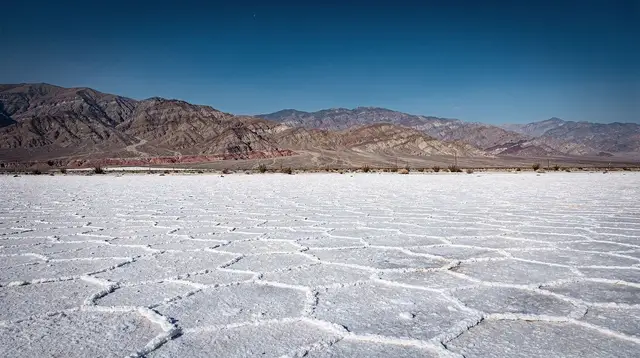
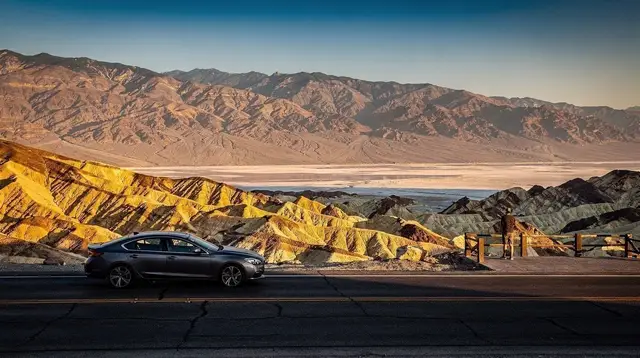
Badwater Basin and Zabriskie Point are the two stops nearly every visitor to Death Valley plans a day around, and they could hardly look more different from one another. Badwater is horizontal — a blinding white salt flat stretching toward distant mountains, and the lowest point in North America at roughly -86 m (-282 ft) below sea level. Zabriskie Point is vertical — a viewpoint perched above a maze of eroded, golden-brown badlands that seem to fold and ripple, best known for the way sunrise and sunset light rakes across them.
Both sit inside the boundaries of the national park, both are short, well-marked stops rather than backcountry hikes, and both are commonly done in the same visit. But they reward different timing, different levels of physical caution, and different expectations about what you’ll actually experience once you’re standing there. This guide covers what each stop involves, how to sequence them, what the park entrance fee covers, and where the genuine hazards are — because Death Valley’s heat is not an exaggeration, and neither Badwater’s shade situation nor its accessibility should be oversold.
Badwater Basin: the lowest point in North America
Badwater Basin sits at approximately -86 m (-282 ft) below sea level, on the floor of Death Valley proper, along Badwater Road south of Furnace Creek. From the parking area, a boardwalk leads a short distance onto the basin, after which the maintained path gives way to the salt flat itself — a crust of sodium chloride and other minerals left behind as ancient Lake Manly evaporated.
Most visitors walk somewhere between a few hundred metres and about 1.5 km (roughly 1 mile) out onto the flat before turning back. There is no fixed endpoint; you walk out as far as curiosity, light, and heat allow, then retrace your steps. The polygonal salt patterns are the main visual draw, and they’re at their most striking a little distance out from the boardwalk, once the crowd around the parking area thins out.
What Badwater is not
It’s worth being direct about this: Badwater Basin offers no shade whatsoever, from the parking area to as far out onto the flat as anyone walks. There are no trees, no structures, no natural shelter. In summer, the white salt surface reflects a significant amount of solar radiation back upward, meaning you’re exposed to heat from above and below at once — a real factor beyond what the air temperature alone suggests.
The surface itself is also not a smooth, universally walkable one. Close to the boardwalk it’s relatively firm and even, but further out it becomes more uneven, cracked, and crusted. This is not a paved or fully wheelchair-accessible path; a wheelchair or mobility device can typically manage the boardwalk and the immediate area just beyond it, but the full walk out onto the flat is not accessible terrain. Anyone planning the visit around full accessibility should treat the boardwalk area as the realistic limit rather than assuming the whole basin is reachable.
When to visit Badwater
Morning is the better call, particularly outside the cooler months. Death Valley’s summer air temperatures regularly exceed 49°C (120°F), among the hottest recorded anywhere on Earth, and the salt flat’s reflected heat pushes the experienced conditions higher still. An early start means cooler air, softer light for photos, and less time standing on a surface radiating heat back at you. In the cooler months (roughly November through March), the difference between morning and midday is far less dramatic, but mornings still tend to have calmer light and thinner crowds.
Whatever the season, carry more water than feels necessary, wear real sun protection (hat, sunglasses, sunscreen), and don’t plan a long, lingering walk on the flat in the hottest hours of a summer day. This isn’t a place where hydration or timing decisions are merely a matter of comfort — heat illness is a genuine risk here.
Zabriskie Point: a five-minute walk to one of the best views in the park
Zabriskie Point could not be more different logistically. From its dedicated parking area just off CA-190, a short paved path — about five minutes on foot, with a modest but manageable incline — leads up to the overlook. From there, the view opens across a badlands landscape of eroded, colorfully banded hills, with the valley floor and the Panamint Range beyond.
This is one of the most photographed spots in Death Valley, and for good reason: the light plays across the folds of the badlands in a way flat desert distances rarely allow. It’s also one of the easiest “big view” payoffs in the entire park relative to the effort required to reach it.
When to visit Zabriskie Point
Sunrise is generally considered the standout time — the low, warm light rakes across the badlands and brings out color and texture that flattens out under the harsher light of midday. Sunset is a strong second choice and, practically speaking, easier to combine with the rest of a day spent driving between sights. Either way, arriving close to golden hour rather than at midday will make a real difference to what you come away with, in photographs and in general impression of the place.
Temperatures at Zabriskie are, unsurprisingly, cooler at dawn or dusk than in the middle of a summer day — another reason to time it around light rather than convenience.
Distance and driving time between the two
Badwater Basin and Zabriskie Point sit roughly 17-18 miles (about 28 km) apart, connected via Badwater Road and CA-190, with a drive time of about 30 minutes depending on how many pull-offs you stop at along the way (several other viewpoints line this stretch of road). This makes the pair easy to combine into a single loop: an early start at one, followed by the other, with time in between for the drive and any additional stops.
| Leg | Approximate distance | Approximate drive time |
|---|---|---|
| Badwater Basin → Zabriskie Point | ~17-18 miles / 28 km | ~30 minutes |
| Las Vegas → Death Valley (Furnace Creek area) | ~120 miles / 193 km | ~2-2.5 hours |
Furnace Creek, roughly midway between the two viewpoints, is the park’s main hub for fuel, food, and lodging, and a natural base if staying overnight rather than doing the whole visit as a day trip from Las Vegas.
The park entrance fee
Death Valley National Park charges a vehicle entrance fee, running at roughly $30 per vehicle as of 2026, valid for 7 consecutive days and covering all sites within the park, Badwater Basin and Zabriskie Point included. An America the Beautiful annual pass also covers entry if you’re planning to visit multiple national parks in the same trip — worth considering if Zion, Bryce Canyon, or the Grand Canyon are also on the itinerary. Fee stations and self-pay kiosks are located at the main park entrances; keep the receipt or pass visible in your vehicle.
Self-drive versus an organized tour
Given the distances involved — Death Valley is roughly 2 to 2.5 hours from Las Vegas each way — most visitors choose between driving themselves or booking an organized tour, and the two options suit fairly different priorities.
Driving yourself gives full control over timing. You can arrive at Zabriskie Point for sunrise, linger at Badwater as long as the heat allows, add extra stops like Artist’s Palette or Dante’s View, and leave whenever suits you. This flexibility is the main reason serious photographers and anyone chasing specific light conditions tend to prefer self-driving. It does mean planning your own route, fuel stops (services inside the park are limited and priced accordingly), and heat-safety precautions — see our desert driving safety guide before setting out.
An organized tour removes the navigation and driving fatigue, which matters on a genuinely long round trip, and typically bundles in a knowledgeable guide and a handful of fixed stops. The trade-off is a fixed schedule: you’ll see both Badwater and Zabriskie, likely along with other highlights, but on the operator’s timing rather than your own, which can mean missing the best light at one or the other depending on the itinerary’s structure.
For visitors combining Death Valley with a longer Los Angeles-Las Vegas route, a multi-stop tour through Death Valley between Los Angeles and Las Vegas can fold the detour into a journey you’re already making, rather than requiring a separate round trip from either city.
For a Las-Vegas-based day trip, a guided day tour to Death Valley from Las Vegas covers the drive and typically both viewpoints without requiring you to rent a car or navigate the park yourself. Travelers arriving from the Los Angeles side have similar options, including a private one-day trip through Death Valley to Las Vegas, or, for those with more time, a multi-day tour linking Los Angeles, Death Valley, Las Vegas, and the Grand Canyon that treats these two viewpoints as one stop within a longer Southwest loop.
| Approach | Best for | Trade-off |
|---|---|---|
| Self-drive | Chasing specific sunrise/sunset light, flexible timing, extra stops | Requires your own navigation, fuel planning, and heat-safety judgment |
| Organized tour | No driving fatigue, guided context, bundled logistics | Fixed schedule, fixed stops, less control over light timing |
Combining the visit with the rest of Death Valley
Both sites work well as anchors for a broader loop through the park rather than a there-and-back visit to just the two of them. Nearby highlights along the same stretch of road include Artist’s Palette and Dante’s View, and many self-drivers build a route that takes in several viewpoints across a single morning or afternoon.
If Death Valley is one stop on a longer circuit rather than a dedicated trip, see our three-day Las Vegas and Death Valley itinerary for how it fits alongside other Southern Nevada highlights, or the broader day-trip guide to Death Valley from Las Vegas for a fuller rundown of the drive and what else to see along the way.
For safety specifics on the drive itself — heat, vehicle preparation, and remote-road precautions — the Death Valley driving safety guide is worth reading before you go, and the general Las Vegas summer heat guide covers the broader regional context if your trip falls between June and August.
What to pack for both stops
Neither site is remote in the sense of requiring backcountry gear, but both are far enough from services that showing up unprepared turns a pleasant stop into a genuinely uncomfortable one. A few essentials are worth throwing in the car before leaving Las Vegas or Furnace Creek:
- More water than you think you’ll need. A gallon per person for a half-day out is a reasonable baseline in the warmer months, and there’s nowhere to refill at either Badwater or Zabriskie itself.
- Real sun protection — a wide-brimmed hat, sunglasses, and sunscreen reapplied if you’re out on the salt flat for more than 20-30 minutes, since the reflected glare off the salt is more intense than it looks.
- Sturdy, closed shoes for Badwater. The salt crust is uneven and, in places, sharp-edged; sandals are a poor choice.
- A full tank of fuel before entering the park. Fuel is available at Furnace Creek but at a premium, and there’s nothing at either Badwater or Zabriskie themselves.
- Offline maps and any tickets or reservations downloaded in advance, given the near-total absence of cell signal at both sites — see the FAQ above.
None of this is exotic advice, but Death Valley’s reputation for extremity is earned, and the gap between “prepared” and “underprepared” here is measured in real discomfort, not inconvenience.
Extending the day beyond Badwater and Zabriskie
Most visitors who make the drive out from Las Vegas or Los Angeles don’t stop at just these two points. Artist’s Palette, a short detour off Badwater Road known for its multicolored volcanic and sedimentary hills, and Dante’s View, a high overlook above the valley floor, both sit within easy reach of the same stretch of road and are commonly folded into the same day. Neither requires much additional walking, which makes them natural additions rather than separate expeditions.
For travelers who’d rather not plan this sequencing themselves, several tour options build Badwater and Zabriskie into a longer look at the park. A private day tour covering the best of Death Valley from Las Vegas typically threads together Badwater, Zabriskie, and a handful of the other viewpoints along this same corridor with a driver-guide handling the navigation.
Photographers chasing the badlands’ best light might instead consider a sunset-and-stargazing tour that pairs the salt flats with Death Valley’s exceptionally dark night sky, since the same remoteness that strips away cell signal also removes light pollution — a genuine asset once the sun is down. For those wanting a smaller, more flexible group than a standard bus tour, a small-group VIP tour of Death Valley and the Mojave Desert from Las Vegas covers similar ground with fewer fellow travelers.
If stargazing after a Zabriskie sunset appeals but a dedicated Death Valley night tour doesn’t fit the schedule, the guided desert stargazing tour guide covers options closer to Las Vegas itself, and the state and national parks night sky guide rounds up the region’s other reliably dark-sky spots for comparison.
Planning takeaways for Badwater Basin and Zabriskie Point
- Sequence them around light and heat: Zabriskie Point at sunrise or sunset for the best views and coolest conditions; Badwater Basin in the morning, especially in summer, to limit heat exposure.
- Budget about 30 minutes to drive between them, plus time for any additional pull-offs along Badwater Road and CA-190.
- Carry the park entrance fee or pass — roughly $30 per vehicle in 2026, covering both sites for 7 days.
- Don’t expect shade, full wheelchair accessibility, or comfortable summer temperatures at Badwater — it is an open, reflective salt flat with none of the three, at any hour of a summer day.
- Don’t count on phone signal at either site; download maps and confirm your route before leaving Las Vegas, Los Angeles, or your Death Valley lodging.
- Choose self-drive for flexibility, an organized tour for convenience — both are reasonable ways to see these two viewpoints, and the right choice depends on how much you want to control your own schedule versus hand off the driving.
Death Valley Day Trips
Verified deep-linked GetYourGuide tours. Book through these links and we earn a small commission at no cost to you.
GetYourGuide does not provide a product photo for this activity — the image shows the meeting point, photographed by us.