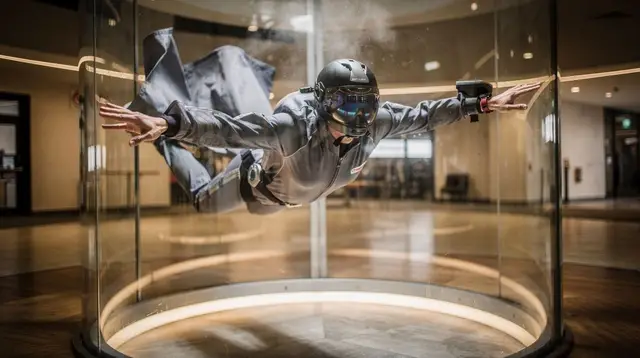
Indoor Skydiving in Las Vegas: Wind Tunnel Free Fall for Every Age
How much does indoor skydiving cost in Las Vegas?
A beginner package with roughly two minutes of flight time, instruction, and gear runs about $85-100 per person. A longer three-minute package is around $150, extra flights cost about $50 each, and group rates drop sharply, from roughly $325 for five flyers to around $1,000 for a 20-person, one-hour group session.
Free fall without the airplane
Indoor skydiving takes the one part of a real skydive that people actually come for - the sensation of stable, cushioned free fall - and produces it inside a vertical wind tunnel, with no aircraft, no altitude, and no parachute required. A powerful column of air, generated by large fans and shaped by a glass flight chamber, pushes upward at speeds that can exceed 100 mph (160 km/h). A trained instructor floats in the chamber with each flyer, and the airflow does the rest: it holds a body in a stable, floating position the same way it would during the several seconds of true free fall that happen after jumping from a plane and before a parachute deploys.
This is why indoor skydiving has become one of the most popular adrenaline activities near the Strip - it delivers a real, physical sensation of flight with almost none of the friction that keeps people from trying a real skydive: no age minimum in the traditional sense, no drive to a remote airfield, no weather risk, and a session that fits into an hour rather than half a day.
How a session actually works
A typical beginner session follows the same basic script at every major operator, whether the facility sits near the resort corridor or slightly off it:
- Check-in and brief ground training. Staff walk flyers through body position, hand signals used inside the tunnel (since talking is impossible over the airflow noise), and basic safety rules - roughly 15-20 minutes.
- Suiting up. Flyers put on a jumpsuit, helmet, earplugs, and goggles over their own clothing.
- Flight rotations. Each person takes their turn in the chamber with an instructor, who supports and guides their body position for the full flight time booked - commonly around one minute per flight in a beginner package, split across two rotations to add up to the advertised total.
- Video and photos (optional add-on at most locations). Cameras mounted in the chamber can capture the flight for an extra fee.
The whole visit, including training, suiting up, and both rotations, generally runs 45-90 minutes for a small group, even though the fan-powered flight time itself is measured in single-digit minutes.
What it actually costs in 2026
Pricing scales with total flight time and group size, and - like most Las Vegas attractions - the number quoted online is a starting point rather than a guarantee.
| Package | Flight time | Typical price (per person) |
|---|---|---|
| Beginner / intro package | ~2 minutes total | ~$85-100 |
| Extended package | ~3 minutes total | ~$150 |
| Additional flight (add-on) | ~1 minute | ~$50 |
| Small group (5 people) | ~15 minutes combined | ~$325 |
| Large group (up to 20 people) | ~1 hour combined | ~$1,000 |
These figures are order-of-magnitude ranges checked in 2026, not a price a specific operator has guaranteed for a specific date - promotions, off-peak hours, and bundled packages all move the final number up or down. Always confirm the current price and included flight time before paying, since “2 minutes” can be split, timed, or counted differently between operators.
Who can actually do it
This is the detail that separates indoor skydiving from almost every other adrenaline activity near the Strip: there is no fixed minimum age. Instead, most wind tunnels set a minimum body weight, because the airflow needs enough mass to work against for a stable flight. In practice that generally allows children as young as around three or four years old to fly, alongside grandparents, wheelchair users transferring in with staff assistance, and first-timers who have never done anything like it.
It is one of the very few genuinely three-generation activities available in the city, and it fits naturally alongside a broader family-friendly Las Vegas itinerary or a stop among the wider set of family-friendly attractions on the Strip.
A real tandem skydive is a different story entirely: operators require flyers to be 18 years old, no exceptions, because it is a legal waiver issue as much as a safety one. There is also typically a maximum weight limit for a tandem jump that does not apply the same way to indoor flying. A family with young kids or a group with a wide age range can all fly together in the tunnel; the same group could not all jump from a plane together even if everyone wanted to.
Indoor skydiving vs. a real skydive: what’s actually different
It is worth being direct about this, because marketing sometimes blurs the two into one interchangeable “skydiving experience.” They are related but genuinely different activities.
| Indoor skydiving (wind tunnel) | Real tandem skydiving | |
|---|---|---|
| Minimum age | None - weight-based, often ~3-4 years old | 18 years old |
| Location | Climate-controlled facility, can be near the Strip | Remote airfield/aerodrome outside the resort corridor |
| Total time commitment | ~45-90 minutes | ~3-4 hours including transport and check-in |
| Actual “flight” duration | 1-3 minutes of fan-powered floating | Roughly 45-60 seconds of true free fall, then a parachute canopy ride |
| Weather dependency | None - runs on schedule indoors | Fully weather-dependent; can be delayed or cancelled |
| Typical price (per person) | ~$85-150 for a standard package | Meaningfully higher once the full jump package is booked |
| Altitude / height involved | None - stays at ground level | Exits an aircraft at several thousand feet |
The sensations overlap on one specific point: both recreate the feeling of stable, wind-supported free fall, and instructors who work in tunnels are often the same people who train real skydivers, because the body positions are genuinely similar. But a real skydive adds elements the tunnel cannot: the climb in the aircraft, the moment the door opens, several seconds of accelerating fall before reaching terminal velocity, and then the parachute deploying and carrying the flyer down over open desert scenery.
None of that exists inside a building. Anyone expecting an identical experience in either direction - tunnel flyers expecting an aircraft, or skydivers expecting the polish of a tunnel - will be disappointed; they are better understood as two separate activities that happen to share one core sensation.
A genuine outdoor skydive near Las Vegas also requires driving out to a working aerodrome away from the Strip, since no drop zone operates from the resort corridor itself, and the full experience - transport, check-in, gear, briefing, the flight to altitude, the jump, and the drive back - commonly takes 3-4 hours door to door. Indoor skydiving compresses a comparable adrenaline hit into a fraction of that time, with no travel required if the tunnel sits near the Strip.
Weather: the difference that actually matters
Because the wind tunnel operates entirely indoors in a sealed flight chamber, nothing about the Nevada climate affects it - not the summer heat that regularly reaches 38-43°C (100-110°F), not wind, not the rare desert rainstorm. A session booked for 2pm in August runs exactly as scheduled.
A real outdoor tandem skydive has no such guarantee. Wind, cloud ceiling, and visibility all factor into whether a drop zone flies on a given day, and any booking should build in the possibility of a same-day delay or reschedule. This is one of the most consequential and least advertised differences between the two activities - book the outdoor jump with flexibility in your schedule, and treat the tunnel as the reliable, weather-proof option when a trip’s dates are fixed.
What to expect physically
Indoor skydiving is genuinely accessible, but it is not effortless. The airflow pushes against the whole body, and holding the trained “box” position - arms and legs extended, core engaged - works muscles that most people do not use this way. First-time flyers commonly feel it in the neck, shoulders, and lower back the next day, similar to a moderate workout. It is not painful during the flight itself, and instructors physically support and correct body position throughout, but it is a real physical activity, not a passive ride.
Ears can also feel pressure from the wind noise and airflow, which is why earplugs are issued as standard equipment, along with a helmet with a visor or goggles to protect the eyes from the wind.
What to wear and bring
- Snug athletic clothing underneath the provided flight suit - loose clothing, skirts, or anything with drawstrings or hoods can catch the airflow and cause problems.
- Closed-toe, laced shoes. Sandals, flip-flops, and slip-ons are typically not allowed in the chamber.
- No loose jewelry, scarves, or hair accessories that could detach in the wind; long hair should be tied back and tucked under the helmet.
- Glasses wearers may need to use a strap or switch to contacts, since standard glasses can be blown off during flight; ask the operator about options when booking.
- An ID for check-in and to sign the standard waiver, required of every flyer or a parent/guardian for minors.
Booking timing and what fills up
Indoor skydiving slots are limited by how many flight rotations a chamber can run per hour, and popular evening and weekend times can sell out, particularly around holidays and major Strip events. A same-day walk-in is sometimes possible on a quiet weekday, but booking ahead - especially for a group package - is the reliable approach, and it locks in the advertised price before any last-minute rate changes.
Where indoor skydiving fits in a Las Vegas trip
Because a full session runs under two hours including check-in and suiting up, it slots easily into almost any kind of visit. It pairs naturally with other short, high-energy stops such as Slotzilla’s zipline over Fremont Street or the drop rides and views at the STRAT SkyJump and thrill rides, and it works as a rain-or-shine, heat-or-cold backup activity on a day when outdoor plans near Red Rock Canyon or Valley of Fire are affected by extreme temperatures.
For travelers who want more ground-level adrenaline without leaving the resort corridor, a few bookable options complement the wind tunnel well. A high-speed loop in a genuine stunt plane is about as close as a short Las Vegas booking gets to real free-fall-adjacent thrills in the air - see a real aerobatic stunt plane flight over Las Vegas for a very different kind of airborne rush.
On the ground, an adrenaline-focused afternoon can also include official F1-style karting, a session of tactical gel blaster combat, or simply outdoor go-karts for a lower-cost thrill that also welcomes kids.
For a full afternoon out in the desert rather than another indoor stop, a guided desert ATV tour covers similar adrenaline territory outdoors, and it sits comfortably next to a full write-up of the racing and shooting range experiences that fill the same “one big adrenaline activity per day” slot. Travelers building a rainy-day or heat-day backup list sometimes pair it with an indoor escape room or simulator session, or a evening ghost tour once the desert heat has faded.
Anyone weighing whether to also book a real tandem skydive during the same trip should treat it as a separate decision with its own logistics - a drive out to an aerodrome away from the Strip, a half-day time block, and a weather-dependent schedule - rather than an upgrade of the tunnel experience. Both are worth doing on their own terms; neither substitutes for the other.
Slotting it into a longer itinerary
Indoor skydiving works as a one-hour add-on rather than a day’s plan, which makes it easy to drop into almost any trip length. First-time visitors following a three-day Las Vegas itinerary or the broader step-by-step first-time Las Vegas guide can slot a session into a free hour between Strip attractions without reshuffling the rest of the plan.
Families working from a four-day Las Vegas with kids itinerary often use it as the “everyone flies together” activity precisely because it skips the age minimum that rules out a real skydive. Travelers on a tighter schedule following a one-day Strip essentials plan can still fit it in early, since the whole visit rarely runs past 90 minutes. Anyone still deciding on overall trip length can check how many days to spend in Las Vegas before working out where a short activity like this one fits.
Indoor Skydiving in Las Vegas: FAQ
How much does indoor skydiving cost in Las Vegas?
Expect roughly $85-100 for an entry package with about two minutes of actual flight time, instruction, and all gear included. A three-minute package runs closer to $150, and an extra flight added on typically costs around $50. These are order-of-magnitude figures; promotions and time slots move the final price.
What is the minimum age for indoor skydiving in Las Vegas?
Wind tunnel flying is generally open to young children, with the real limit set by minimum body weight rather than a fixed birthday - most facilities fly kids as young as three or so once they meet the weight threshold. That is dramatically younger than the 18-year minimum for a real tandem skydive.
Is indoor skydiving the same feeling as jumping out of a real plane?
No. The wind tunnel recreates the sensation of stable free fall very convincingly, but it skips the aircraft climb, the door opening, the several seconds of accelerating fall before terminal velocity, and the parachute canopy ride down. It is its own sport, not a substitute experience for a real skydive.
Do I need a reservation, or can I just walk in?
Walk-ins are sometimes possible, but flight slots are limited and popular times fill up, especially evenings and weekends. Booking ahead is the safer approach, particularly for a group package.
Can indoor skydiving be cancelled by weather?
No - it happens inside a climate-controlled building, so it runs on schedule regardless of wind, heat, or storms outside. A real outdoor tandem skydive, by contrast, is weather-dependent and can be delayed or rescheduled on short notice.
How does the price compare to a real tandem skydive near Las Vegas?
A real tandem jump costs meaningfully more once transport, the full airport experience, and the jump package are added up, and it takes a half-day rather than an hour. Indoor skydiving is the cheaper, faster, and far more predictable of the two.
What should I wear for indoor skydiving?
Snug-fitting athletic clothing works best under the provided flight suit - avoid loose items, skirts, or anything with hoods, drawstrings, or loose jewelry that could catch in the airflow. Closed-toe lace-up shoes are required, and long hair should be tied back.
Thrills and Adrenaline
Verified deep-linked GetYourGuide tours. Book through these links and we earn a small commission at no cost to you.
GetYourGuide does not provide a product photo for this activity — the image shows the meeting point, photographed by us.