Lower Antelope Canyon Guide: The Corkscrew, Tickets and Stairs
What is Lower Antelope Canyon and how is it different from Upper Antelope?
Lower Antelope Canyon, nicknamed 'The Corkscrew,' is a narrower, deeper slot canyon near Page, Arizona, entered and exited via several sets of steep metal stairs rather than walked flat like Upper Antelope. It runs with different Navajo-owned operators, generally costs less (roughly $60-95 per adult in 2026), and produces softer, more diffuse light rather than the dramatic vertical light beams Upper Antelope is known for.
The Corkscrew: a different canyon, not a cheaper copy of Upper Antelope
Most first-time visitors hear “Antelope Canyon” and picture one place. In reality there are two distinct slot canyons a few minutes apart near Page, Arizona, each carved by the same seasonal flash floods through the same Navajo sandstone, but each run by separate operators, on separate land access, with a genuinely different physical experience.
Lower Antelope Canyon, known locally as “The Corkscrew,” is the deeper, narrower, more physically demanding of the two. If you have already read about Upper Antelope Canyon and are trying to decide between them, or trying to decide whether to do both, this guide covers what makes Lower Antelope different — and where the common assumptions about it turn out to be wrong.
Lower Antelope sits on Navajo Nation tribal land, like all of Antelope Canyon, roughly 440 km (about 275 miles) from Las Vegas via Grand Circle — a drive of about 4.5 hours on mostly paved highway. It is not a stop you tack onto a Las Vegas day trip casually; most visitors either commit a full day to the round trip or, better, treat it as part of a multi-day Grand Circle itinerary that also takes in Horseshoe Bend, Lake Powell and Monument Valley.
Physically, this is a different visit than Upper Antelope
This is the single most important thing to understand before booking. Upper Antelope Canyon is walked entirely on a flat, sandy canyon floor — no stairs, no climbing, accessible to almost anyone who can walk a short distance on uneven ground. Lower Antelope Canyon is not walked flat. The canyon drops and narrows as you move through it, and the only way in and back out is via several flights of steep, narrow metal stairs and ladders, bolted into the sandstone walls, connecting different chambers of the slot.
Expect:
- Multiple sets of stairs, some quite steep, with handrails but limited width.
- Passages narrow enough in places that larger bags, tripods or bulky camera gear can be awkward to carry through.
- No alternate, step-free route — the stairs are the only way to complete the canyon.
- Uneven natural rock underfoot between the staircases, sometimes slick with fine sand.
Because of this, Lower Antelope Canyon is not recommended for visitors with mobility limitations, significant balance or joint issues, heart conditions that make stair climbing risky, or pronounced claustrophobia. The canyon narrows overhead in sections and the group moves through single-file with a guide setting the pace — there isn’t room to step aside if you need space. If any of this sounds like a concern, Upper Antelope Canyon is the far more accessible choice, and it’s worth choosing it deliberately rather than discovering the stairs at the entrance.
Guided access only, on a licensed Navajo permit
There is no independent or self-guided visit to either Antelope Canyon. All access to Lower Antelope Canyon runs through licensed Navajo tour operators on timed permits, and a guide accompanies every group throughout the visit — partly for safety on the stairs, partly because the Navajo Nation controls and manages access to the site. The two best-known operators running Lower Antelope specifically are Ken’s Tours and Antelope Canyon Navajo Tours, both based in Page and both offering direct online booking.
A standard guided tour of Lower Antelope Canyon runs about 1 hour to 1 hour 15 minutes door to door — shorter than many visitors expect, given the drive required to get there. Photography-oriented tours, when offered, can run longer and sometimes visit during quieter time slots, but they still move through the same stairs and passages as a standard tour.
a standard guided walk through Lower Antelope Canyon covers the core experience: entry, the full canyon route with your Navajo guide, and exit, typically bundled with basic transport logistics in Page.
What it costs, and why it’s usually less than Upper Antelope
Ticket pricing for both canyons changes with season, time slot and operator, but as a working range for 2026, Lower Antelope Canyon tours typically run about $60-95 per adult, generally somewhat less than comparable Upper Antelope tickets. The gap exists partly because Lower Antelope has historically been marketed as the more strenuous, less “showcase” option, even though many photographers and repeat visitors prefer its sculpted, twisting rock forms.
| Booking route | Typical cost | Trade-off |
|---|---|---|
| Direct with Navajo operator (Ken’s Tours, Antelope Canyon Navajo Tours) | Lower — ticket price only | Requires knowing which operator runs which time slot; cancellation terms vary by operator |
| Third-party booking platform | Ticket price + separate service fee | Easier to compare and cancel; combined tours (e.g. with Horseshoe Bend) often bundled in one booking |
Neither route is objectively “correct” — booking directly with the operator generally saves money if you already know your travel dates are firm, while a booking platform can be worth the added fee for flexibility or for bundling multiple stops into one transaction. What matters is comparing the final total, not the headline number, since service fees on third-party platforms are not always shown until checkout.
For a photography-leaning day that includes the nearby overlook, a Lower Antelope Canyon tour bundled with Page-area logistics is a straightforward way to combine the canyon with the rest of a Page stop in one booking.
Light: diffuse and sculptural, not the vertical beam shot
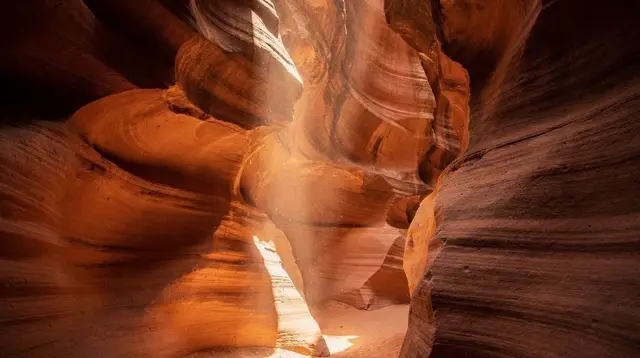
The image most people associate with “Antelope Canyon” — a dramatic, near-vertical shaft of sunlight cutting down through the slot into a cloud of drifting sand — belongs almost entirely to Upper Antelope Canyon, and even there it is a midsummer, midday phenomenon, not something visible on every visit or in every season. Lower Antelope Canyon’s shape works against that effect. Its narrower, more twisting profile lets in softer, more indirect, more diffuse light rather than concentrated vertical beams, because the canyon’s geometry scatters direct sun before it can reach the floor as a clean shaft.
This isn’t a flaw — many photographers specifically prefer Lower Antelope for its flowing rock textures, layered colour gradients, and the way light bounces between the narrow walls — but it does mean visitors chasing a light-beam photo should go to Upper Antelope, not Lower Antelope, and should not expect this guide, or any operator, to promise a beam here. No tour company can guarantee light beams at either canyon on any given day; conditions depend on the sun’s angle, the season, and even cloud cover, and Lower Antelope’s design makes the classic beam shot rare rather than merely occasional.
Booking around the Navajo Nation’s daylight saving time
This trips up more visitors than the stairs do. Arizona as a state does not observe daylight saving time — but the Navajo Nation, which includes Page and the Antelope Canyon area, does, to stay synchronized with neighbouring Utah and New Mexico. The practical result: for roughly half the year, Page and the Navajo Nation run on a different clock than the rest of Arizona, even though both are nominally in the same state and time zone the rest of the year.
If you’re arriving from Las Vegas (Pacific Time, which does observe daylight saving time) or from a non-Navajo part of Arizona, do not assume your phone’s automatic time zone reflects the correct local time in Page. Confirm your tour’s start time directly with the operator, in absolute terms if possible (“your slot is at 10:15 am Page/Mountain Daylight Time”), rather than relying on a device that may pick up a signal from a neighbouring, non-Navajo cell tower. Arriving late to a timed slot in high season generally means losing the booking outright — permits are scheduled tightly, and there is rarely a same-day alternative slot to shift into.
When to book, and why same-day rarely works
Both Antelope Canyons run on limited daily capacity set by the Navajo Nation, and Lower Antelope Canyon slots sell out days to weeks in advance during the high season (roughly April through October, and especially around holidays and weekends). Winter has more availability but shorter days and colder mornings. Whatever the season, do not plan on booking Lower Antelope Canyon the same day you intend to visit — walk-up availability, when it exists at all, is unreliable and should never be the basis of a Page/Antelope Canyon leg of your trip.
Combining Lower Antelope with other nearby sights in one booking can simplify logistics: a combined tour covering both Lower Antelope Canyon and Horseshoe Bend is worth considering if you want to see both in a single, pre-arranged day rather than coordinating separate reservations and drive times yourself.
Lower Antelope vs. Upper Antelope, side by side
| Lower Antelope Canyon (“The Corkscrew”) | Upper Antelope Canyon | |
|---|---|---|
| Terrain | Narrow passages, several flights of steep metal stairs | Flat, sandy canyon floor |
| Mobility / accessibility | Not recommended for limited mobility or claustrophobia | Easier for most visitors; no stairs |
| Typical 2026 adult price | ~$60-95 | Generally higher than Lower |
| Tour length | ~1 hour to 1h15 | Similar, varies by operator |
| Light beams | Rare; diffuse, indirect light | Best known for midday summer beams (not guaranteed) |
| Operators | Ken’s Tours, Antelope Canyon Navajo Tours, others | Separate set of Navajo-licensed operators |
Getting there from Las Vegas
Lower Antelope Canyon sits within the same Grand Circle cluster as Antelope Canyon and Page, Horseshoe Bend, Lake Powell and Monument Valley — and, at roughly 4.5 to 5 hours’ drive one-way from Las Vegas, it is not a realistic single-day round trip if you also want to see the canyon itself unhurried.
Most visitors either fly or drive to Page and stay overnight, or join an organized multi-day tour that builds in the transit time. See our Grand Circle 3-day itinerary for one way to sequence Page, Antelope Canyon and Horseshoe Bend without rushing the drive, or read what an organized multi-day tour actually includes before deciding between a self-drive itinerary and a fully guided package.
If mobility, time, or the stairs make Lower Antelope Canyon impractical for your group, Upper Antelope Canyon remains the flatter, more universally accessible alternative in the same area, and the Antelope Canyon booking and Navajo permit guide walks through the reservation process for either canyon in more detail.
Frequently asked questions about Lower Antelope Canyon
Is Lower Antelope Canyon the same as Upper Antelope Canyon?
No. They are two separate slot canyons a short drive apart near Page, Arizona, run by different Navajo-owned tour operators with separate tickets, entrances and guides. Upper Antelope is walked on a flat sandy floor; Lower Antelope requires climbing several flights of narrow metal stairs.
How much does a Lower Antelope Canyon tour cost in 2026?
Expect roughly $60-95 per adult for a standard guided tour, generally less than equivalent Upper Antelope tickets. Prices vary by operator, season and whether you book a standard or photography-oriented slot, and third-party booking platforms often add separate service fees on top.
Can I visit Lower Antelope Canyon without a guide?
No. All access is on Navajo Nation tribal land, and every visitor must be accompanied by a licensed Navajo guide on a timed permit. There is no independent, self-guided or walk-up entry.
Will I see light beams at Lower Antelope Canyon?
It’s unlikely and never guaranteed. Lower Antelope’s narrower, twisting shape lets in more diffuse, indirect light rather than the vertical shafts that appear at Upper Antelope around midday in summer. Visit Lower Antelope for its sculpted rock forms and depth, not for beam photography.
Is Lower Antelope Canyon accessible for people with mobility issues or claustrophobia?
It is not recommended. The route involves multiple steep, narrow metal staircases and tight passages with no alternate route, and there is no wheelchair-accessible or step-free option. Visitors with mobility limitations, certain heart or joint conditions, or significant claustrophobia should consider Upper Antelope Canyon instead.
How long does a Lower Antelope Canyon tour last?
Standard guided tours run about 1 hour to 1 hour 15 minutes, including entry, the guided walk-and-climb through the canyon, and exit. Photography-focused tours booked directly with an operator can sometimes run longer.
What time zone is Page, Arizona on, and why does it matter for booking?
Page and the surrounding Navajo Nation observe daylight saving time even though the rest of Arizona state does not, so their clock can differ from nearby non-Navajo Arizona towns for part of the year. Always confirm the local time of your booked slot directly with the operator rather than assuming it matches your phone’s automatic time zone.
Should I book directly with a Navajo tour operator or through a third-party platform?
Both work, but direct bookings with operators such as Ken’s Tours or Antelope Canyon Navajo Tours typically avoid the extra service fees that third-party platforms add, while established booking platforms can offer easier cancellation policies and combined itineraries. Compare the final total price, not just the headline ticket price.
Antelope Canyon and Page Day Trips
Verified deep-linked GetYourGuide tours. Book through these links and we earn a small commission at no cost to you.
GetYourGuide does not provide a product photo for this activity — the image shows the meeting point, photographed by us.