Mike O'Callaghan-Pat Tillman Memorial Bridge Walk
Is the Mike O'Callaghan-Pat Tillman Memorial Bridge walkway free, and what does it offer?
Yes, the pedestrian walkway on the bridge is free and open daily during daylight hours, with free parking at a small lot on the Nevada side. It gives the best elevated overview of Hoover Dam and the Colorado River, but it does not replace a ticketed Power Plant Tour for anyone who wants to go inside the dam itself.
The dam’s best view costs nothing
Most visitors who drive out to Hoover Dam budget for a ticket, a line, and a guided walk through the powerhouse. Fewer of them know that the single best vantage point for photographing the dam as a whole — arch, spillways, intake towers, canyon walls, and the turquoise ribbon of the Colorado River far below — is a free pedestrian walkway that requires no ticket, no reservation, and no security screening line. That walkway runs alongside the roadway deck of the Mike O’Callaghan-Pat Tillman Memorial Bridge, the bypass structure that carries US-93 traffic across the Black Canyon just downstream of the dam.
The bridge opened in 2010 specifically to take through-traffic off the top of Hoover Dam, which had become both a security concern and a bottleneck. As a side effect, it created an observation platform with a view that the dam’s own roadway never offered: a straight-on, elevated look at the entire downstream face of the dam from roughly 1,500 feet away, with nothing blocking the frame.
This guide covers exactly what the free walkway offers, how it differs from paying for the Power Plant Tour, how to get there, and what to actually expect once you’re standing on it — including the parts nobody mentions until they’re already up there in full sun with no shade in sight.
What the walkway actually is
The pedestrian walkway sits on the downstream side of the bridge deck, separated from vehicle traffic by a solid barrier, and runs the full length of the crossing. It is open to the public during daylight hours, free of charge, with no gate, no staff presence, and no capacity limit beyond the physical width of the path.
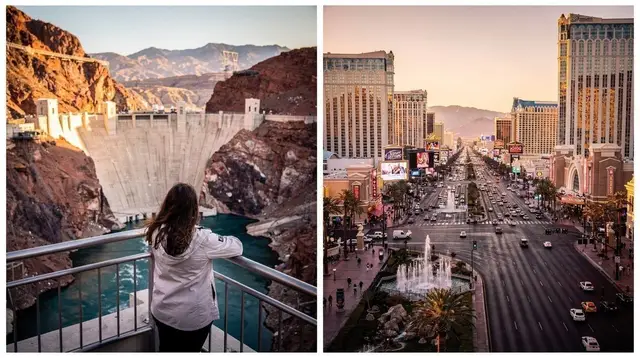
The walkway sits roughly 890 feet above the Colorado River — noticeably higher than the dam’s own crest, since the bridge spans the canyon downstream where the gorge is deeper. From the highest and most central point of the walk, visitors get a head-on view of the dam’s entire downstream face: the two intake towers on the Arizona and Nevada sides, the spillway structures, the visitor center perched above, and the narrow slot of green-blue water squeezed between canyon walls hundreds of feet below.
This is a fundamentally different experience from standing on top of the dam itself or taking the Power Plant Tour. On the dam, you’re at water level relative to the structure, looking along its length or down into the powerhouse. From the bridge, you’re looking at the dam from the side and slightly above, which is the angle that makes it actually look like the enormous structure it is. Almost every well-known postcard-style photo of Hoover Dam that shows the whole arch and both canyon walls in one frame was taken from this bridge or the approach road near it.
Free parking, and its limits
A dedicated parking area serves the walkway on the Nevada side of the bypass, just off the approach road near US-93, with a marked pedestrian route leading onto the bridge deck. Parking here is free — there is no fee gate and no meter.
The honest caveat: it is a public lot with a finite, fairly modest number of spaces, and it is not staffed or actively managed. On weekends, holidays, and any morning when a tour bus or two happens to unload nearby, spaces can fill up, and there’s no guarantee of an open spot the moment you arrive. Arriving early in the day, both for parking availability and for the reasons covered below, is the reliable way to avoid circling for a space.
This lot is separate from the paid parking areas directly at Hoover Dam itself, which serve the visitor center and the guided tours. You don’t need to pay anything at the dam’s own gate if all you’re doing is the bridge walk — just head for the bypass parking area instead.
How long to plan for
Most visitors spend 20 to 40 minutes on the walkway itself: the walk out to the best viewpoint, time for photos, and the walk back. It’s not a long hike — the whole point-to-point distance on foot is short — but people tend to linger at the center section where the view opens up fully in both directions.
Combined with the roughly 45-minute drive from the Strip, this makes the bridge walk one of the easiest worthwhile stops in the entire Hoover Dam and Lake Mead area to fit into a half-day trip. It pairs naturally with a visit to the dam itself, a stop in Boulder City, or a longer loop out to Lake Mead or Valley of Fire.
Best time to go: early, before the sun and the crowds
Two separate reasons point the same direction: go early.
Light. The dam’s downstream face and the canyon walls around it catch the best light in the morning, when the sun is lower and the contrast between the pale concrete, the dark rock, and the water is at its clearest. By midday, the sun sits high and flat, washing out the texture that makes the photos worth taking in the first place.
Heat and exposure. The walkway has no shade whatsoever — not a canopy, not a tree, nothing. It is open concrete and steel above a desert canyon, and it heats up fast once the sun climbs. In the warmer months, standing on an unshaded bridge deck at midday in the Mojave sun is genuinely uncomfortable and, on the hottest days, a real heat risk if you linger. Going in the first couple of hours after sunrise avoids both problems at once — better light, tolerable temperatures, and typically lighter foot traffic and a better chance at that free parking spot.
Bridge walk vs. the Power Plant Tour: they’re not the same visit
It’s worth being direct about this, because it’s the most common point of confusion: the free bridge walkway is not a substitute for a ticketed visit to the dam itself, and the two answer different questions.
| Bridge walkway | Power Plant Tour | |
|---|---|---|
| Cost | Free | Roughly $25 per person (2026) |
| What you see | The dam from the outside, at a distance, from above | The dam’s interior: generator floor, intake towers up close |
| Reservation needed | No | Recommended, especially in peak season |
| Time required | 20-40 minutes | Roughly 1 hour, plus arrival and security time |
| Best for | Photos, overview, quick stop | Understanding how the dam works, seeing the engineering up close |
If your goal is a great photo and a sense of scale, the bridge delivers that for free in well under an hour. If you want to actually go inside the dam, see the massive generators that convert the Colorado River’s flow into electricity, and stand at the base of the intake towers, that requires the separate ticketed tour at the dam itself — the bridge walkway does not include or substitute for that interior access.
Many visitors do both: bridge first thing in the morning for light and quiet, then the dam’s own visitor center and tour once it opens.
Safety on the walkway: real guard rails, real exposure
The walkway itself is a solid, well-built pedestrian path with substantial guard rails along its full length — this is not a rickety or improvised structure, and structurally it is very safe. That said, a few things are worth knowing before you’re up there:
- The height is real and the views are open. At roughly 890 feet above the river, with clear sightlines straight down toward the water in places, this is genuinely disorienting for anyone prone to vertigo. If heights bother you, stick to the more central, enclosed-feeling sections and keep some distance from the rail rather than pressing right up against it for photos.
- Wind can be strong and sudden. Funneling through the canyon, wind gusts on the bridge deck can be noticeably stronger than what you felt in the parking lot. Hold onto hats, loose bags, and anything you don’t want to see sail into the canyon — and hold onto small children’s hands rather than letting them run ahead near the rail.
- No shade, at any time of day. Worth repeating: sunscreen, a hat, and water are not optional extras here, they’re the baseline, especially if you go later than early morning.
- Uneven crowd flow at peak times. The walkway is wide enough for two-way pedestrian traffic, but it narrows the experience when a tour bus group and a wave of independent visitors converge at the best viewpoint simultaneously. Early morning again helps here.
What not to expect
A few honest limits worth setting before you go, so the visit matches reality rather than assumption:
- Not a step-free, effortless stroll for every mobility need. The walkway is paved and relatively flat, which helps, but it involves a real walking distance from the parking area and some exposure to wind and heat that can be more taxing than it looks in photos. If mobility or heat sensitivity is a concern, plan for a slower pace and bring water regardless of the time of year.
- No guaranteed calm conditions. Wind on an exposed bridge 890 feet above a canyon river is not something any visitor can promise you won’t experience — some days it’s still, some days it’s genuinely gusty, and there’s no way to know in advance which you’ll get.
- No guaranteed parking spot. The lot is free and convenient, but it’s also small and unstaffed. On a busy weekend morning, especially one that overlaps with a national holiday, there’s a real chance of arriving to a full lot and needing patience, not just a claimed guarantee that a space will be waiting.
- No access route from the dam’s own roadway. Do not plan on walking or biking directly between the dam’s visitor facilities and the bridge without checking current signage — security-related access restrictions around the dam have shifted over time, and assuming an open path that no longer exists is a common way to waste time on site.
Making it part of a bigger trip
The bridge walkway is one of the easiest free stops to fold into a longer day in the Hoover Dam and Lake Mead area. A common half-day pattern: leave the Strip early, hit the bridge walkway first for light and parking, then move on to the dam’s own visitor center and, if desired, a ticketed tour, before continuing to Boulder City for lunch or out to Lake Mead for the afternoon.
For travelers combining Hoover Dam with other nearby stops in a single guided day, a Hoover Dam and Red Rock Canyon combo tour from Las Vegas covers the dam alongside Red Rock Canyon’s scenic loop without the need to plan the driving and parking logistics yourself. Travelers who’d rather see the dam from the water can also consider a 90-minute midday sightseeing cruise near Hoover Dam, which gives a very different angle on the same structure from below rather than above.
For a more active option in the same stretch of the Colorado River, a guided four-hour kayak tour to Emerald Cave from Las Vegas pairs well with an early bridge visit for anyone building a full outdoors day around the Hoover Dam and Lake Mead area.
Practical checklist
- Distance from the Strip: roughly 35-40 miles, about 45 minutes by car.
- Cost: free walkway, free dedicated parking nearby.
- Time needed: 20-40 minutes on the walkway itself.
- Best time: early morning, for light, temperature, and parking availability.
- Bring: water, sunscreen, a hat, and something to secure loose items against wind.
- Pair with: the Hoover Dam visitor center and Power Plant Tour, Boulder City, or Lake Mead.
- Don’t expect: shade, guaranteed calm wind, guaranteed parking, or interior access to the dam itself.
The bridge walkway won’t show you how Hoover Dam generates power, and it isn’t a substitute for the guided interior tour if that’s what you’re after. But for the cost of a tank of gas and 45 minutes of driving, it delivers the single most photographed view of one of the most famous engineering structures in the American Southwest — for free, with no line, no ticket, and no reservation required. For travelers weighing whether the dam is worth a stop at all on a day trip from Las Vegas, that combination is hard to beat.
Hoover Dam Tours
Verified deep-linked GetYourGuide tours. Book through these links and we earn a small commission at no cost to you.
GetYourGuide does not provide a product photo for this activity — the image shows the meeting point, photographed by us.